Key Takeaways
- SEO = getting your website to appear higher in unpaid Google search results
- Google's process: Crawl → Index → Rank using 200+ signals
- The 4 pillars: Technical SEO, On-Page SEO, Off-Page SEO (backlinks), Content SEO
- SEO takes 3–12 months but results compound exponentially over time
- AI platforms like ChatGPT and Perplexity reward the same signals as Google
SEO — Search Engine Optimization — is the process of improving a website so it ranks higher in unpaid (organic) search results on Google, Bing, and other search engines. When someone searches for a topic related to your business, SEO determines whether your website appears on page one or page ten. The higher you rank, the more visitors you attract — without paying for each click.
In 2026, SEO is more important than ever. Over 68% of all online experiences begin with a search engine. The first organic result on Google receives approximately 28% of all clicks. If your website is not ranking, you are effectively invisible to anyone who doesn't already know your brand name.
This guide covers everything a beginner needs to understand SEO — how it works, why it matters, the four core pillars, and exactly where to start.
How Search Engines Work
To understand SEO, you first need to understand what search engines are actually doing. Google's job is to provide the most useful, relevant, and trustworthy answer to every search query — as fast as possible. To do this, Google operates three interconnected processes:
- Crawling: Googlebot, Google's automated spider, continuously visits websites across the internet, following links from page to page and reading content. Think of it as a librarian cataloguing every book in an infinite library.
- Indexing: After crawling, Google stores the information it found in a massive database called the index. Only indexed pages can appear in search results. Pages blocked by robots.txt, marked with noindex tags, or judged as low quality may be excluded from the index.
- Ranking: When someone types a query into Google, the algorithm evaluates every indexed page relevant to that query and ranks them in order of most-to-least useful, using 200+ ranking signals. SEO is the process of optimizing those signals in your favour.
Key Takeaways
- SEO is a long-term strategy. Most pages take 3–6 months to reach their ranking potential after publication. Consistency compounds — sites that publish and optimize consistently for 12+ months see dramatically accelerating results.
- Content quality is the foundation. No technical optimization can compensate for content that doesn't genuinely help users. Google's Helpful Content system rewards pages that demonstrate real expertise and satisfy the user's intent.
- Backlinks remain a top-3 ranking factor. Links from other websites signal authority and trust. Building a high-quality backlink profile is essential for competitive keywords.
- Technical health is the prerequisite. Even perfect content cannot rank if Google cannot find, crawl, or index it properly.
- SEO works alongside AI search. As ChatGPT, Perplexity, and Google's AI Overviews grow, the same signals that make content rank on Google also make it more likely to be cited by AI — structured content, expertise, and topical authority.
The 4 Pillars of SEO
1. Technical SEO
Technical SEO ensures that search engines can discover, crawl, render, and index your website without obstruction. It is the foundation everything else rests on. If your technical setup is broken, no amount of great content or backlinks will produce rankings.
Core technical SEO elements:
- Crawlability: Your robots.txt file must not accidentally block Googlebot from important pages. Your site must respond to HTTP requests reliably and quickly.
- Indexability: No important pages should have noindex meta tags, orphaned from internal links, or caught in redirect loops.
- Site speed & Core Web Vitals: Google uses LCP (Largest Contentful Paint), INP (Interaction to Next Paint), and CLS (Cumulative Layout Shift) as ranking signals. Your pages must load fast and be visually stable. See the Core Web Vitals Guide for full details.
- HTTPS: All pages must be served over HTTPS. HTTP pages are flagged as "Not Secure" and rank lower.
- XML Sitemap: A sitemap submitted to Google Search Console helps Google discover and prioritize crawling of your most important pages.
- Mobile-friendliness: Google uses mobile-first indexing — it primarily crawls and ranks the mobile version of your site. Your site must be fully functional and readable on mobile devices.
- Structured Data (Schema Markup): JSON-LD schema helps Google understand what your content is about and makes it eligible for rich results (star ratings, FAQ accordions, event listings).
2. On-Page SEO
On-page SEO covers every optimization you make on the page itself — the content, HTML structure, and metadata — to signal to search engines what the page is about and why it deserves to rank.
Core on-page SEO elements:
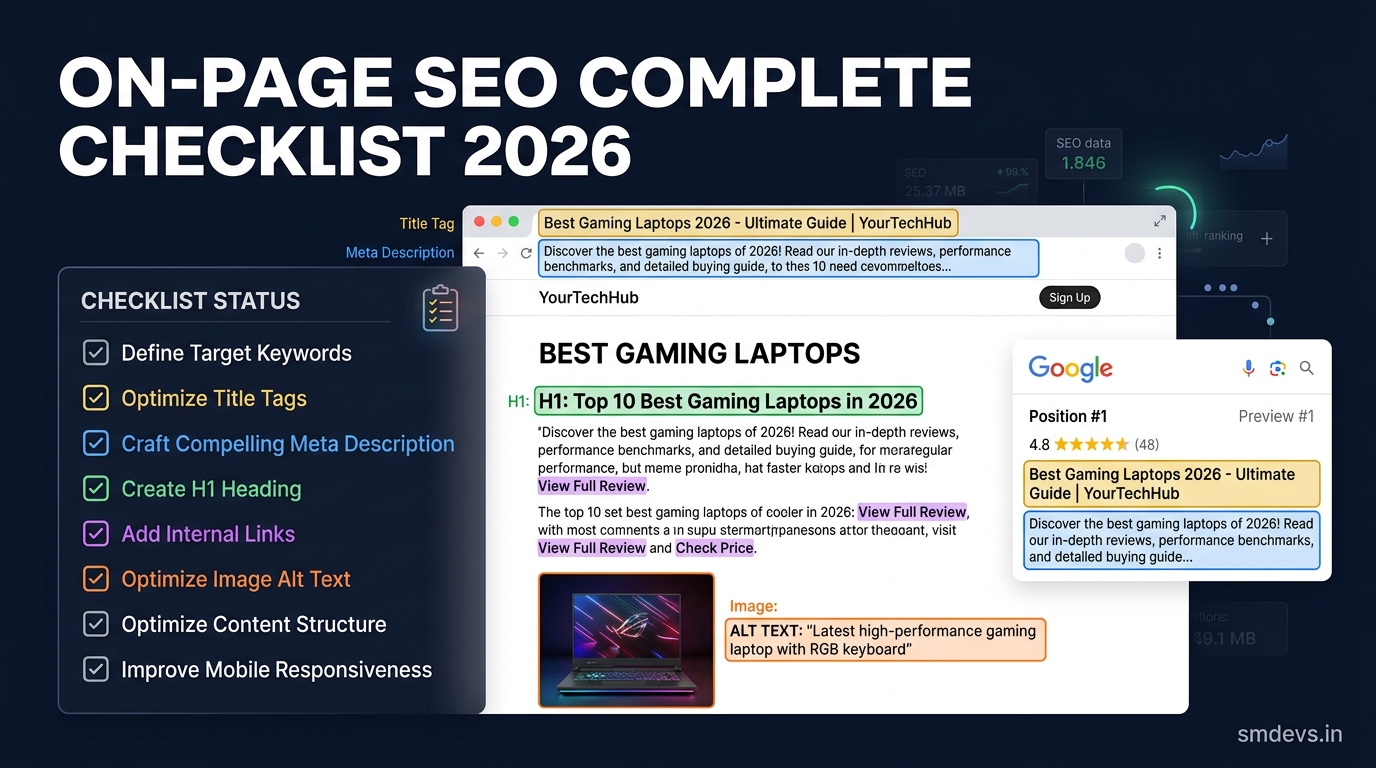
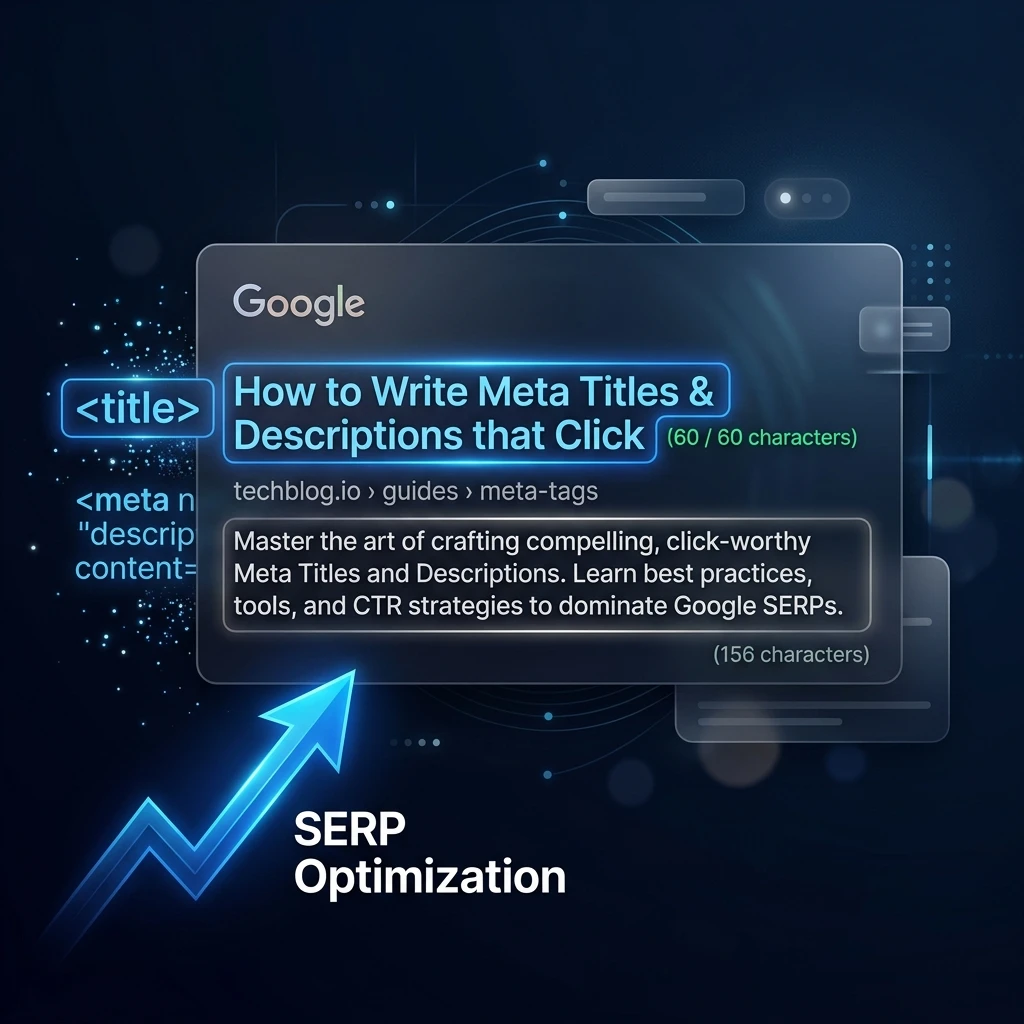
- Title Tag: The blue clickable link in search results. Must contain your primary keyword, ideally near the start, and be 50–60 characters. This is the single most important on-page ranking signal.
- Meta Description: The snippet below the title in search results. Not a direct ranking factor, but a well-written meta description dramatically improves click-through rate (CTR). Target 140–160 characters with a natural mention of the primary keyword and a soft call to action.
- H1 Tag: Every page must have exactly one H1 containing the primary topic keyword. The H1 signals the main subject of the page to both users and crawlers.
- Heading Hierarchy (H2–H6): Use H2s for main sections, H3s for subsections. Never skip levels (no H3 without an H2 parent). A logical heading structure improves both readability and crawlability.
- Keyword Placement: Include the primary keyword in the first 100 words, naturally throughout the content, and in at least one subheading. Target 1–2% keyword density — enough for relevance, never enough to feel forced.
- Image Alt Text: Every image must have descriptive alt text. Alt text helps visually impaired users and gives Google a text signal for what the image depicts.
- Internal Links: Link to relevant pages on your own site. Internal links distribute PageRank, help users navigate, and help Googlebot discover your content. Use descriptive anchor text, not "click here."
- URL Structure: Keep URLs short, lowercase, and keyword-inclusive. Use hyphens, not underscores. Example: /resources/blogs/what-is-seo-complete-guide
- Content Depth: Pages should comprehensively cover their topic. Google rewards pages that satisfy the full scope of a search intent without requiring the user to go elsewhere.
3. Off-Page SEO (Link Building)
Off-page SEO refers to actions taken outside your own website that influence your rankings. The most important off-page signal is backlinks — links from other websites pointing to yours.
Why backlinks matter: Google treats a backlink as a vote of confidence. When an authoritative, relevant website links to your page, it signals that your content is trustworthy and valuable. Pages with more high-quality backlinks consistently outrank pages with fewer, all else being equal.
Key backlink quality factors:
- Authority of the linking site: A link from the BBC, TechCrunch, or a government .gov site is worth exponentially more than a link from an unknown blog.
- Topical relevance: A backlink from a site in your industry carries more weight than a link from an unrelated site. A link to your SEO guide from another SEO site is more valuable than a link from a cooking blog.
- Anchor text: The clickable text of the link. Descriptive anchor text ("SEO audit checklist") sends a stronger relevance signal than generic anchor text ("click here").
- Link placement: Links within the main body content of an article are weighted more heavily than links in footers, sidebars, or navigation.
- Dofollow vs. nofollow: Dofollow links pass PageRank. Nofollow links (marked with rel="nofollow") do not, though they can still drive referral traffic and brand awareness.
4. Content SEO
Content SEO is the practice of creating content that satisfies both user intent and search engine signals. It is where keyword research, E-E-A-T (Experience, Expertise, Authoritativeness, Trustworthiness), and content strategy converge.
The content SEO process:
- Keyword Research: Identify what your target audience is actually searching for. Focus on search intent — informational, commercial, transactional, or navigational — and create content that matches the format users expect for that intent.
- Content Creation: Write comprehensive, accurate, original content that goes deeper than competitors. Demonstrate firsthand experience and expertise. Include specific examples, data, and insights that a superficial treatment would miss.
- E-E-A-T Signals: Add author bylines with credentials, cite authoritative sources, keep content updated, and ensure your site demonstrates trustworthiness through HTTPS, contact information, and privacy policies. See the E-E-A-T Checklist Guide.
- Topic Clusters: Structure your content around topic clusters — a comprehensive pillar page supported by 8–15 in-depth cluster articles, all internally linked. This architecture signals topical authority to Google. See the Topic Cluster Strategy guide.
- Content Refreshing: Update older content regularly. Google rewards freshness, and outdated statistics or broken links actively hurt rankings.
SEO vs. Paid Ads (PPC) — Key Differences
| Factor | SEO (Organic) | PPC (Paid Ads) |
|---|---|---|
| Cost per click | Free (after investment in content/links) | Paid per click (₹5–₹500+ per click) |
| Time to results | 3–12 months | Immediate |
| Longevity | Compounds over time — traffic continues without ongoing spend | Stops the moment you stop paying |
| Trust signals | Higher — users trust organic results more | Lower — clearly labelled as ads |
| Click-through rate | Higher for branded/informational queries | Higher for transactional queries |
| Best use case | Long-term brand building and sustainable traffic | Immediate lead generation, product launches, testing |
How Long Does SEO Take to Work?
This is the most commonly asked question about SEO, and the honest answer is: it depends, but most pages take 3–12 months to reach their ranking potential.
The key factors that determine your timeline:
- Domain age and authority: Older domains with established backlink profiles rank faster than brand new sites.
- Content quality and depth: Comprehensive, genuinely useful content ranks faster than thin, superficial content.
- Competition: Low-competition long-tail keywords can rank in weeks. Competitive head keywords in established niches can take 12–18 months.
- Technical health: A site with clean technical SEO gets crawled more frequently and indexes new content faster.
- Backlink acquisition rate: Sites that actively build high-quality backlinks rank significantly faster than those relying on passive link acquisition.
The most important thing to understand about SEO timelines is that results compound. The first 6 months feel slow. Months 12–24 see exponential acceleration. Sites that commit to SEO for 2+ years with consistent content and link building often achieve a self-sustaining traffic flywheel that pays dividends indefinitely.
Local SEO vs. National SEO
If your business serves customers in a specific geographic area — a restaurant, a law firm, a dental practice, a local plumber — Local SEO is your priority alongside traditional SEO.
Local SEO focuses on appearing in:
- Google's "Local Pack" (the map and three business listings at the top of local search results)
- Google Maps searches
- Location-qualified queries: "SEO agency in Mumbai," "dentist near me"
The key local SEO tools are Google Business Profile optimization, local citations (consistent NAP — Name, Address, Phone — across directories), and locally-relevant content. See the Local SEO Framework infographic for the full framework.
SEO and AI Search — What Changes in 2026
Google's AI Overviews, ChatGPT, Perplexity, and other AI-powered search tools are changing how users find information. However, the foundations of good SEO remain unchanged — and in many ways, they matter more than ever:
- AI systems cite authoritative, well-structured sources. Pages with strong E-E-A-T signals are more likely to be cited in AI answers.
- Structured data (schema markup) makes your content machine-readable, which helps both traditional search crawlers and AI retrieval systems understand and cite your content correctly.
- Topical authority — demonstrated through topic clusters and comprehensive coverage — is exactly what AI systems look for when deciding which source to cite.
- Conversational, question-answering content formats (FAQ sections, How-To guides) perform well both in traditional featured snippets and in AI-generated answers.
Where to Start with SEO
If you are new to SEO, follow this order:
- Technical foundation first: Fix crawlability, indexation, and site speed. Run a free audit with our SEO Structure Analyzer.
- Keyword research: Identify what your audience searches for and map content to those queries. Use our Keyword Intent Analyzer.
- On-page optimization: Optimize title tags, meta descriptions, heading structure, and content depth for your target keywords. Check with our On-Page SEO Checker.
- Content creation: Publish comprehensive, expert content on your priority topics. Build topic clusters for maximum authority.
- Link building: Earn backlinks through quality content, guest posting, and digital PR. Review your profile with the Link Profile Analyzer.
- Monitor and iterate: Track rankings and traffic in Google Search Console. Update what isn't working, double down on what is.
Frequently Asked Questions
Is SEO dead?
No — SEO is not dead, and the evidence suggests it is becoming more important, not less. Google processes over 8.5 billion searches per day in 2026. Organic search remains the largest driver of website traffic across virtually every industry. What has changed is that superficial, low-effort SEO tactics no longer work. High-quality, expert content with strong technical foundations and legitimate backlinks performs better than ever.
Can I do SEO myself without hiring an agency?
Yes. The fundamentals of SEO are learnable, and many small businesses and content creators successfully grow organic traffic without hiring agencies. Free tools handle the technical analysis, keyword research, and on-page checking. The areas where agencies typically add the most value are strategic link building (which requires relationships and outreach at scale) and high-volume content production. Start by doing it yourself — the hands-on experience is invaluable — and hire specialists when your budget and scale justify it.
What is the difference between white hat and black hat SEO?
White hat SEO refers to techniques that comply with Google's guidelines — quality content, legitimate link building, proper technical implementation. Black hat SEO refers to manipulative techniques that violate Google's guidelines — keyword stuffing, link schemes, cloaking, hidden text. Black hat techniques can produce rapid short-term gains but almost always result in manual penalties or algorithmic demotions that can destroy a site's organic traffic overnight. The risk-to-reward ratio for black hat SEO is almost never justified for legitimate businesses.
How many keywords should I target per page?
One primary keyword per page, with 3–5 semantically related secondary keywords naturally incorporated. "Keyword targeting" in 2026 is really about targeting a topic and its full semantic landscape, not stuffing a single phrase repeatedly. Google understands topical relationships — a page about "how to do keyword research" will naturally rank for dozens of related queries if the content comprehensively covers the topic.
Does social media affect SEO?
Social media does not directly influence Google search rankings — social shares are not a confirmed ranking signal. However, social media has strong indirect SEO benefits: it distributes content to audiences who may link to it (generating backlinks), drives referral traffic that improves user engagement signals, and builds brand awareness that increases branded search volume over time. A strong social media presence supports but does not substitute for technical SEO and content quality.
Your Next Step
Start with a free technical audit: use our SEO Structure Analyzer to check your most important page. Then explore the full infographic library for visual quick-reference guides on every SEO and trading topic.