Key Takeaways
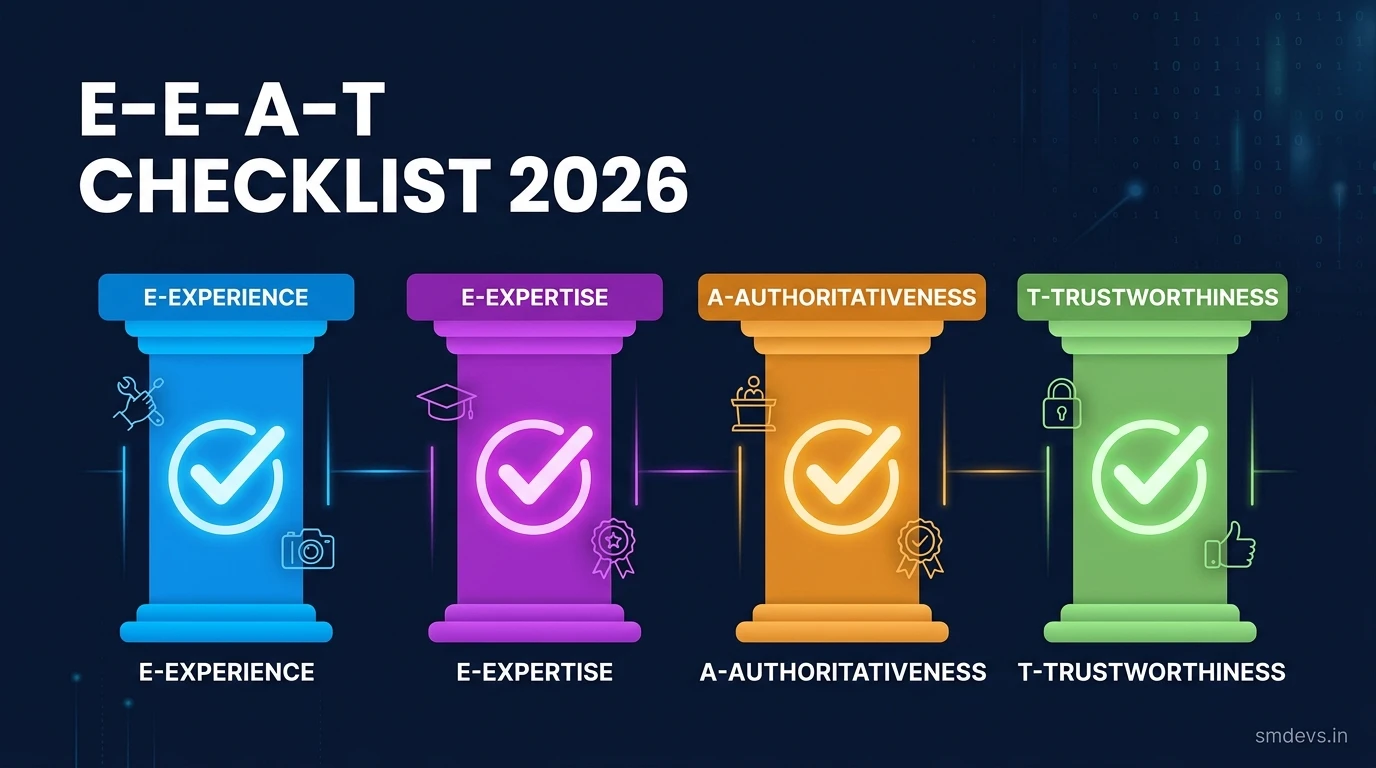
- E-E-A-T = Experience, Expertise, Authoritativeness, Trustworthiness — Google's content quality framework
- Experience is the newest pillar — add real first-hand examples and case studies to every article
- Trustworthiness is the foundation — HTTPS, contact info, and privacy policy are non-negotiable
- YMYL content (health, finance, legal) requires the highest E-E-A-T standards
- E-E-A-T is built over time through consistent publishing, credentials, and link acquisition
Google's E-E-A-T framework is the most important content quality standard in SEO today — and it has only grown more critical following every Helpful Content update since 2022. Whether you run a blog, an e-commerce site, a SaaS product, or a local business website, understanding and implementing E-E-A-T signals is now a non-negotiable requirement for ranking competitive keywords.
This guide explains exactly what E-E-A-T means, how Google evaluates each pillar, and gives you a complete actionable checklist to implement all four components on your site.
What Is E-E-A-T?
E-E-A-T stands for Experience, Expertise, Authoritativeness, and Trustworthiness. It is the framework used by Google's Search Quality Raters — a team of human evaluators who assess search result quality — to evaluate whether content meets the standards of a high-quality, helpful result.
The framework evolved from the original E-A-T (Expertise, Authoritativeness, Trustworthiness) to E-E-A-T in December 2022, when Google added "Experience" as the first E. This addition explicitly acknowledged that firsthand, real-world experience is a distinct quality signal — separate from theoretical expertise.
Important: E-E-A-T is not a direct ranking algorithm. It is a qualitative framework that guides Google's Quality Raters. However, the signals that demonstrate E-E-A-T are picked up by Google's algorithms — and sites that signal strong E-E-A-T consistently rank better for competitive keywords.
Key Takeaways
- E-E-A-T applies to both the page and the site as a whole — you must signal authority at the content level and the domain level.
- YMYL (Your Money or Your Life) content — health, finance, legal, safety — is held to the highest E-E-A-T standards. One factual error can permanently suppress a YMYL page's rankings.
- Experience is the newest and most underimplemented signal. Adding genuine first-hand experience markers to your content can significantly differentiate you from AI-generated competitors.
- Trustworthiness is the foundation — Google's documentation states that Trust is the most important of the four pillars. A site with serious trust issues cannot compensate with high expertise.
- E-E-A-T is evaluated on a spectrum — not a binary pass/fail. Continuously improving your signals over time compounds results.
Pillar 1 — Experience
Experience is the most recently added pillar and the most concrete differentiator in a world flooded with AI-generated content. Google wants to see evidence that the author has actually done the thing they are writing about — not just researched it.
What Experience signals look like:
- First-person accounts of specific scenarios: "When I ran this exact SEO audit on a client's e-commerce site with 15,000 products, we found..."
- Screenshots, data exports, or real results from your own work
- Case studies based on your actual clients or projects with specific (not hypothetical) numbers
- Product reviews that reference how you personally used the product, what problems you encountered, and how you solved them
- Before-and-after comparisons based on your own tests
How to implement Experience signals:
- Add an author bio to every article that mentions the author's relevant first-hand experience
- Include at least one specific real example or case study per article
- Use phrases like "In my experience," "When I tested this," "My client saw X result" — but only when genuinely true
- Add timestamps and date stamps so readers can verify your experience is current
Pillar 2 — Expertise
Expertise refers to the depth of knowledge demonstrated in your content. It is about technical accuracy, comprehensiveness, and the ability to address nuances that a surface-level treatment misses.
What Expertise signals look like:
- Content that covers a topic in sufficient depth — not just the basics, but the edge cases, exceptions, and advanced considerations
- Accurate, up-to-date information that reflects the current state of the field
- Citations of primary sources: academic studies, official documentation, peer-reviewed research, government data
- Author credentials relevant to the content — a cardiologist writing about heart health, a CPA writing about tax strategy
- Demonstrated subject matter depth through correct use of technical terminology
How to implement Expertise signals:
- Write comprehensive content — for competitive keywords, target 1,500+ words that genuinely cover the topic, not padded filler
- Cite authoritative sources: link to .gov, .edu, and established industry publications
- Include a clear author byline with credentials on every article
- Create dedicated author pages with professional background, publications, and credentials
- Update content regularly — outdated information is an expertise signal in the wrong direction
Pillar 3 — Authoritativeness
Authoritativeness is about your reputation in your field — specifically, whether other authoritative sources cite, reference, or link to your content. This is where the overlap between E-E-A-T and traditional link building becomes most apparent.
What Authoritativeness signals look like:
- Backlinks from authoritative sites within your niche (a medical site linking to your health content, a finance publication linking to your investment guide)
- Brand mentions on authoritative platforms — even unlinked mentions signal that credible sources are aware of your work
- Guest articles or bylines on recognised publications in your industry
- Being cited as a source in other content
- Social proof: genuine reviews, testimonials, and community recognition
- Consistent publishing track record — authority builds over time, not overnight
How to build Authoritativeness:
- Execute a strategic link building campaign targeting sites in your specific niche (not generic directories)
- Pursue guest posting opportunities on authoritative industry publications
- Participate actively in communities where your target audience and peers gather — forums, LinkedIn, X, niche newsletters
- Create genuinely linkable assets: original research, comprehensive guides, tools, infographics — content that others want to reference
- Build entity associations: ensure your brand, authors, and topics are clearly associated in Google's Knowledge Graph
Pillar 4 — Trustworthiness
Google's own documentation identifies Trustworthiness as the most critical pillar: "The most important member of the E-E-A-T family is Trust." A page can have high experience, expertise, and authority — but if there are serious trust signals missing, those other factors become irrelevant.
What Trustworthiness signals look like:
- HTTPS / SSL certificate — non-negotiable in 2026
- Clear, accurate contact information (phone, email, physical address where applicable)
- A complete, clear privacy policy and terms of service
- Accurate, fact-checked content with corrections visible when errors are found
- Authentic reviews and testimonials (not obviously fabricated or cherry-picked)
- Clear disclosure of affiliate relationships, advertising, and sponsored content
- Transparent editorial policies for content sites
- Low or zero spam complaints and phishing associations
How to implement Trustworthiness signals:
- Ensure HTTPS across your entire site with a valid, non-expired SSL certificate
- Add a complete Contact page with multiple contact methods
- Publish and maintain a current Privacy Policy and Terms of Service
- Develop a clear editorial correction policy — if you publish an error and correct it, note the correction prominently
- Display genuine customer reviews and handle negative reviews professionally
- Add trust badges, professional associations, or certifications where relevant
YMYL Content — The Highest Stakes
YMYL stands for "Your Money or Your Life." It refers to content that could significantly impact a person's financial decisions, health outcomes, safety, or legal situation. YMYL content is held to the highest E-E-A-T standards because the consequences of inaccurate or misleading content in these areas can be severe.
YMYL topic areas include:
- Health and medical: symptoms, diagnoses, treatments, medications, mental health
- Finance: investing, taxes, insurance, loans, retirement planning
- Legal: legal rights, laws, regulations, court processes
- Safety: product safety, emergency procedures, natural disaster preparedness
- Civic: elections, voting, government policies
If your site covers any YMYL topics, every piece of content must have clearly credentialed authorship, be reviewed by qualified experts, cite primary sources, and be kept current.
E-E-A-T Implementation Checklist
| Pillar | Action | Priority |
|---|---|---|
| Experience | Add author byline with relevant personal experience to every article | High |
| Experience | Include at least one real case study or specific example per article | High |
| Expertise | Cite authoritative primary sources for every factual claim | High |
| Expertise | Create comprehensive author pages with credentials and background | Medium |
| Authoritativeness | Build niche-relevant backlinks through guest posting and digital PR | High |
| Authoritativeness | Create linkable assets (tools, research, infographics) | Medium |
| Trustworthiness | Ensure HTTPS across the entire site | Critical |
| Trustworthiness | Publish complete Contact, Privacy Policy, and Terms pages | Critical |
| Trustworthiness | Display genuine reviews and testimonials | Medium |
Frequently Asked Questions
Is E-E-A-T a direct ranking factor?
E-E-A-T itself is not a direct algorithmic ranking factor — you cannot score yourself on an "E-E-A-T meter." However, the signals that demonstrate E-E-A-T (backlinks, author credentials, accurate content, trust signals) are directly picked up by Google's algorithms. Sites that consistently improve their E-E-A-T signals tend to see corresponding ranking improvements, particularly after algorithm updates that reward quality signals.
How does AI-generated content affect E-E-A-T?
AI-generated content that lacks first-hand experience signals, has no credentialed author, and makes no original contributions to a topic is the type of content Google's Helpful Content updates are specifically designed to suppress. This doesn't mean AI tools can't be used — they can assist with structure, research, and drafting — but the published output must demonstrate genuine Experience, Expertise, Authoritativeness, and Trustworthiness. The Experience pillar was added specifically in response to the explosion of AI-generated content.
How long does it take to build E-E-A-T?
E-E-A-T is built over time through consistent publishing, credentialed authorship, link acquisition, and trust signal development. For a new site, foundational trust signals (HTTPS, Contact page, Privacy Policy) can be implemented immediately. Author credentials and bylines take days to weeks. Authoritativeness through link building typically requires 6–18 months of sustained effort. There is no shortcut — E-E-A-T is fundamentally about demonstrating genuine expertise and trustworthiness over time.
Does E-E-A-T apply to personal blogs?
Yes, but the expectations scale with the topic's impact. A personal blog about a hobby with no YMYL elements has a lower E-E-A-T threshold than a medical or financial advice site. However, even personal blogs benefit from clear authorship, accurate information, and trust signals. As blogs grow in traffic and topical reach, E-E-A-T becomes increasingly important regardless of the niche.
Your Next Step
Download the E-E-A-T Checklist 2026 infographic for a printable implementation reference. To understand how E-E-A-T fits into Google's broader ranking framework, see the Google Ranking Signals 2026 infographic. And to build the authoritative content architecture that supports E-E-A-T at scale, read the Topic Cluster Strategy guide.