Key Takeaways
- Topic clusters are the #1 content architecture strategy for topical authority in 2026
- AI platforms (ChatGPT, Perplexity, Gemini) preferentially cite topically authoritative sites
- Start with one pillar + 8–10 cluster pages before expanding to new clusters
- Bidirectional internal linking (pillar to clusters AND clusters to pillar) is the key mechanism
- Results take 6–12 months but compound significantly over time
If you've been publishing blog posts consistently but not seeing the organic traffic growth you expected, the problem likely isn't content quality. It's content architecture. The old approach — targeting individual keywords with isolated articles — is being systematically outcompeted by sites that have adopted the Topic Cluster model.
This guide explains what topic clusters are, why they work for both Google and AI platforms like ChatGPT and Perplexity, and gives you a precise 4-step framework to implement your first cluster starting today.
What Is a Topic Cluster?
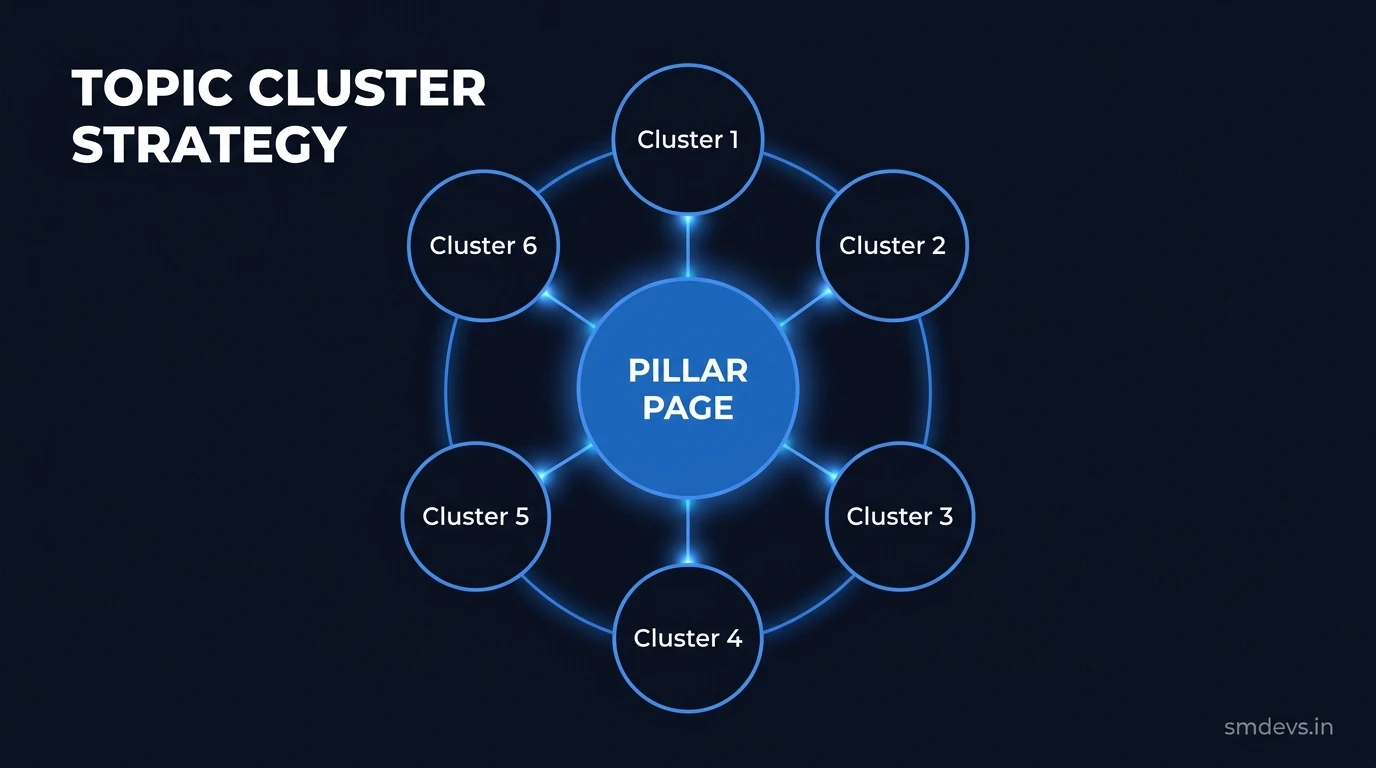
A topic cluster is a content architecture model built around three elements:
- Pillar Page: A comprehensive, long-form page that covers a broad topic from end to end. It targets a high-volume, broad keyword (e.g., "SEO strategy") and acts as the authoritative hub for everything related to that topic on your site.
- Cluster Pages: Individual, in-depth articles that each cover a specific subtopic within the pillar topic (e.g., "keyword research," "on-page SEO," "link building," "technical SEO audit"). Each cluster page targets a more specific long-tail keyword.
- Internal Links: The connective tissue. Every cluster page links back to the pillar page, and the pillar page links out to every cluster page. This bidirectional internal linking structure is what signals topical authority to Google.
The result is a hub-and-spoke architecture where your pillar page is the hub and your cluster pages are the spokes — all interconnected, all reinforcing each other's authority.
Key Takeaways
- Topic clusters signal topical authority — the single most important factor in competitive SEO in 2026.
- AI platforms (ChatGPT, Perplexity, Gemini) preferentially cite topically authoritative sites when generating answers, making this strategy doubly important.
- Internal links pass PageRank between your cluster and pillar pages, lifting the ranking potential of every page in the cluster.
- Start small: One cluster of 8–10 tightly linked pages beats ten isolated articles on ten different topics.
- Pillar pages require depth, not length: Cover the topic comprehensively, not repetitively. Quality over word count.
Why Topic Clusters Work for Google
Google's algorithm has evolved significantly from simple keyword matching. Modern Google uses a semantic understanding of content — it evaluates whether your site demonstrates genuine expertise across a topic, not just whether individual pages contain target keywords.
When Google's crawlers find a pillar page linking to ten deep, well-written cluster articles — all of which link back to the pillar — they interpret this as evidence that your site is a comprehensive resource on that subject. This signals topical authority, which directly lifts rankings for all pages in the cluster.
The internal link structure also allows PageRank to flow between pages in the cluster. A cluster page that earns a backlink from an external site passes some of that authority to your pillar page (and vice versa), amplifying the ranking power of the entire cluster.
Why Topic Clusters Work for AI Platforms
This is where the strategy becomes even more compelling in 2026. AI platforms like ChatGPT, Perplexity, and Google's Gemini (used in AI Overviews) don't just index keywords — they evaluate whether a source is comprehensively authoritative on a topic.
When these systems are generating an answer about, say, "SEO strategy," they look for sources that have demonstrated depth across the full topic. A site with a pillar page on SEO strategy that links to cluster articles on keyword research, on-page optimization, technical SEO, and link building is far more likely to be cited as a source than a site with a single standalone article on SEO strategy — even if the standalone article is excellent.
Topical authority signals, in other words, cross over from traditional SEO into AI retrieval. The same content architecture that helps you rank on Google helps you get cited by AI platforms.
The 4-Step Topic Cluster Implementation Framework
Step 1 — Choose Your Pillar Topic
A good pillar topic has three characteristics:
- Broad enough to support 8–15 subtopic articles beneath it.
- Specific enough to be relevant to your target audience — avoid topics so broad they attract unfocused traffic.
- Commercially aligned — it should relate to what you sell, what you teach, or what your audience needs help with.
Examples of good pillar topics:
- "SEO strategy" (for a digital marketing site) → Can branch into keyword research, on-page SEO, technical SEO, link building, local SEO, content strategy, etc.
- "Swing trading" (for a trading education site) → Can branch into chart patterns, indicators, risk management, position sizing, trade journaling, etc.
- "Email marketing" (for a SaaS company) → Can branch into list building, segmentation, automation, deliverability, A/B testing, etc.
Keyword targeting: Pillar pages typically target broad keywords with 1,000–10,000 monthly searches and high competition. You are not trying to rank the pillar page immediately — you are building the cluster that will lift it over time.
Step 2 — Identify Your Cluster Subtopics
The goal is to identify 8–15 specific questions and subtopics that someone interested in your pillar topic would also want to know about. Each subtopic becomes a separate cluster article.
Research methods:
- Google "People Also Ask": Search your pillar keyword and read through the PAA box. Every question there is a potential cluster topic.
- Google Autocomplete: Type your pillar keyword into Google and note the autocomplete suggestions. These are the actual queries users type.
- Keyword tools: Use Ahrefs, SEMrush, or free alternatives to find long-tail variations of your pillar keyword. Filter for keywords with KD (Keyword Difficulty) ≤ 30 for clusters that can rank relatively quickly.
- Competitor analysis: Look at what articles rank in the top 10 for your pillar keyword. What subtopics do those top-ranking pages link to?
- Your own expertise: What questions do your customers, readers, or students repeatedly ask about your pillar topic?
Prioritization: Start with the subtopics that have the most search volume and clearest search intent. These become your first cluster articles.
Step 3 — Create and Interlink
This is the most execution-intensive step. For each cluster page:
- Write a focused, comprehensive article on the specific subtopic — not a surface-level overview, but a genuinely useful deep dive.
- Include at least one prominent internal link back to the pillar page, using anchor text that includes the pillar keyword.
- Link to 2–3 other relevant cluster pages within the same cluster where it makes natural contextual sense.
For the pillar page:
- Include a section or summary for each major subtopic, with a link to the corresponding cluster article.
- The pillar page should read as a comprehensive overview — detailed enough to be valuable standalone, but linking out to cluster articles for readers who want to go deeper on any specific subtopic.
Internal link best practices:
- Use descriptive anchor text (e.g., "keyword research process") not generic text ("click here" or "learn more").
- Place internal links naturally within the body content, not just at the bottom of the page.
- Avoid over-linking — 3–5 internal links per article is typical; more than 10 can dilute link equity.
Step 4 — Measure and Expand
After publishing your initial cluster (pillar + 6–8 cluster articles), track these metrics over the following 3–6 months:
- Pillar page impressions and clicks in Google Search Console (should increase as cluster pages build its authority)
- Average position of both the pillar page and cluster pages
- Organic traffic to the cluster as a whole (not just individual pages)
- Pages indexed — verify all cluster pages are indexed in Google Search Console
Once your initial cluster gains traction (typically 3–6 months), expand it: add more cluster pages, update older articles with new internal links, and build external backlinks to the pillar page to accelerate authority growth.
Topic Cluster vs. Traditional Blog Posting — A Comparison
| Approach | Traditional Blog | Topic Cluster |
|---|---|---|
| Content structure | Isolated articles | Interconnected hub + spokes |
| Keyword targeting | One keyword per article | Broad keyword + long-tail cluster |
| Internal linking | Ad-hoc, inconsistent | Systematic, bidirectional |
| Authority signal to Google | Page-level | Topic-level (much stronger) |
| AI platform citation likelihood | Low | High (topical comprehensiveness) |
| Time to results | 3–6 months per article | 6–12 months for cluster, then compound growth |
| Long-term compounding | Minimal | Strong (authority builds across the cluster) |
Common Topic Cluster Mistakes to Avoid
- Creating cluster pages that are too similar. Each cluster article must cover a distinct subtopic with its own unique focus keyword. If two cluster articles are covering essentially the same ground, you risk keyword cannibalization.
- Only linking one way. The cluster only works if both the pillar links to clusters AND clusters link back to the pillar. Bidirectional linking is the key mechanism.
- Publishing all cluster articles at once. Google may not be able to crawl all pages quickly if they are published simultaneously. Publish 2–3 articles per week for sustained crawl attention.
- Choosing a pillar topic you cannot cover comprehensively. If you cannot produce 8–15 genuinely useful cluster articles on a topic, it is not the right pillar topic for your site.
- Neglecting to update the cluster over time. Clusters are living content systems. Update pillar and cluster articles annually, add new cluster pages as new subtopics emerge, and refresh internal links when new relevant content is published.
How Many Topic Clusters Does a Site Need?
This depends on your site's focus and resources. For most sites:
- New site (0–6 months old): Focus on one cluster. Build it deeply before expanding. Google needs to understand your topical focus.
- Established site (6–24 months): 2–3 clusters covering your core topic areas. Ensure each cluster is fully developed before starting a new one.
- Authority site (2+ years): As many clusters as you have core topic areas. Each cluster should have a minimum of 8 articles before you start a new one.
Frequently Asked Questions
How long should a pillar page be?
There is no fixed word count, but pillar pages are typically 3,000–8,000 words. The length should be determined by what is needed to comprehensively cover the topic — not by hitting an arbitrary word count. A pillar page must be detailed enough to be genuinely useful as a standalone resource while also providing clear entry points into cluster articles for deeper dives.
Can I turn existing blog posts into a topic cluster?
Yes, and this is often the most efficient approach for established sites. Audit your existing content, identify posts that cover subtopics of a common theme, designate (or create) one comprehensive post as the pillar, then add internal links connecting everything. You may need to expand some existing articles to make them cluster-worthy, but you avoid starting from scratch.
How many cluster pages does a cluster need to be effective?
Research suggests a minimum of 6–8 cluster pages to create a meaningful topical authority signal. The sweet spot for most niches is 10–15 cluster articles per pillar. Fewer than 6 articles may not be enough for Google to recognize the topical cluster structure. More than 20 cluster articles per pillar starts to become difficult to maintain with consistent quality.
Should the pillar page try to rank immediately?
Not necessarily. The pillar page is primarily a structural hub that accumulates authority over time as cluster pages build links and rankings. In the early stages, cluster pages (which target lower-difficulty long-tail keywords) will often rank first and begin driving traffic and authority back to the pillar. Think of the cluster as a rising tide that lifts all boats.
Does topic cluster strategy work for e-commerce sites?
Yes. E-commerce sites can build clusters with a category page as the pillar (e.g., "running shoes") and cluster articles covering subtopics like "how to choose running shoes," "best running shoes for flat feet," "running shoe brands compared," etc. These clusters build authority that can lift the ranking of the category page itself — which typically drives the highest revenue for e-commerce sites.
Your Next Step
Download the Topic Cluster Strategy infographic for a visual reference of the complete hub-and-spoke model. For the content that goes into your clusters, see the Keyword Research Process infographic to identify the right subtopic keywords. And to understand how Google evaluates the authority of your pillar and cluster pages, see the Google Ranking Signals 2026 infographic.