Key Takeaways
- The Nifty 50 is India's most widely traded stock market index — and the benchmark that every investor, trader, and mutual fund manager in India tracks daily. Maintained by NSE Indices Ltd (a subsidiar
What is the Nifty 50?
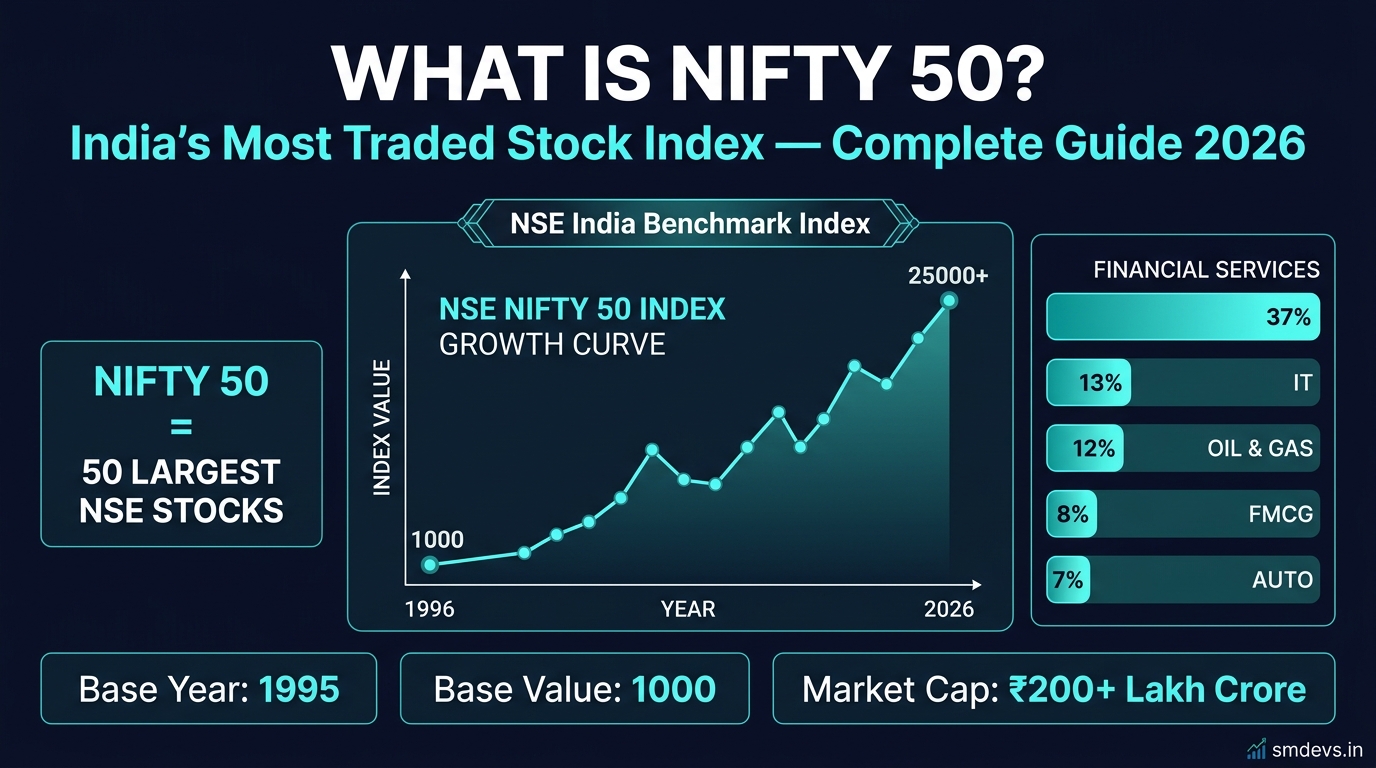
The Nifty 50 (officially called the NIFTY 50 or CNX Nifty) is a free-float market capitalisation-weighted index of the 50 largest and most liquid stocks listed on the National Stock Exchange of India (NSE). It is maintained by NSE Indices Limited, a wholly-owned subsidiary of NSE.
Key facts:
- Base year: 1995 | Base value: 1,000 points
- Launch date: April 22, 1996
- Number of stocks: 50
- Market cap coverage: Approximately 65% of the total NSE market capitalisation
- Rebalancing: Semi-annually (March and September)
The Nifty 50 is India's most actively used index for: equity benchmarking, futures and options trading (NSE's Nifty 50 F&O is one of the world's most actively traded derivatives), mutual fund performance comparison, and ETF investing.
Also read: What is Sensex? BSE India's Benchmark Index — the companion to Nifty 50 on the BSE.
Nifty 50 vs Sensex: Key Differences
| Feature | Nifty 50 | Sensex (S&P BSE Sensex) |
|---|---|---|
| Exchange | NSE (National Stock Exchange) | BSE (Bombay Stock Exchange) |
| Stocks | 50 companies | 30 companies |
| Base year | 1995 (base = 1,000) | 1978–79 (base = 100) |
| Launched | 1996 | 1986 |
| F&O trading | Most actively traded — global leader | Less popular for F&O |
| Correlation | ~0.99 — both move almost identically | |
How is the Nifty 50 Calculated?
Like the Sensex, the Nifty 50 uses the Free-Float Market Capitalisation Method:
Nifty 50 = (Sum of Free-Float Market Cap of all 50 companies / Base Market Cap) × 1,000
Free-Float Market Cap = Current Price × Free-Float Shares (excludes promoter holdings, government stakes, and locked-in shares)
This means larger companies have a bigger weight. A 5% move in Reliance Industries affects the Nifty far more than a 5% move in a smaller constituent. The top 10 stocks by weight typically represent 55–60% of the index's total movement.
Nifty 50 Sector Composition (2026)
| Sector | Weight (%) | Key Stocks |
|---|---|---|
| Financial Services | ~37% | HDFC Bank, ICICI Bank, Kotak, SBI, Axis Bank, Bajaj Finance |
| Information Technology | ~13% | TCS, Infosys, HCL Technologies, Wipro, Tech Mahindra |
| Oil, Gas & Consumable Fuels | ~12% | Reliance Industries, ONGC, BPCL |
| FMCG | ~8% | ITC, HUL, Nestle India, Britannia, Tata Consumer |
| Automobile & Auto Components | ~7% | M&M, Tata Motors, Maruti Suzuki, Bajaj Auto, Hero MotoCorp |
| Healthcare | ~4% | Sun Pharma, Dr Reddy's, Cipla, Divi's Lab |
| Metals | ~3% | JSW Steel, Tata Steel, Hindalco |
| Others | ~16% | Telecom, Power, Capital Goods, Consumer Durables |
Nifty 50 Historical Performance
| Year | Level | Event |
|---|---|---|
| 1996 | 1,000 (base) | Index launched |
| 2000 | ~1,600 | IT bubble peak; correction to 900 after dot-com bust |
| 2008 | 6,300 → 2,600 | Global financial crisis — 59% crash in 12 months |
| 2014 | 7,500 | Modi government election; FII confidence surge |
| 2020 (Mar) | 7,610 | COVID-19 crash — fastest 35% fall in history |
| 2021 | 18,000 | V-shaped recovery; domestic retail investor surge |
| 2024 | 26,216 (ATH) | All-time high — September 27, 2024 |
| 2026 | ~24,000–25,500 | Consolidation after 2024 peak; global rate normalisation |
Long-term CAGR: Nifty 50 has delivered approximately 13–15% CAGR since inception (1995–2026), making it one of the best-performing major indices globally over this period.
How to Invest in the Nifty 50
You cannot buy the Nifty 50 index directly. But you can get Nifty 50 exposure through:
1. Nifty 50 Index Mutual Funds
Funds that passively replicate the Nifty 50 portfolio. Very low cost (expense ratio 0.05–0.20%). Examples:
- UTI Nifty 50 Index Fund
- HDFC Index Fund — Nifty 50 Plan
- Nippon India Index Fund — Nifty 50 Plan
- SBI Nifty Index Fund
Ideal for long-term investors who want to earn the market return without active stock picking.
2. Nifty 50 ETFs (Exchange-Traded Funds)
Traded on NSE/BSE like stocks. Lower expense ratio than index funds (0.03–0.10%):
- Nippon India ETF Nifty 50 BeES (oldest and most liquid)
- HDFC Nifty 50 ETF
- ICICI Prudential Nifty 50 ETF
- Kotak Nifty 50 ETF
3. Nifty 50 Futures & Options
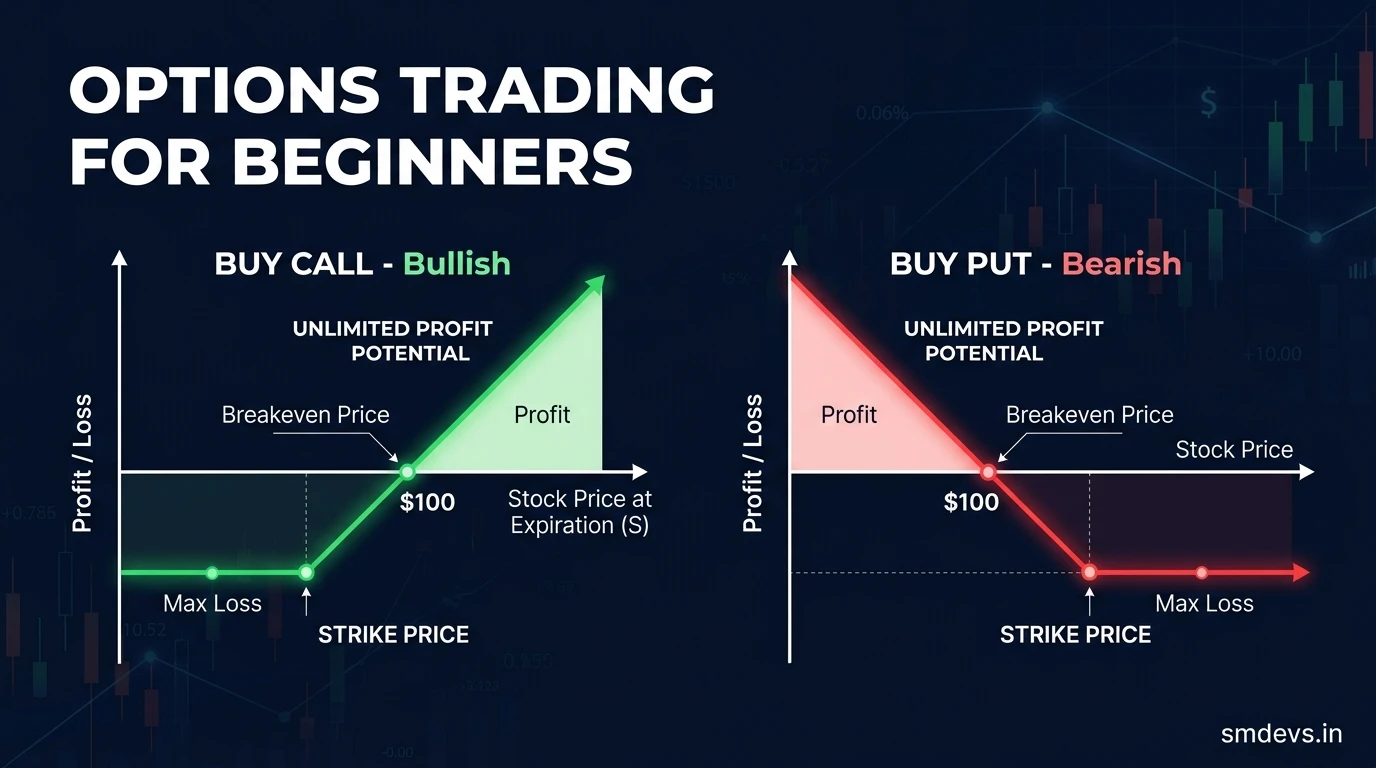
For traders: Nifty 50 futures (lot size 25) and options (weekly + monthly expiry, lot size 25) are the most liquid derivatives on NSE. Options premium ranges from ₹5 to ₹500+ depending on moneyness and expiry. For options trading basics, see: Options Trading Beginner Guide India.
Using Nifty 50 as an Investment Signal
Nifty 50 P/E Ratio
NSE publishes the trailing P/E ratio of Nifty 50 daily. Historical valuation ranges:
- P/E below 15: Historically undervalued — major buying opportunities (COVID 2020: P/E 17.5 at bottom; 2008 crisis bottom: P/E 11)
- P/E 18–22: Fair value range — comfortable long-term accumulation zone
- P/E above 28: Historically overvalued — markets expensive; reduce lump-sum, continue SIP
- P/E above 35: Extreme overvaluation — COVID recovery: P/E hit 42x (Jan 2021)
FAQs: Nifty 50
What is Nifty 50 in simple words?
Nifty 50 is a number that tells you how India's 50 largest and most liquid companies are performing as a group on the NSE. When Nifty rises, it means these companies' total value increased that day. When it falls, they lost value. It's the most popular shorthand for "how is the Indian stock market doing?" — especially for traders and F&O participants.
What is the difference between Nifty and Nifty 50?
They are the same thing. "Nifty" informally refers to the "Nifty 50" index. NSE has many other indices (Nifty Bank, Nifty IT, Nifty Midcap 150, etc.) — when people say "Nifty is up 200 points today," they always mean the Nifty 50 specifically.
What is the Nifty 50 all-time high?
The Nifty 50 hit its all-time high of 26,216.05 points on September 27, 2024. As of 2026, it trades in the 24,000–25,500 range after post-ATH consolidation and global rate normalisation.
How is Nifty 50 different from Nifty Bank?
Nifty 50 tracks 50 companies across all major sectors. Nifty Bank (Bank Nifty) tracks only 12 banking stocks — it's a sectoral index representing the banking industry specifically. Bank Nifty is more volatile than Nifty 50 because banking stocks amplify economic cycles. For Bank Nifty, see our dedicated guide: What is Bank Nifty?