Key Takeaways
- Bank Nifty (officially NIFTY Bank) is the index that tracks India's 12 most liquid banking stocks on the NSE. It is simultaneously the most actively traded and most dangerous index for retail traders
What is Bank Nifty?
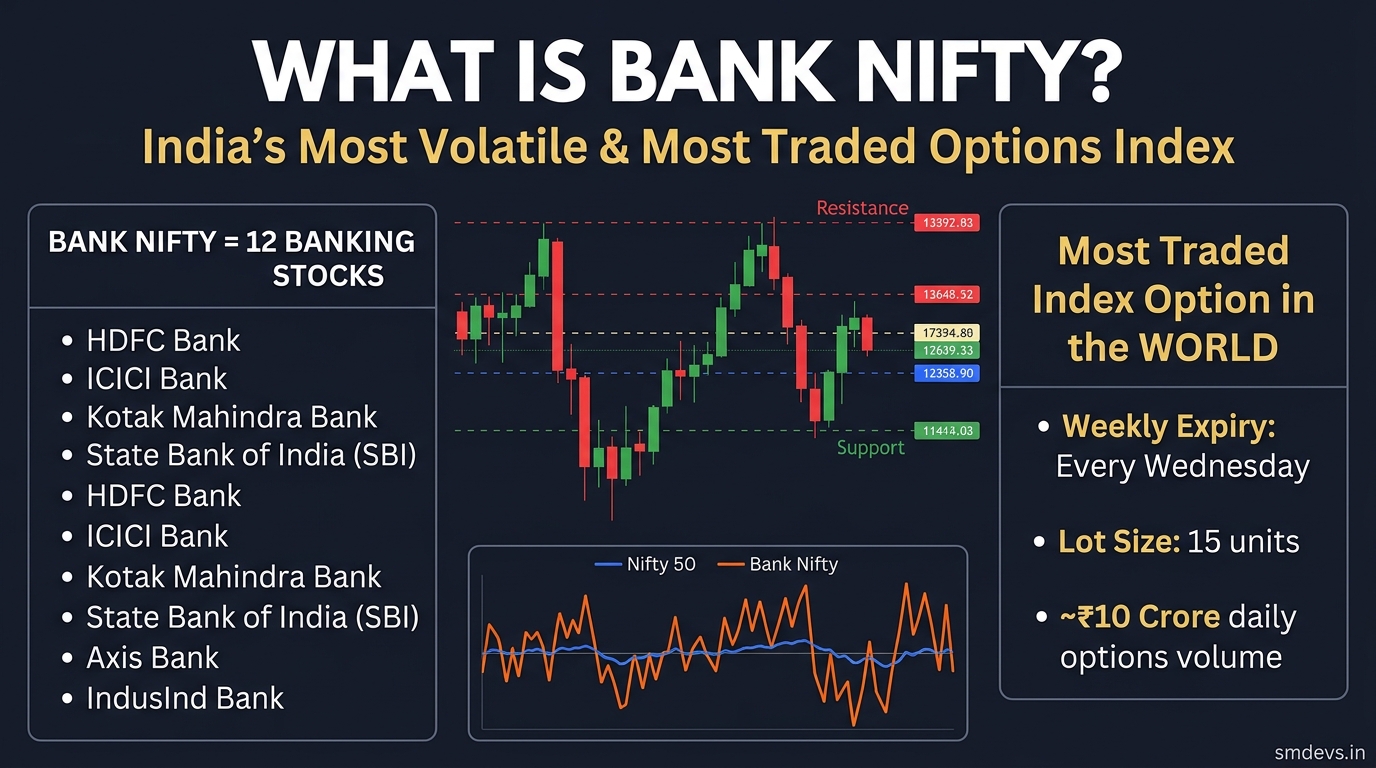
Bank Nifty (full name: NIFTY Bank Index) is a sectoral index that tracks the performance of the 12 most liquid and large-cap banking stocks listed on the NSE. It is computed using the free-float market capitalisation method — the same methodology as Nifty 50. Maintained by NSE Indices Limited.
Key facts:
- Base date: January 1, 2000 | Base value: 1,000
- Number of stocks: 12 banking stocks
- Options expiry: Weekly (every Wednesday) + monthly (last Wednesday of month)
- Lot size: 15 units per contract
- Global distinction: NSE's Bank Nifty options are among the most actively traded derivative contracts in the world
Also read: What is Nifty 50? for the broader market index context.
Bank Nifty Constituent Stocks (2026)
| Bank | Approx. Weight | Type |
|---|---|---|
| HDFC Bank | ~28–32% | Private — largest by market cap |
| ICICI Bank | ~22–25% | Private |
| Kotak Mahindra Bank | ~10–12% | Private |
| State Bank of India (SBI) | ~8–10% | Public sector (PSU) |
| Axis Bank | ~7–9% | Private |
| IndusInd Bank | ~3–5% | Private |
| Bank of Baroda | ~2–3% | PSU |
| Punjab National Bank | ~2% | PSU |
| Federal Bank | ~2% | Private |
| Canara Bank | ~1.5% | PSU |
| AU Small Finance Bank | ~1.5% | SFB |
| IDFC First Bank | ~1% | Private |
HDFC Bank and ICICI Bank together account for approximately 50–57% of the index weight — making Bank Nifty extremely sensitive to moves in these two stocks.
Why is Bank Nifty More Volatile Than Nifty 50?
Bank Nifty is typically 1.5x–2x more volatile than Nifty 50 on any given day. The reasons:
- Concentrated exposure: 12 stocks vs Nifty's 50 — less diversification means individual stock events have larger impact
- Sector sensitivity: Banking stocks are highly sensitive to RBI policy decisions, interest rate changes, GDP data, NPA announcements, and quarterly results. Any RBI announcement (rate hike, CRR change, liquidity measures) moves Bank Nifty 200–500 points within minutes.
- High leverage amplification: The enormous F&O volumes mean large institutional positions can create sharp moves. Options expiry (every Wednesday) creates extreme intraday volatility as positions are unwound.
- RBI/Credit events: A single bank's quarterly results or NPA (Non-Performing Asset) announcement can move Bank Nifty 1–3% immediately — vs smaller moves in the broader Nifty 50.
Bank Nifty vs Nifty 50: Key Trading Differences
| Feature | Bank Nifty | Nifty 50 |
|---|---|---|
| Daily range | 300–800 points typical (higher on events) | 100–300 points typical |
| Lot size | 15 units | 25 units |
| Weekly expiry | Every Wednesday | Every Thursday |
| Typical ATM premium | ₹150–₹400 per lot (volatile event days: ₹500+) | ₹80–₹250 per lot |
| Bid-ask spread | Tight — extremely liquid | Also tight |
| Best for | Experienced options traders, momentum plays | Beginners, trend trading, positional |
Key Events That Move Bank Nifty Dramatically
- RBI Monetary Policy Committee (MPC) decisions: Held 6 times per year. Rate hikes hurt banking margins (NIM compression) — Bank Nifty often falls 300–700 points on hike announcements. Rate cuts are bullish for banks — 400–800 point rallies.
- Bank quarterly results: HDFC Bank's quarterly earnings (January, April, July, October) alone can move Bank Nifty 500–1,000 points. Watch NIM (Net Interest Margin), NPA (Non-Performing Assets), and loan growth figures.
- US Federal Reserve decisions: Fed rate decisions affect FII flows into India — large FII selling hits banking stocks disproportionately.
- Credit events: Any major bank announcing elevated NPAs, fraud, or regulatory action causes sharp selloffs. Yes Bank (2020), DHFL, IL&FS — these events taught traders to respect Bank Nifty's downside velocity.
- Expiry days (every Wednesday): Weekly expiry creates massive position unwinding. The last 1 hour of Wednesday's trading session often sees Bank Nifty move 200–500 points on gamma squeeze dynamics.
Bank Nifty Options: How to Trade It
Bank Nifty options are the most popular trading instrument for Indian retail traders. For a complete options guide, read: Options Trading Beginner Guide India.
Bank Nifty-Specific Options Tips
- Avoid buying options on Tuesdays and expiry-day Wednesdays: Theta decay is highest in the last 24 hours before expiry. Buying OTM options with 1 day remaining is statistically one of the most losing propositions in Indian markets.
- Respect the RBI event calendar: Buy options before RBI MPC decisions to benefit from increased implied volatility. But do NOT hold through the announcement if you're a buyer — sell before, because IV often collapses after the announcement regardless of direction ("buy the rumour, sell the news").
- Use Bank Nifty pivot levels: Our Pivot Point Calculator generates Bank Nifty support and resistance levels that options traders use extensively. R1 and S1 levels act as option writer's targets for weekly expiry.
- Be aware of weekend risk: Wednesday expiry means new positions carry 3 days of overnight risk (Wednesday evening to Monday morning) for the new week's options. Budget for this when calculating expected premium.
Bank Nifty for Long-Term Investors
If you're a long-term investor (not a trader), Bank Nifty provides exposure through:
- Nifty Bank ETFs: Nippon India ETF Bank BeES, HDFC Bank ETF, Mirae Asset Nifty Bank ETF — track Bank Nifty's performance passively
- Banking sector mutual funds: DSP Banking & PSU Fund, ICICI Prudential Banking & Financial Services Fund — actively managed banking sector exposure
Over the very long term (10+ years), Indian private banks (HDFC, ICICI, Kotak) have delivered strong returns as India's banking penetration has grown from low levels. However, banking sector funds are more volatile than diversified equity funds — suitable only for investors comfortable with higher short-term volatility.
FAQs: Bank Nifty
What is Bank Nifty in simple words?
Bank Nifty is a stock market index that tracks the 12 largest and most liquid banking companies listed on NSE. It tells you how India's banking sector is performing as a whole. When you hear "Bank Nifty is up 500 points today," it means these 12 banking stocks collectively gained 500 index points. Bank Nifty is also the world's most traded index options product.
What is the lot size of Bank Nifty?
The lot size for Bank Nifty futures and options is 15 units per contract (as of 2026). This means 1 Bank Nifty options contract covers 15 units of the index. If Bank Nifty is at 52,000 and you buy one ATM Call at ₹200, your total premium = 15 × ₹200 = ₹3,000. SEBI periodically revises lot sizes — always verify the current lot size on NSE's website before trading.
When does Bank Nifty expire?
Bank Nifty has weekly options that expire every Wednesday. Monthly options expire on the last Wednesday of each month. This is different from Nifty 50, which expires every Thursday. The different expiry days mean both indices can be traded simultaneously with minimal overlap in risk events.
Is Bank Nifty riskier than Nifty 50?
Yes — significantly. Bank Nifty is typically 1.5x–2x more volatile than Nifty 50. The concentrated exposure to 12 banking stocks (vs 50 diverse stocks in Nifty 50) means single events (RBI policy, major bank earnings, NPA announcements) can move Bank Nifty 3–5% in a single day. For beginners, Nifty 50 options are recommended before graduating to Bank Nifty trading.