Key Takeaways
- The risk reward ratio in trading compares how much you risk losing versus how much you could potentially gain on a trade.
- A 1:3 risk reward ratio means risking ₹1 to potentially earn ₹3.
- Traders use stop-loss and take-profit levels to define their risk and reward before entering a trade.
- A higher ratio allows traders to remain profitable even with a lower win rate.
- Most professional traders aim for at least a 1:2 or 1:3 risk reward ratio.
- The formula is simple:
- Risk Reward Ratio = Potential Risk ÷ Potential Reward
- Tools like risk reward calculators help traders quickly evaluate trade setups.
- Combining risk reward ratio, win rate, and position sizing forms the foundation of long-term trading success.
Risk Reward Ratio in Trading: The Complete Guide Every Trader Must Read (2026)
TL;DR:
The risk reward ratio in trading tells you how much you stand to gain for every rupee or dollar you put at risk.
A 1:3 ratio means you risk ₹1 to potentially earn ₹3.
Traders use it alongside stop-loss and take-profit levels to filter out weak setups, stay consistent, and stay profitable even when not every trade wins.
Most professionals aim for a minimum 1:2 ratio. Tools to calculate it are available for free on smdevs.in.
What Is Risk Reward Ratio in Trading?
Every time you place a trade, you are making a bet. You are betting that the price will move in your favour. But markets are unpredictable. What separates consistently profitable traders from those who blow up their accounts is not always how often they are right , it is how well they manage what they stand to lose versus what they stand to gain.
That is exactly what the risk reward ratio in trading measures.
In plain terms, the risk reward ratio compares the maximum amount you could lose on a trade to the maximum amount you expect to gain if the trade goes as planned.
"The goal of a successful trader is to make the best trades. Money is secondary." , Alexander Elder, Trader & Author of Trading for a Living
Written as risk : reward, a ratio of 1:3 means you are willing to lose ₹1 for the chance to make ₹3. The lower your risk number relative to your reward number, the more attractive the trade setup looks on paper.
This one metric, when applied consistently, can make an average strategy profitable and turn a profitable strategy exceptional.
Why the Risk Reward Ratio Matters More Than Win Rate
Here is a reality check most beginner traders miss: you do not need to win the majority of your trades to make money.
Think about that for a moment.
If your risk reward ratio is 1:3, you only need to win roughly 1 out of every 4 trades to break even. Win 2 out of 4, and you are in profit , even though you lost twice.
|
Win Rate |
Risk:Reward |
Net Result (10 Trades, ₹100 risk each) |
|
50% |
1:1 |
Break Even (₹500 won, ₹500 lost) |
|
50% |
1:2 |
+₹500 Profit (₹1,000 won, ₹500 lost) |
|
50% |
1:3 |
+₹1,000 Profit (₹1,500 won, ₹500 lost) |
|
40% |
1:3 |
+₹500 Profit (₹1,200 won, ₹600 lost) |
|
30% |
1:3 |
Break Even (₹900 won, ₹700 lost) |
Assuming ₹100 risk per trade and consistent stop-loss adherence.
The numbers reveal something powerful. A trader who wins only 40% of the time but maintains a 1:3 risk reward ratio is still profitable. Meanwhile, a trader who wins 60% of the time but chases bad setups with a 1:0.5 ratio can slowly drain their account.
This is why professionals treat the risk reward ratio as the foundation of every trade, not an afterthought.
Risk Reward Ratio Formula: How to Calculate It Step by Step
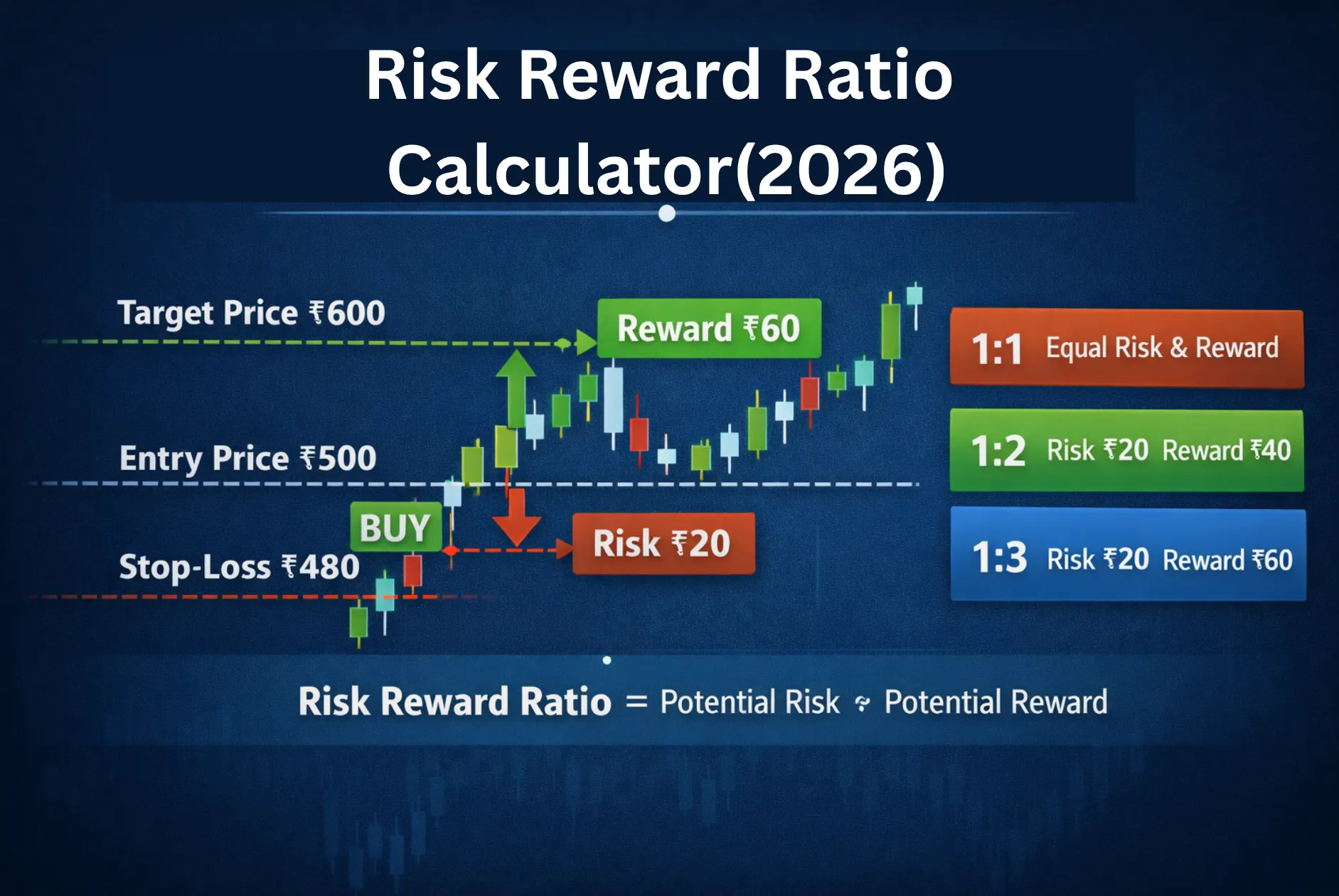
Calculating the risk reward ratio is straightforward. You need three numbers before you enter any trade:
-
Entry Price : the price at which you buy or sell
-
Stop-Loss Price : the price where you exit if the market moves against you
-
Target Price : the price where you plan to take profits
The Formula
Potential Risk = Entry Price – Stop-Loss Price (for a long/buy trade)
Potential Reward = Target Price – Entry Price
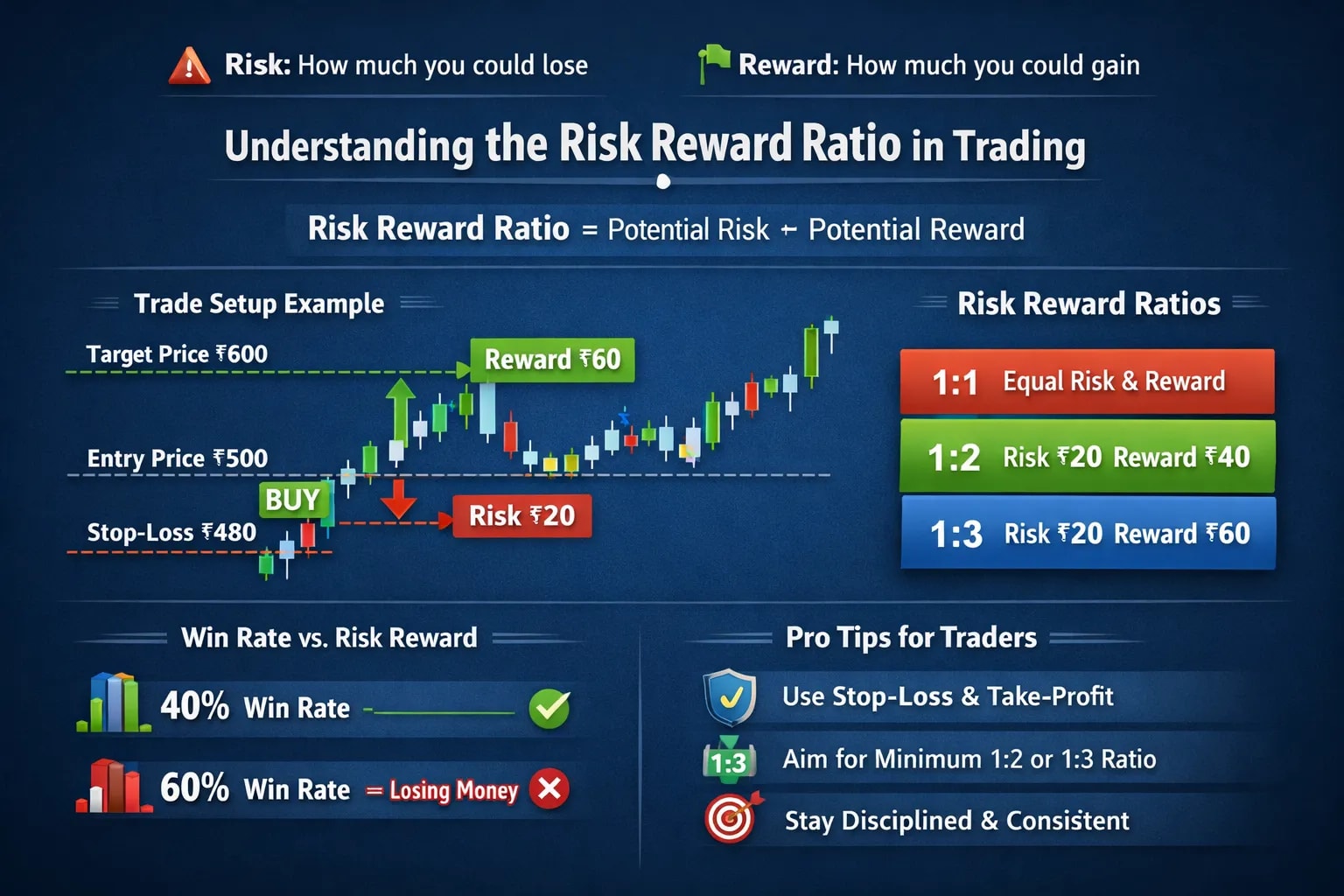
Risk Reward Ratio = Potential Risk ÷ Potential Reward
Step-by-Step Example
Suppose you want to buy shares of a company:
-
Entry Price: ₹500
-
Stop-Loss: ₹480 (you exit if it drops here)
-
Target Price: ₹560 (your profit goal)
Calculation:
-
Potential Risk = ₹500 – ₹480 = ₹20
-
Potential Reward = ₹560 – ₹500 = ₹60
-
Risk Reward Ratio = ₹20 ÷ ₹60 = 1:3
For every ₹1 you risk, you stand to gain ₹3. That is a solid setup by most trading standards.
"Risk comes from not knowing what you're doing." , Warren Buffett
For Short (Sell) Trades
The formula flips slightly:
Potential Risk = Stop-Loss Price – Entry Price
Potential Reward = Entry Price – Target Price
Risk Reward Ratio Examples Across Asset Classes
The risk reward concept applies across all markets. Here is how it looks in practice:
Example 1: Stock Trading (Equity)
|
Parameter |
Value |
|
Stock |
Reliance Industries |
|
Entry Price |
₹2,800 |
|
Stop-Loss |
₹2,740 |
|
Target Price |
₹2,980 |
|
Risk |
₹60 |
|
Reward |
₹180 |
|
Risk:Reward |
1:3 |
Example 2: Forex Trading
|
Parameter |
Value |
|
Pair |
EUR/USD |
|
Entry |
1.0850 |
|
Stop-Loss |
1.0820 |
|
Target |
1.0910 |
|
Risk |
30 pips |
|
Reward |
60 pips |
|
Risk:Reward |
1:2 |
Example 3: Intraday (Options or Futures)
|
Parameter |
Value |
|
Entry |
₹150 |
|
Stop-Loss |
₹143 |
|
Target |
₹171 |
|
Risk |
₹7 |
|
Reward |
₹21 |
|
Risk:Reward |
1:3 |
No matter the asset , stocks, forex, crypto, commodities, or options , the calculation stays the same. The discipline of applying it consistently is what separates serious traders from gamblers.
What Is the Ideal Risk Reward Ratio for Trading?
There is no single universal answer , but there are industry benchmarks most traders follow.
The most commonly recommended risk reward ratio is 1:2 or 1:3.
Here is a breakdown by experience level and style:
|
Trader Type |
Recommended Minimum R:R |
Notes |
|
Beginner |
1:2 |
Easier to find; reduces pressure on win rate |
|
Intermediate |
1:3 |
Allows profitability even with a 35–40% win rate |
|
Swing Trader |
1:3 to 1:5 |
Larger moves; more time for the trade to play out |
|
Day Trader / Scalper |
1:1.5 to 1:2 |
Higher frequency, lower per-trade reward is acceptable |
|
Position Trader |
1:5 to 1:10 |
Long-term setups with higher profit potential |
"I look for opportunities with tremendously skewed reward-risk opportunities." , Paul Tudor Jones, Legendary Hedge Fund Manager
A ratio below 1:1 should almost always be avoided. It means you are risking more than you expect to gain, which requires an exceptionally high win rate just to break even.
Risk Reward Ratio vs Win Rate: How They Work Together
These two metrics are inseparable. Knowing one without the other is like knowing only half the story.
The relationship can be described using the Minimum Win Rate formula:
Minimum Win Rate = Risk ÷ (Risk + Reward)
|
Risk:Reward |
Minimum Win Rate to Break Even |
|
1:1 |
50% |
|
1:2 |
33.3% |
|
1:3 |
25% |
|
1:4 |
20% |
|
1:5 |
16.7% |
This table tells you something remarkable. A trader with a 1:5 risk reward ratio only needs to win roughly 1 in 6 trades to break even. Everything above that is pure profit.
This is why high risk reward ratios are so powerful , they give you a wider margin for error, meaning you can be wrong more often and still stay in the game.
How Stop-Loss and Take-Profit Orders Define Your Ratio
The risk reward ratio is only as reliable as the discipline behind it. Setting the correct stop-loss and take-profit levels is how you lock in your ratio before entering a trade.
Stop-Loss Order
A stop-loss is an automatic exit instruction. If the price moves against you and hits your stop level, the platform closes your trade. It caps your loss at the predetermined amount and takes emotion out of the equation.
Common stop-loss placement methods:
-
Below a key support level (for long trades)
-
Above a key resistance level (for short trades)
-
Based on Average True Range (ATR) , a volatility measure
-
At a fixed percentage of the entry price (e.g., 2%)
Take-Profit Order
A take-profit order automatically closes your trade once the price hits your target. It locks in your gain before the market reverses.
Common take-profit placement methods:
-
At the next key resistance level (for long trades)
-
At a Fibonacci extension level (e.g., 1.618)
-
Based on a fixed risk multiplier (e.g., 3× the stop distance)
Together, these two tools turn the risk reward ratio from a concept into a real, working system. Set them before you enter, and let the trade play out without interference.
Common Mistakes Traders Make with Risk Reward Ratio
Even experienced traders sometimes undermine their own risk management. Here are the most frequent mistakes to avoid:
1. Moving the Stop-Loss After Entry Many traders move their stop further away when a trade goes against them, hoping it will recover. This destroys your planned ratio and turns a calculated risk into an open-ended one.
2. Taking Profits Too Early Fear of a reversal causes many traders to exit before reaching their target. If you consistently close at 1.5× your risk when you planned for 3×, your actual ratio is far below what you expected.
3. Using an Arbitrary Stop-Loss Placing a stop "just because it feels right" instead of basing it on a technical level (support, resistance, ATR) makes your ratio meaningless. The stop must be logical, not random.
4. Confusing the Ratio with Win Probability A 1:3 ratio does not mean you will win 75% of the time. It only tells you the financial relationship between your risk and reward. Probability is a separate analysis altogether.
5. Ignoring Commissions and Spreads Especially for scalpers and day traders, transaction costs eat into your reward. Always factor in brokerage fees and spreads when calculating your effective ratio.
Risk Reward Ratio Across Different Trading Styles
Different trading strategies demand different approaches to the ratio.
Scalping (Very Short-Term)
-
Holding time: seconds to minutes
-
Typical R:R: 1:1 to 1:1.5
-
Relies on extremely high win rates (70%+)
-
Small individual profits compounded across dozens of trades daily
Day Trading (Intraday)
-
Holding time: minutes to hours; closed by end of day
-
Typical R:R: 1:2
-
Moderate win rate (45–55%) combined with disciplined ratio management
-
Relies on technical analysis for entry and exit signals
Swing Trading (Multi-Day)
-
Holding time: days to weeks
-
Typical R:R: 1:3 to 1:5
-
Lower win rate acceptable (35–45%)
-
Gives trades more time to develop; catches larger price moves
Position Trading (Long-Term)
-
Holding time: weeks to months
-
Typical R:R: 1:5 to 1:10
-
Rare trades, but each one is high conviction
-
Often used by institutional investors and macro traders
How to Use a Free Risk Reward Ratio Calculator
Manually calculating ratios before every trade is time-consuming. That is why a free online risk reward ratio calculator is one of the most practical tools a trader can use.
How to use it:
-
Enter your Entry Price , where you plan to open the trade
-
Enter your Stop-Loss Price , your maximum acceptable loss level
-
Enter your Target Price , where you plan to take profit
-
The calculator instantly shows your Risk:Reward Ratio
At smdevs.in, you have access to completely free trading tools designed to simplify these calculations. No sign-up required. No hidden charges. Just fast, accurate results so you can spend more time analysing the market and less time doing manual arithmetic.
Try the Free Risk Reward Ratio Calculator on smdevs.in
Other free tools you may find useful on smdevs.in:
Final Thoughts: Make the Ratio Work for You
The risk reward ratio in trading is not a magic formula. It will not predict market direction or guarantee profits. What it does is give you a structured, logical framework that keeps you from making impulsive, emotion-driven decisions.
Here is a simple rule to carry into every trade:
Never enter a trade where your potential reward is less than twice your potential risk.
That single discipline, applied consistently over hundreds of trades, is one of the clearest dividing lines between amateur and professional trading.
Combined with a solid entry strategy, proper position sizing, and the free tools available at smdevs.in, you have everything you need to approach the markets with confidence and clarity.
Frequently Asked Questions(Faqs)
What is a good risk reward ratio for trading?
A ratio of 1:2 is generally considered the minimum acceptable for most traders, while 1:3 is widely regarded as solid risk management practice. At 1:3, you only need to win roughly 1 in 4 trades to be profitable, which gives you a meaningful buffer. The "best" ratio ultimately depends on your strategy, trading style, and win rate. Scalpers may work with 1:1.5, while swing traders often target 1:3 to 1:5.
How do you calculate the risk reward ratio in trading?
The formula is simple:
-
Risk = Entry Price – Stop-Loss Price (for a buy trade)
-
Reward = Target Price – Entry Price
-
Risk Reward Ratio = Risk ÷ Reward
Example: Entry at ₹1,000, Stop-Loss at ₹970, Target at ₹1,090. Risk = ₹30, Reward = ₹90, Ratio = 1:3.
What is the difference between risk reward ratio and win rate?
The risk reward ratio tells you the financial relationship between your potential loss and potential gain. Win rate tells you the percentage of trades you win. Both are required to assess true profitability. A 1:3 ratio with a 40% win rate is profitable; a 1:0.5 ratio with a 70% win rate may not be.
Is a 1:1 risk reward ratio good for trading?
A 1:1 ratio means you risk the same amount you hope to gain. This is not necessarily bad, but it demands a win rate above 50% just to break even , after commissions, that threshold rises even higher. Most experienced traders prefer at least 1:2 to give themselves a more forgiving margin of error.
Can I use the risk reward ratio in mutual fund investing?
Yes, although the method differs from active trading. For mutual fund or long-term equity investors, the ratio involves comparing downside risk (how much the fund or stock could fall based on historical volatility or fundamental analysis) against expected returns over a defined period. A fund with 10% upside potential and 3% downside risk carries a roughly 3.3:1 reward-to-risk ratio , a favourable setup for a conservative investor.
Disclaimer: This blog is for educational purposes only and does not constitute financial or investment advice. Trading involves risk. Please conduct your own research or consult a SEBI-registered advisor before making investment decisions.