Key Takeaways
- Call options give the right to buy — profit when underlying rises above strike + premium
- Put options give the right to sell — profit when underlying falls below strike − premium
- Option buyers have limited risk (premium paid); sellers face potentially unlimited risk
- Time decay (Theta) erodes option value every day — enemy of buyers, friend of sellers
- For beginners: buy ATM/slightly ITM options only; avoid far OTM lottery plays
Options trading is one of the most powerful — and most misunderstood — tools available to market participants. When used correctly, options allow traders to define exactly how much they are willing to risk, profit from multiple market scenarios (not just directional moves), and generate consistent income from their existing portfolios. When misused, options can result in losses far exceeding the initial investment.
This guide covers options trading from first principles — how options work, the four basic positions every trader must understand, how option prices are determined, and which strategies are most appropriate for beginners in Indian markets.
What Is an Option?
An option is a financial contract that gives the buyer the right, but not the obligation, to buy or sell an underlying asset at a predetermined price (the strike price) on or before a specific date (the expiry date). The buyer pays a premium to the seller for this right.
Two critical distinctions from futures:
- The buyer has a choice: They can exercise the option or let it expire worthless. Their maximum loss is the premium paid.
- The seller has an obligation: If the buyer exercises, the seller must fulfill. The seller receives the premium but carries potentially unlimited risk (especially for call sellers).
Call Options vs. Put Options
Call Option (CE — Call European in Indian markets)
A Call option gives the buyer the right to buy the underlying at the strike price before expiry.
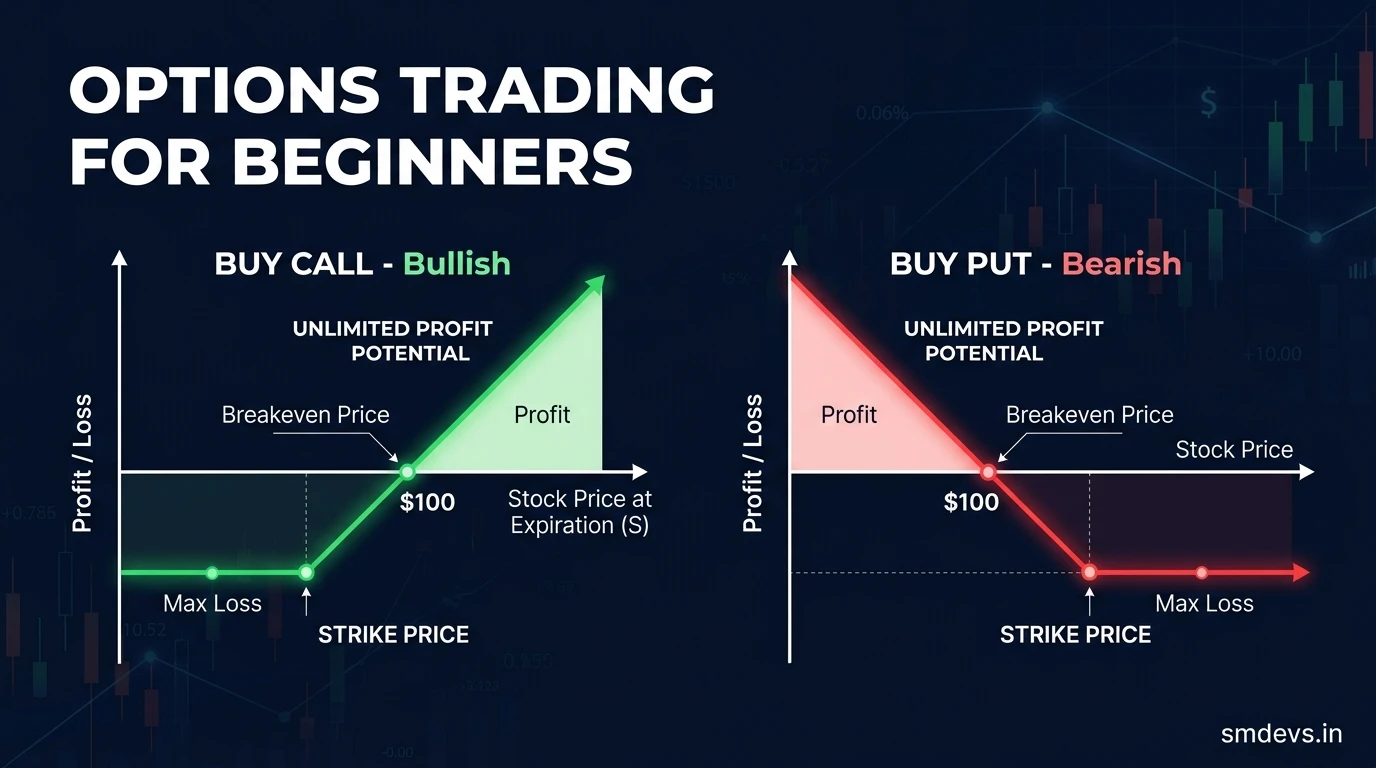
Buy Call (Long Call): You pay a premium. You profit if the underlying price rises above Strike + Premium. Your maximum loss is the premium paid. This is the simplest bullish options position.
Example: Nifty is at 24,000. You buy a 24,200 Call option paying ₹150 premium (per unit) × 75 (lot size) = ₹11,250 total cost. If Nifty expires at 24,500: profit = (24,500 − 24,200 − 150) × 75 = ₹11,250. If Nifty expires below 24,200: you lose your entire ₹11,250 premium.
Put Option (PE — Put European in Indian markets)
A Put option gives the buyer the right to sell the underlying at the strike price before expiry.
Buy Put (Long Put): You pay a premium. You profit if the underlying price falls below Strike − Premium. Your maximum loss is the premium paid. This is the simplest bearish options position — and also functions as portfolio insurance.
Example: Nifty is at 24,000. You buy a 23,800 Put paying ₹120 premium × 75 = ₹9,000. If Nifty expires at 23,400: profit = (23,800 − 23,400 − 120) × 75 = ₹21,000. If Nifty expires above 23,800: you lose your ₹9,000 premium.
Key Takeaways
- Option buyers have limited risk and unlimited profit potential. The premium is the maximum loss for any long option position.
- Option sellers have limited profit and potentially unlimited risk. Selling naked options without understanding the risk is extremely dangerous.
- Time decay (Theta) works against buyers and for sellers. Options lose value every day, accelerating sharply in the final week before expiry.
- Never buy far OTM options hoping for a lottery win. OTM options expire worthless over 85% of the time — they are heavily stacked against buyers.
- For beginners, stick to buying ATM or slightly ITM options — better Delta means better response to price moves, lower Theta decay damage.
The Option Premium — What You're Paying For
The premium you pay for an option has two components:
- Intrinsic Value: The "real" value of the option — how much money you would make if you exercised right now. An ITM call with underlying at 24,200 and strike at 24,000 has ₹200 of intrinsic value. OTM options have zero intrinsic value.
- Time Value (Extrinsic Value): The additional premium above intrinsic value, representing the probability that the option will become profitable before expiry. Time value decreases every day (Theta decay) and falls to zero at expiry.
This is why simply buying cheap OTM options and waiting "for the market to move" almost always fails: Even if the market moves in your direction, time value erosion can prevent your option from becoming profitable — especially if the move happens slowly or with declining volatility.
The Option Greeks — Understanding Option Behaviour
| Greek | Measures | Beginner Relevance |
|---|---|---|
| Delta | How much option price moves per ₹1 move in underlying | ATM call ≈ 0.5 Delta — earns ₹0.50 per ₹1 Nifty rise. Use this to estimate P&L. |
| Theta | Premium lost per day due to time decay | The enemy of option buyers. Check Theta before buying — avoid high-Theta positions near expiry. |
| Vega | Sensitivity to Implied Volatility changes | Premium expands when market fear rises (IV spike). Options bought before a big event may lose value if IV crashes after the event (IV crush). |
| Gamma | Rate of change of Delta | High Gamma near expiry — ATM options can gain or lose value explosively in the final days. |
Implied Volatility — The Most Important Pricing Factor
Implied Volatility (IV) is the market's expectation of how much the underlying will move before expiry. Higher IV = more expensive options. Lower IV = cheaper options.
IV Percentile: Compare current IV to its historical range. If IV Percentile is above 80%, options are historically expensive — better to sell premium. If IV Percentile is below 20%, options are historically cheap — better to buy.
IV Crush: One of the biggest traps for beginner options buyers. Before earnings or a major event, IV rises dramatically (making options expensive). After the event, regardless of the price move, IV collapses — sometimes losing 40–60% of its value in hours. Option buyers who hold through the event often lose money even when the stock moves in their direction.
5 Essential Options Strategies for Beginners
1. Buy Call — Simple Bullish
When to use: You expect a significant upward move before expiry. Buy ATM or 1-strike ITM calls. Risk: Premium paid. Reward: Unlimited above breakeven.
2. Buy Put — Simple Bearish / Portfolio Hedge
When to use: You expect a significant downward move, or you want to protect a long equity portfolio. Buy ATM or 1-strike ITM puts. Risk: Premium paid. Reward: Significant if market falls sharply.
3. Bull Call Spread
Buy a lower-strike call, sell a higher-strike call in the same expiry. Reduces premium cost but caps maximum profit. Best for moderate bullish views where you want to reduce the cost of buying a call.
Example: Buy 24,000 Call at ₹200, Sell 24,400 Call at ₹80. Net premium = ₹120. Max profit = (400 − 120) × 75 = ₹21,000 per lot. Max loss = ₹120 × 75 = ₹9,000.
4. Bear Put Spread
Buy a higher-strike put, sell a lower-strike put. Reduces premium cost of buying a put. Best for moderate bearish views.
5. Covered Call
Own the underlying shares (or futures) and sell a call option against them to collect premium. Maximum profit is capped at strike + premium received. Best for investors who own stocks and want to generate monthly income.
Options Expiry in India — Key Dates
| Contract | Expiry | Notes |
|---|---|---|
| Nifty 50 options | Every Thursday (weekly) | Monthly expiry = last Thursday of month. Most liquid. |
| Bank Nifty options | Every Wednesday (weekly) | Highest intraday volatility of all index options. |
| Sensex options | Every Friday (weekly) | BSE-listed; growing liquidity. |
| Stock options | Last Thursday of month only | Monthly only; check for illiquidity in far-month contracts. |
Frequently Asked Questions
How much money do I need to start options trading in India?
For buying options (long calls or puts), you only need the premium cost. A single ATM Nifty option lot costs ₹5,000–15,000 depending on IV and time to expiry. However, trading with only the minimum means one loss wipes your entire position. Most advisors recommend at least ₹50,000–1,00,000 to allow proper position sizing (risking only 5–10% per trade) when starting with options buying. For selling options (which requires significantly higher margin), plan for ₹1.5–2 lakh minimum per lot of Nifty options.
Why do options expire worthless so often?
Statistically, approximately 75–85% of all options held to expiry expire worthless. This is not random — it reflects the structural edge that option sellers have through time decay. The premium a buyer pays represents a risk premium for the protection or leverage the option provides. For the buyer to profit, the underlying must move enough, fast enough, to overcome both the premium paid and the ongoing time decay. Most of the time, markets don't move as far or as fast as buyers expect — hence most options expire without intrinsic value.
What is the best options strategy for beginners?
For absolute beginners, start with buying ATM or slightly ITM calls (bullish view) or puts (bearish view). The risk is clearly limited (premium paid), P&L is intuitive, and you gain experience with how options move in response to price, time, and volatility. Avoid: selling naked options (unlimited risk), buying very far OTM options (nearly always expire worthless), and complex multi-leg strategies until you have 6–12 months of experience with simple positions.
What is IV Crush and how do I avoid it?
IV Crush occurs when Implied Volatility drops sharply after a scheduled event (earnings, RBI policy, budget), causing option premiums to collapse even if the underlying moves in your expected direction. To avoid it: don't hold long options through known events unless the expected move is much larger than what the market has priced in (implied move). If you want event exposure, use spreads (bull call spread, bear put spread) which reduce your net Vega exposure and therefore your IV crush risk.
Your Next Step
Study the Futures and Options Complete Guide for broader derivatives context. Use our free trading calculators to practice position sizing and P&L before trading real money. And always apply the 5 Golden Rules of Risk Management — especially critical in options trading where leverage can amplify losses rapidly.