Key Takeaways
- Options trading is one of the most powerful — and most misunderstood — financial instruments available to Indian investors. An option gives you the right (but not the obligation) to buy or sell an ass
What is Options Trading?
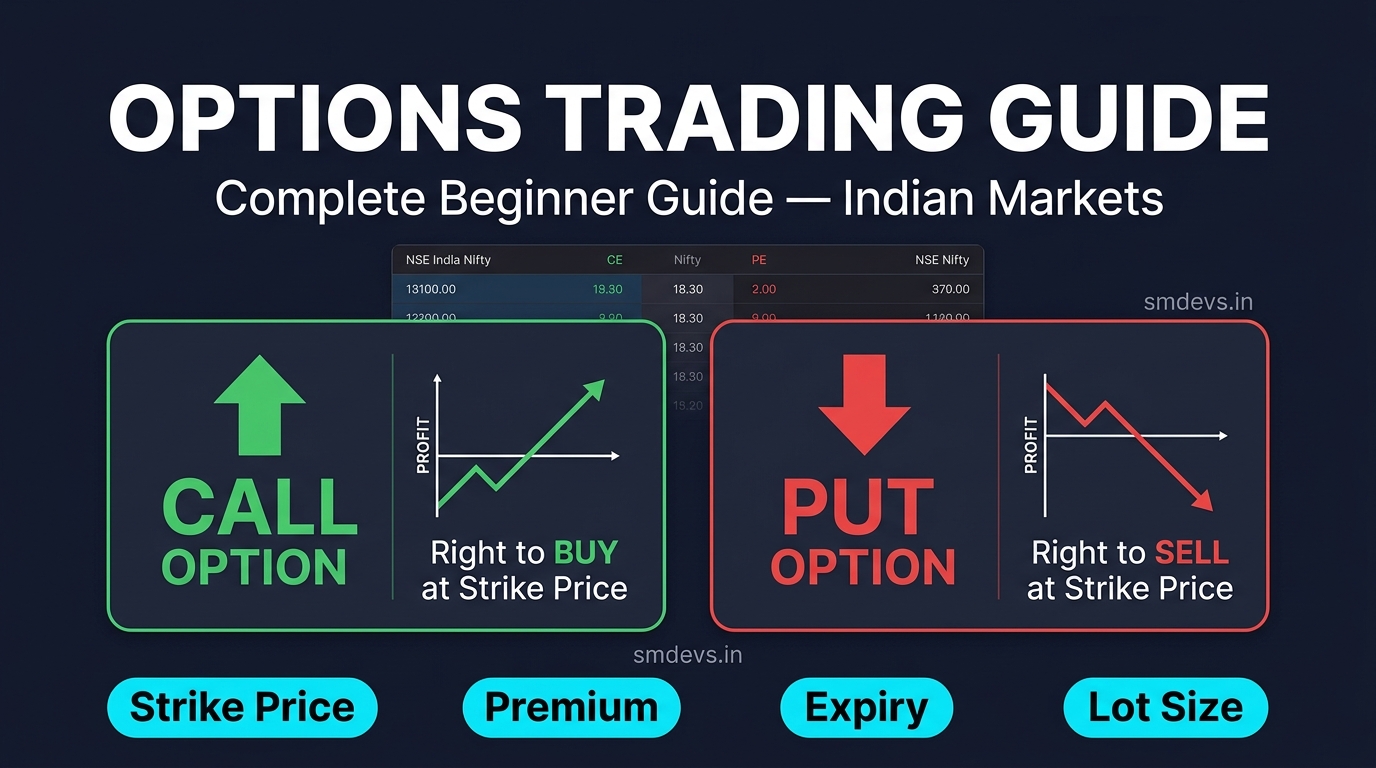
Options trading is the buying and selling of options contracts — financial derivatives that give the buyer the right, but not the obligation, to buy or sell an underlying asset (stock, index) at a predetermined price (strike price) on or before a specific date (expiry).
The key word is "right, not obligation" — unlike futures where you must buy or sell, options give you the choice. You pay a fee (called the premium) for this right. If the market doesn't move in your favour, you simply don't exercise the option — your maximum loss is the premium paid.
In India, options are primarily traded on the NSE (National Stock Exchange) through the F&O (Futures and Options) segment. India's NSE is the world's largest derivatives exchange by contract volume — with Nifty and Bank Nifty options being the most actively traded contracts globally.
Call Options vs Put Options — The Core Difference
| Call Option (CE) | Put Option (PE) | |
|---|---|---|
| Right to | BUY the underlying at strike price | SELL the underlying at strike price |
| Buyer profits when | Price goes UP above strike | Price goes DOWN below strike |
| Buyer's max loss | Premium paid only | Premium paid only |
| Seller's max profit | Premium received | Premium received |
| Seller's max loss | Theoretically unlimited | Strike price minus zero |
| Market view | Bullish | Bearish |
10 Key Options Trading Terms Every Beginner Must Know
1. Strike Price
The price at which the option contract allows you to buy (Call) or sell (Put) the underlying asset. For Nifty options, strikes are available at every 50-point interval (e.g., 24,000; 24,050; 24,100).
2. Premium
The price you pay to buy an option contract. This is your maximum risk when buying options. Premium is determined by intrinsic value + time value. As expiry approaches, time value decays — this is called theta decay and is the enemy of option buyers.
3. Expiry Date
The date on which the option contract expires. In India:
- Weekly expiry: Nifty options expire every Thursday; Bank Nifty every Wednesday
- Monthly expiry: Last Thursday of each month — available for all F&O stocks and indices
- Options lose value rapidly as expiry approaches, especially in the last 2–3 days
4. Lot Size
Options are traded in lots (batches), not single units. Current lot sizes (2026):
- Nifty 50: 25 units per lot
- Bank Nifty: 15 units per lot
- Sensex: 10 units per lot
- Individual stock options: varies by company (typically 200–5,000 shares per lot)
5. In-the-Money (ITM), At-the-Money (ATM), Out-of-the-Money (OTM)
| Term | Call Option | Put Option | Premium |
|---|---|---|---|
| ITM | Strike < Market Price | Strike > Market Price | Most expensive — has intrinsic value |
| ATM | Strike ≈ Market Price | Strike ≈ Market Price | Most liquid — highest time value |
| OTM | Strike > Market Price | Strike < Market Price | Cheapest — no intrinsic value, only time value |
6. Intrinsic Value and Time Value
Premium = Intrinsic Value + Time Value
Intrinsic value = how much the option is worth if exercised today. An ITM Call with market at 24,500 and strike at 24,000 has ₹500 of intrinsic value. Time value is the additional premium reflecting the probability that the option becomes more valuable before expiry.
7. Greeks: Delta, Theta, Vega, Gamma
| Greek | Measures | Beginner's takeaway |
|---|---|---|
| Delta (Δ) | Option price change per ₹1 move in underlying | ATM option Delta ≈ 0.5 — premium moves ₹0.50 for every ₹1 Nifty moves |
| Theta (Θ) | Daily time decay of premium | Options lose value every day even if market doesn't move — hurts buyers, helps sellers |
| Vega (v) | Premium change per 1% change in IV | Higher volatility = higher premiums — buy options before big events (budget, earnings) |
| Gamma (Γ) | Rate of change of Delta | Highest for ATM options near expiry — massive premium swings possible |
8. Implied Volatility (IV)
IV is the market's expectation of future volatility, baked into the option premium. High IV = expensive options. India VIX (Volatility Index) reflects Nifty options' IV — VIX above 20 means expensive premiums, below 15 means cheap premiums. Buy options when IV is low; sell options when IV is high.
9. Open Interest (OI)
The total number of outstanding (unsettled) option contracts at a given strike. High OI at a specific strike often acts as a support (high Put OI) or resistance (high Call OI) level — this is called Max Pain analysis.
10. Options Chain
A table showing all available strikes, their Call and Put premiums, OI, volume, and IV for a given expiry. Available free on NSE India's website. Analysing the options chain is the first skill every options trader must learn.
3 Simple Options Strategies for Beginners
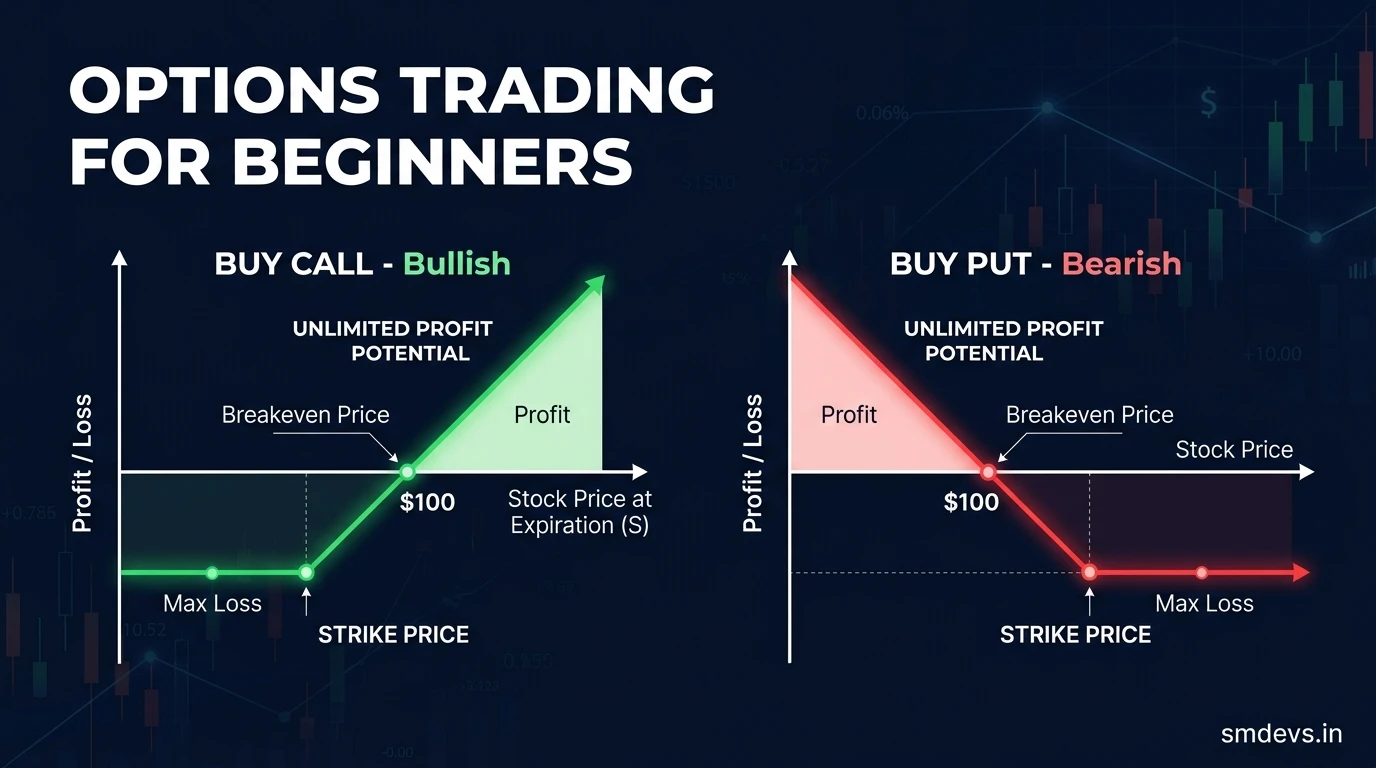
Strategy 1: Buying a Call Option (Bullish View)
When to use: You believe a stock or Nifty will rise significantly before expiry.
- Select a slightly OTM or ATM Call option (e.g., Nifty 24,100 CE when Nifty is at 24,000)
- Pay the premium (your maximum loss)
- Profit if Nifty rises above 24,100 + premium paid before expiry
- Loss limited to premium paid — cannot lose more
Risk: Theta decay erodes your premium daily. Timing matters — being right about direction but wrong about timing still results in a loss.
Strategy 2: Buying a Put Option (Bearish View)
When to use: You believe a stock or index will fall before expiry.
- Select an ATM or slightly OTM Put option (e.g., Nifty 23,900 PE when Nifty is at 24,000)
- Pay the premium
- Profit if Nifty falls below 23,900 minus premium paid
- Useful as portfolio hedge — buy puts on your Nifty/stock portfolio to protect against crashes
Strategy 3: Protective Put (Hedging Existing Holdings)
If you hold Nifty ETFs or stocks worth ₹5 lakh and fear a short-term fall, buy 1 lot of Nifty ATM Put options as insurance. Cost = premium (e.g., ₹5,000–₹8,000). This caps your downside to the premium paid while keeping full upside if markets rise.
Options Trading Risks — What Beginners Must Understand
- Option buying is a high-probability loss activity: Studies show 85–90% of options expire worthless. This means buyers lose their premium most of the time — even experienced traders.
- Theta decay is relentless: An option that doesn't move loses value every single day. Buying weekly options 2–3 days before expiry is extremely high risk.
- Selling options is high-risk: Selling naked (uncovered) options gives you unlimited loss potential. Never sell options without a hedge as a beginner.
- Leverage amplifies losses: Options give 5x–20x leverage. A 5% adverse move in Nifty can wipe out 50–100% of your option premium.
How to Start Options Trading in India (Step by Step)
- Open a demat + trading account with a broker that has good F&O tools: Zerodha, Upstox, Angel One, or Dhan. Ensure F&O segment is activated.
- Learn the options chain: Spend 2 weeks on NSE's options chain without trading — understand how premiums move with Nifty.
- Use our free Options Profit Calculator to simulate P&L before placing any trade.
- Start paper trading: Practice with virtual money for 1–2 months. Only trade real money when you have a clear strategy.
- Begin with index options: Nifty and Bank Nifty options are more liquid and predictable than individual stock options. Start here.
- Risk only what you can afford to lose completely: Never put more than 5% of your portfolio into option buying. Treat option premium as a cost, not an investment.
FAQs: Options Trading India
What is options trading in simple words?
Options trading is buying or selling contracts that give you the right — not the obligation — to buy (Call) or sell (Put) stocks or indices at a fixed price before a fixed date. You pay a fee called premium for this right. If the market moves in your favour, you profit. If it doesn't, you lose only the premium paid — nothing more.
Is options trading legal in India?
Yes — options trading is completely legal in India and regulated by SEBI (Securities and Exchange Board of India). Index options (Nifty, Bank Nifty, Sensex) and stock options on SEBI-approved F&O stocks are traded on NSE and BSE. You need a SEBI-registered broker and a demat account to participate.
What is the minimum amount needed to start options trading in India?
The minimum is the premium for one lot of options. For Nifty 50 (25 units/lot), an ATM option premium might be ₹150–₹300 per unit, making one lot cost ₹3,750–₹7,500. For Bank Nifty (15 units/lot), premiums vary similarly. You don't need lakhs to start — but you should be prepared to lose the entire premium on any trade.
What is the difference between futures and options?
Futures obligate both buyer and seller to complete the transaction at the agreed price on expiry — regardless of market direction. Options give the buyer the right but not the obligation. Futures have unlimited loss potential for both sides; option buyers have capped loss (premium paid) with unlimited profit potential, while option sellers have capped profit (premium received) with unlimited loss potential.