Key Takeaways
- The Sensex — officially the S&P BSE Sensex — is India's oldest and most widely tracked stock market index, maintained by the Bombay Stock Exchange (BSE). It tracks 30 of the largest and most financial
What is the Sensex?
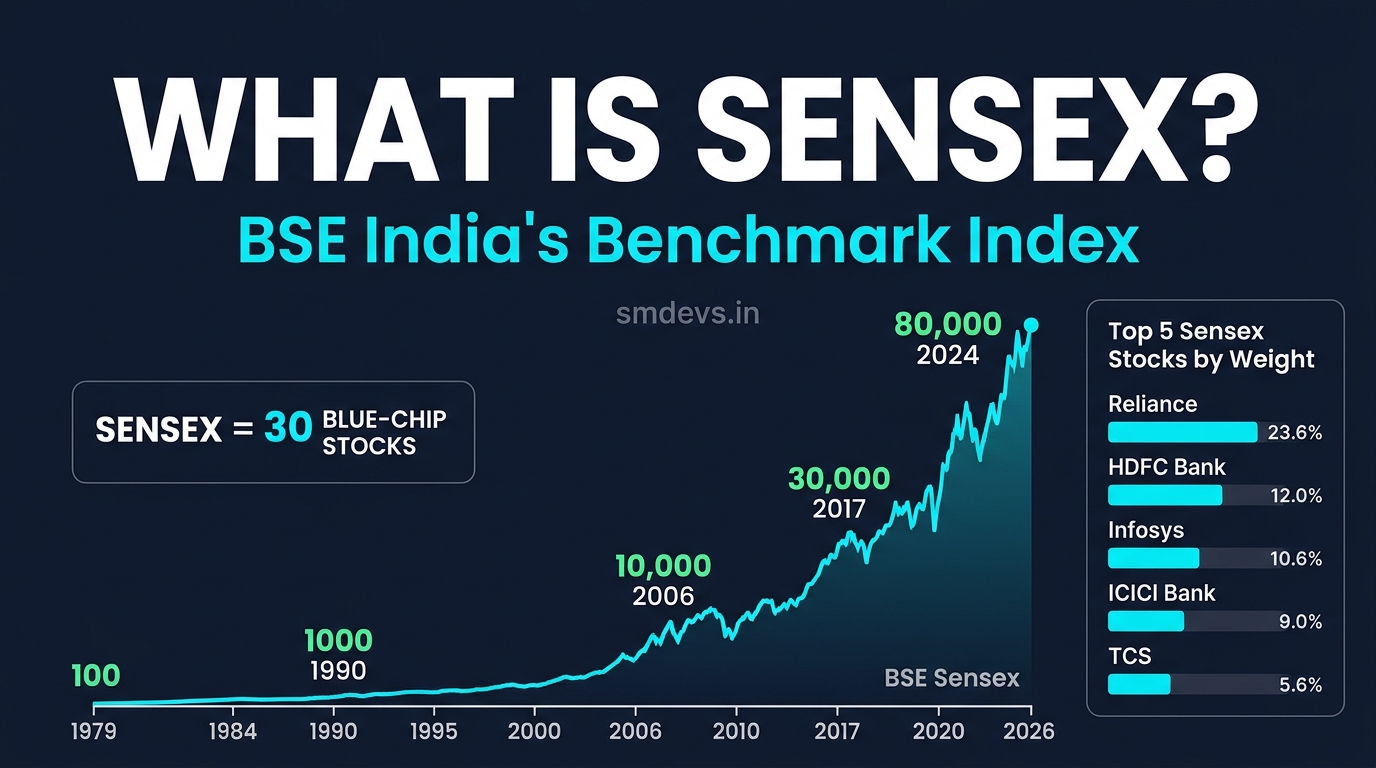
The Sensex (Sensitive Index) is a free-float market capitalisation-weighted index of 30 well-established and financially sound companies listed on the Bombay Stock Exchange (BSE). It is India's oldest stock market index, established on January 1, 1986, with a base value of 100 points as of April 1979.
Its official name is the S&P BSE Sensex, following a licensing agreement between BSE and S&P Dow Jones Indices. It is the most widely reported benchmark of Indian equity market performance — both domestically and internationally.
When CNBC TV18 says "markets closed 500 points higher today" — they mean the Sensex rose by 500 points.
How is the Sensex Calculated?
The Sensex uses the Free-Float Market Capitalisation Method:
Sensex = (Sum of Free-Float Market Cap of 30 companies / Base Market Cap) × Base Index Value (100)
Free-Float Market Cap = Current Share Price × Number of Shares Available for Public Trading (excludes promoter holdings, government stakes, and strategic holdings)
This means larger companies (by market cap) have a higher weight in the index — a 5% move in Reliance Industries affects the Sensex far more than a 5% move in a smaller constituent.
Sensex vs Nifty 50: Key Differences
| Feature | Sensex | Nifty 50 |
|---|---|---|
| Exchange | Bombay Stock Exchange (BSE) | National Stock Exchange (NSE) |
| Stocks | 30 companies | 50 companies |
| Base Year | 1978–79 (base = 100) | 1995 (base = 1,000) |
| Established | 1986 | 1996 |
| Trading Volume | Lower than NSE | Higher — most futures and options traded on NSE |
| Correlation | Very high (~0.99) — both move almost identically | |
For most practical purposes — investing, tracking, and analysis — Sensex and Nifty 50 move in the same direction and tell the same story about Indian equity markets.
Sensex Historical Journey: From 100 to 80,000+
| Year | Sensex Level | Key Event |
|---|---|---|
| 1979 | 100 | Base year established |
| 1990 | ~1,000 | First major bull run |
| 1992 | 4,500 → 2,500 | Harshad Mehta scam — first major crash |
| 2000 | ~5,000 | Dot-com bubble peak |
| 2006 | 10,000 | India's economic boom, IT sector growth |
| 2008 | 21,000 → 8,000 | Global financial crisis — 62% crash in 10 months |
| 2014 | ~25,000 | Modi government elected — FII confidence surge |
| 2020 (Mar) | 25,981 | COVID-19 pandemic crash — 38% fall in 6 weeks |
| 2021 | 60,000 | Fastest 10,000-point rally in history post-COVID |
| 2024 | 85,978 (all-time high) | FII inflows, strong domestic consumption |
| 2026 | ~82,000–84,000 | Consolidation after 2024 peak; rate cut cycle |
Source: BSE India historical data
Top 10 Sensex Constituent Stocks (2026)
| Company | Sector | Approx. Weight |
|---|---|---|
| Reliance Industries | Energy / Telecom / Retail | ~12–14% |
| HDFC Bank | Banking | ~10–12% |
| ICICI Bank | Banking | ~7–9% |
| Infosys | IT Services | ~7–8% |
| TCS (Tata Consultancy Services) | IT Services | ~5–7% |
| Bharti Airtel | Telecom | ~4–5% |
| ITC | FMCG | ~3–4% |
| Larsen & Toubro | Infrastructure | ~3–4% |
| State Bank of India | Banking (PSU) | ~3% |
| Axis Bank | Banking | ~2–3% |
Weights change with share prices — check BSE India for live constituent weights.
How Stocks Get Added or Removed from Sensex
BSE's Index Committee reviews Sensex constituents semi-annually (typically in June and December). Selection criteria:
- Listed on BSE for at least 1 year
- Large-cap stock: Must rank among the top 100 by average free-float market cap over the past year
- Liquidity: High median daily trading value and turnover
- Sector representation: Committee ensures sectoral diversity — not all 30 slots go to banking even if banks have highest market caps
- Financial soundness: Consistent profitability track record
Recent additions include Bajaj Finance and Titan; removals happen when a company's market cap falls or it faces governance issues. BSE announces changes with advance notice.
What Causes Sensex to Rise or Fall?
Factors That Push Sensex Higher
- RBI rate cuts: Lower interest rates make equities more attractive vs fixed deposits
- Strong GDP data: Better economic growth = higher corporate earnings expectations
- FII (Foreign Institutional Investor) inflows: Foreign money buying Indian stocks
- Positive global cues: US Fed rate cuts, strong Dow Jones, stable crude oil prices
- Strong quarterly results: Especially from heavyweight stocks like Reliance, HDFC Bank
Factors That Push Sensex Lower
- RBI rate hikes: Higher rates make debt more attractive; equity valuations compress
- FII selling: Foreign investors exiting Indian markets — often due to stronger US dollar
- High crude oil prices: India imports 85% of its oil — high crude = inflation + trade deficit
- Geopolitical tensions: Wars, sanctions, global uncertainty → risk-off selling
- Weak earnings season: Disappointing results from large-cap heavyweights
- Rupee depreciation: Weak INR relative to USD triggers FII outflows
How to Use Sensex for Investment Decisions
The PE Ratio of Sensex (Market Valuation Tool)
The BSE publishes the trailing Price-to-Earnings (P/E) ratio of the Sensex — a key indicator of whether the market is cheap or expensive:
- Sensex P/E below 16–18: Historically undervalued — good long-term buying zone
- Sensex P/E 18–24: Fair value range
- Sensex P/E above 28–30: Historically overvalued — reduce equity, increase debt allocation
The Sensex P/E touched 40x during the COVID recovery rally (Jan 2021) — historically extreme. Such readings have always preceded corrections.
Using Sensex for SIP Timing (or Not)
If you are investing via SIP (Systematic Investment Plan), Sensex levels generally don't matter — the rupee cost averaging effect means you automatically buy more units when Sensex falls and fewer when it rises. For lump-sum investments, buying when Sensex P/E is below 20 has historically produced superior 5-year returns.
FAQs: Sensex
What is Sensex in simple words?
Sensex is a number that tells you how 30 of India's biggest and best companies are performing as a group. When Sensex goes up, it means these 30 companies collectively became more valuable that day. When it falls, they lost value. It's the most popular shorthand for "how is the Indian stock market doing today?"
What is the difference between Sensex and Nifty?
Sensex tracks 30 stocks listed on BSE (Bombay Stock Exchange). Nifty 50 tracks 50 stocks listed on NSE (National Stock Exchange). Both represent the same large-cap Indian equity market and move almost identically — their day-to-day correlation is above 99%. Nifty 50 is more popular for futures and options trading; Sensex is the original and more widely quoted benchmark globally.
What was the Sensex all-time high?
The Sensex hit its all-time high of 85,978.25 points on September 27, 2024, driven by strong FII inflows, robust domestic consumption, and optimism around rate cuts. As of 2026, it trades in the 80,000–84,000 range after post-peak consolidation.
Can I invest directly in the Sensex?
You cannot buy the Sensex index directly. However, you can invest in it through: (1) Sensex Index Mutual Funds — funds that replicate the Sensex portfolio (e.g., HDFC Sensex Fund, SBI BSE Sensex ETF), (2) BSE Sensex ETFs — traded on BSE like stocks, (3) Sensex Futures & Options — derivative contracts for experienced traders.