Key Takeaways
- India is the second-largest voice search market in the world — and growing fast. With the explosion of affordable smartphones, Google Assistant, Siri, and smart speakers, millions of Indians now ask "
The Voice Search Revolution in India
India has emerged as one of the fastest-growing voice search markets globally due to three converging factors:
- Affordable smartphones: 4G/5G penetration has created 700+ million smartphone users, many of whom are more comfortable speaking than typing
- Hindi and regional language preference: Voice search removes the barrier of typing in English — users can search in Hindi, Tamil, Bengali, or any regional language naturally
- Google Assistant's Indian language support: Google Assistant now supports 8+ Indian languages, making voice search truly accessible to non-English speakers
Key India voice search statistics (2026):
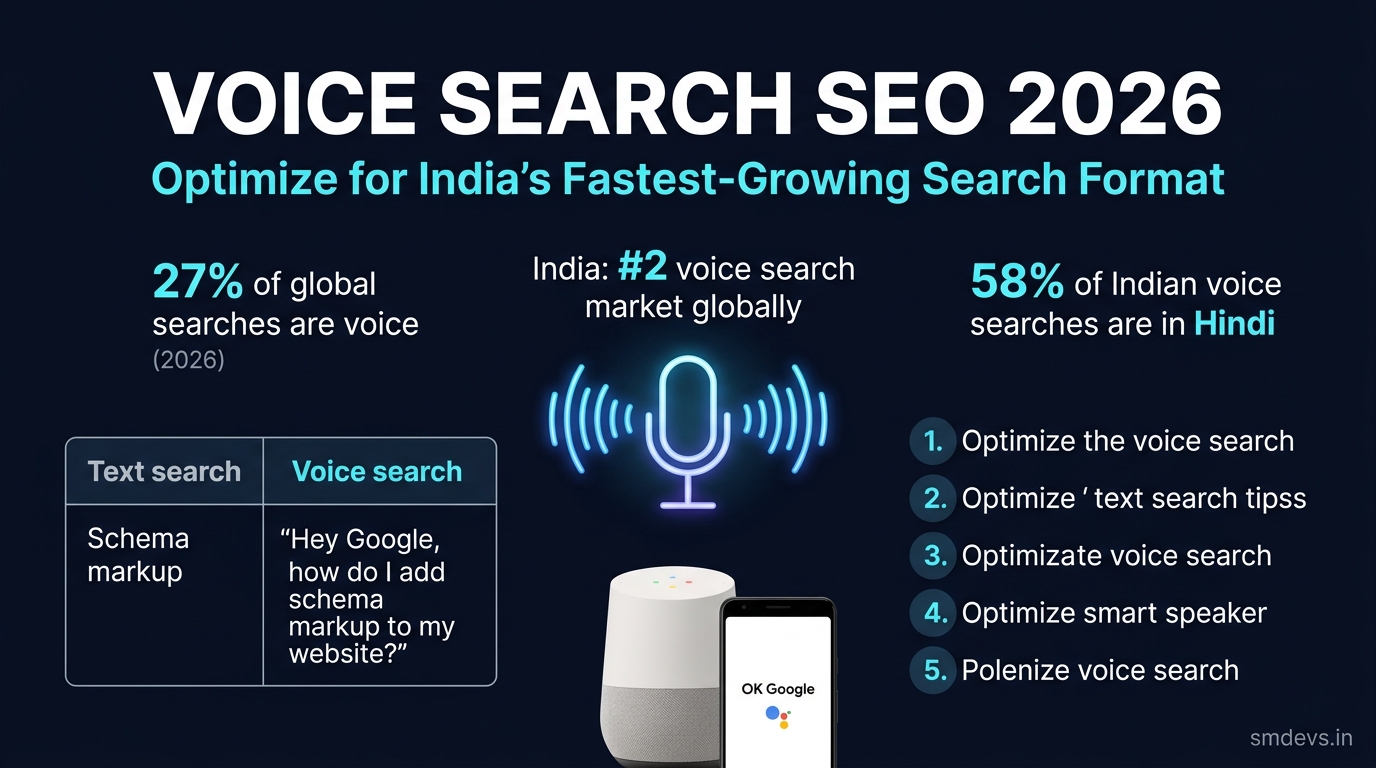
- India is the #2 voice search market globally (after the US)
- 27% of all global internet searches are voice-based
- In India specifically, voice search is growing 270% year-over-year
- 58% of Indian voice searches are in Hindi or other regional languages
- Voice searches are 3x more likely to be local ("near me") than text searches
How Voice Search Differs from Text Search
Voice search fundamentally changes query structure — and therefore the keywords and content format you need to optimise for:
| Characteristic | Text Search | Voice Search |
|---|---|---|
| Query length | 2–4 words ("RSI indicator trading") | Full sentences: "How do I use the RSI indicator for Nifty trading?" |
| Question format | Fragments ("best dividend stocks") | Natural questions ("What are the best dividend stocks in India right now?") |
| Local intent | Lower — "restaurants in Mumbai" | Higher — "Hey Google, what's a good restaurant near me right now?" |
| Conversational | No — keywords only | Yes — includes filler words ("Hey Google, how do I actually...") |
| Immediate action | Research intent dominant | Action intent dominant — voice users want quick, actionable answers |
8 Voice Search SEO Strategies for India
Strategy 1: Target Conversational, Long-Tail Keywords
Voice searches are 3–5x longer than text searches and use natural language. Instead of optimising only for "SIP mutual fund," also optimise for:
- "How do I start a SIP with 500 rupees in India?"
- "What is the best mutual fund to start SIP in 2026?"
- "Hey Google, is my SIP money safe if the market crashes?"
Use Google's "People Also Ask" boxes, AnswerThePublic, and the "Searches related to" section at the bottom of Google results to find these conversational query patterns for your niche.
Strategy 2: Create an FAQ Section on Every Page
FAQ sections directly mirror the question-and-answer format of voice search. When someone asks "Hey Google, what is Bank Nifty?" Google's voice assistant reads the answer from the page's FAQ or featured snippet.
Structure FAQ answers to be:
- Concise: 30–50 words — voice responses are shorter than text snippets
- Direct: Start with the answer, then elaborate
- Conversational: Written as you'd speak — not formal corporate language
Add FAQPage schema markup to all FAQ sections to signal them to Google and increase voice snippet probability. Use our Schema Validator tool to validate.
Strategy 3: Optimise for Featured Snippets (Voice Search Reads These)
For Google Assistant voice responses, Google primarily reads the content from featured snippets. This means winning the featured snippet = winning voice search for that query.
The featured snippet optimisation strategies we covered in our Featured Snippet Guide directly apply to voice search — the same content structure wins both.
Strategy 4: Target "Near Me" and Local Queries
Voice searches have 3x higher local intent than text searches. "Schema markup tool near me" won't be relevant for most topics, but "best stock broker near me" or "income tax consultant near me" are high-volume voice queries.
For local businesses in India: Claim and optimise your Google Business Profile — Google Assistant primarily pulls local results from GBP for "near me" voice queries.
Strategy 5: Make Your Website Lightning Fast (Voice Requires Speed)
Google's voice search algorithm gives significant weight to page speed. The underlying reason: voice users expect instant answers — they're using voice to get quick information, not to browse. Slow pages that might still rank for text search are unlikely to be chosen for voice responses.
Target: LCP under 1.5 seconds for voice-optimised pages (stricter than the standard 2.5s threshold). Achieve this through: WebP images, minimal JavaScript, CDN delivery, and HTTPS. See our Core Web Vitals guide for detailed speed optimisation.
Strategy 6: Use Natural Language in Your Content
Voice search algorithms evaluate conversational naturalness of content. Write content that sounds like how people speak, not how they type. Practical changes:
- Use contractions: "it's" instead of "it is," "you'll" instead of "you will"
- Include question-based headings: "How does this work?" rather than "Mechanism of Action"
- Write in second person: "You should…" rather than "Investors should…"
- Include conversational phrases: "The short answer is…", "Here's what you need to know…"
Strategy 7: Optimise for Hindi and Regional Language Queries
Since 58% of Indian voice searches are in Hindi (or other regional languages), there is a massive opportunity in creating Hindi-language content — or at minimum, addressing common Hindi transliterations:
- "SIP kya hota hai" — "what is SIP" in Hinglish (a voice query format millions use)
- "Share market mein paisa kaise lagayein" — "how to invest in stock market"
- "Mutual fund return kaise calculate karein" — "how to calculate mutual fund returns"
Even English-language pages can benefit by addressing these terms in their content — Google's multilingual understanding connects Hinglish voice queries to English content that best answers them.
Strategy 8: Implement Structured Data (Multiple Schema Types)
Structured data helps Google understand your content's purpose, making it more likely to be selected for voice responses. Priority schema types for voice:
- FAQPage schema — most directly triggers voice responses for question queries
- HowTo schema — for step-by-step instructions (voice assistants often read numbered HowTo steps)
- Article schema — establishes content type and authorship authority
- Organization schema — helps Google verify site authority for voice results
Voice Search in Finance and Trading Content
Voice search is particularly powerful for financial education content — because users ask financial questions conversationally. Queries like:
- "Hey Google, what is the current Nifty 50 level?"
- "OK Google, how do I calculate intrinsic value of a stock?"
- "Hey Siri, what is the difference between SIP and lump sum investment?"
These are natural voice queries our content at smdevs.in targets. The FAQs at the end of every blog post, the featured snippet-optimised direct answers, and the fast loading pages create a strong foundation for voice search visibility.
FAQs: Voice Search Optimization India
What is voice search SEO?
Voice search SEO is the practice of optimising your website to appear in voice-based search results from Google Assistant, Siri, Alexa, and similar voice assistants. It differs from traditional SEO in that it targets conversational, natural language queries (full questions) rather than keyword fragments, and specifically aims to win featured snippets — which voice assistants read aloud as their responses.
How popular is voice search in India?
India is the world's second-largest voice search market. Approximately 27% of all internet searches in India include a voice component in 2026, growing 270% year-over-year. This growth is driven by affordable smartphone penetration, Google Assistant's support for Hindi and 7 other Indian languages, and the preference of many Indian users for speaking over typing — particularly for longer, conversational queries.
How do I optimize my blog for voice search?
Key voice search optimisation tactics: (1) Add a comprehensive FAQ section with conversational, question-based headings and concise 30–50 word answers, (2) Target long-tail, question-form keywords ("how do I..." rather than just the keyword), (3) Win featured snippets for your target queries — voice assistants read featured snippet content, (4) Ensure your website loads in under 2 seconds, (5) Add FAQPage schema markup to FAQ sections, (6) Write in natural, conversational language — not formal corporate prose.