Key Takeaways
- A stock split is one of the most searched corporate actions in Indian markets — particularly when a high-profile company like Adani Power or Mazagon Dock announces one. Stock splits are often misunder
What is a Stock Split?
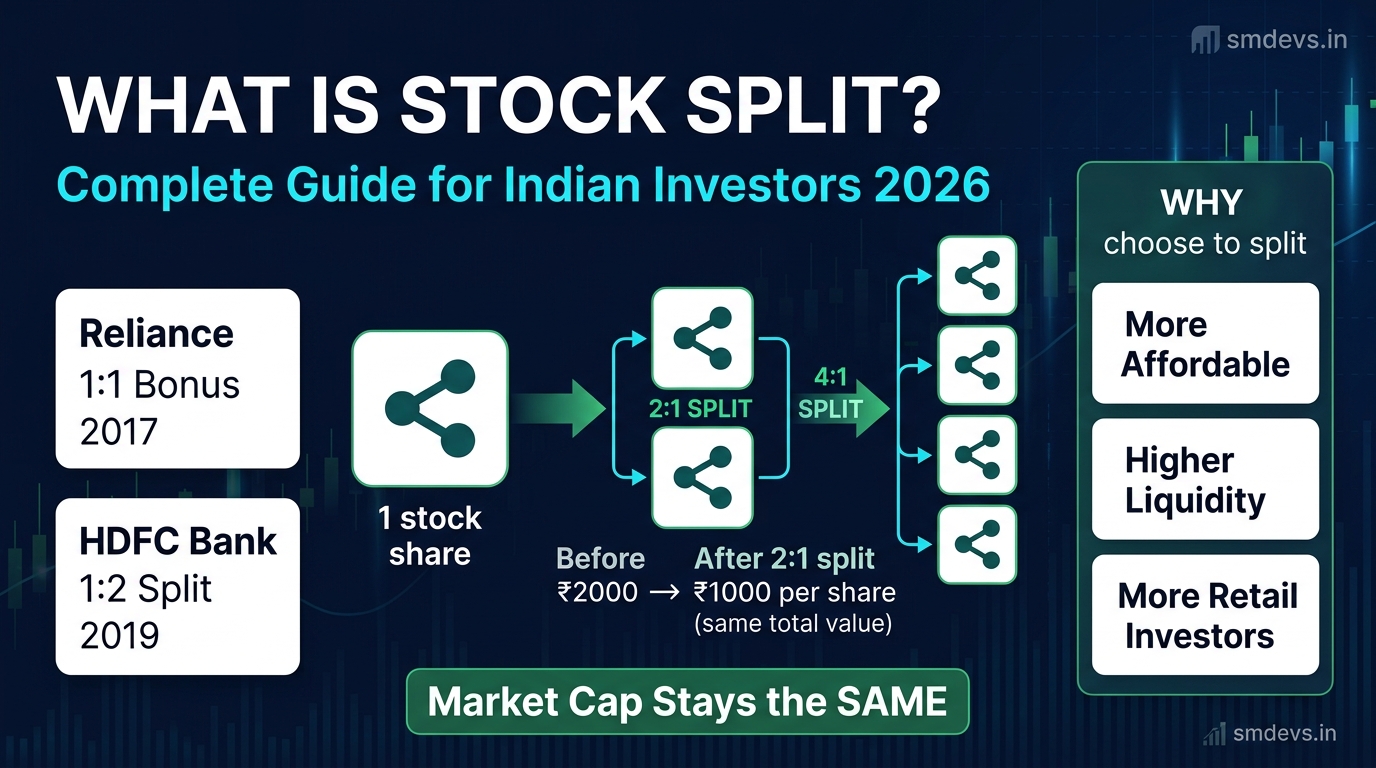
A stock split is a corporate action where a company divides each of its existing shares into a specific number of new shares. The total number of outstanding shares increases, but the share price decreases proportionally — so the company's total market capitalisation remains unchanged.
Think of it like cutting a pizza: cutting a ₹1,000 pizza into 2 slices doesn't make it a ₹2,000 pizza — each slice is now worth ₹500. You have more slices, but the total pizza's value is identical.
How Does a Stock Split Work? (Step-by-Step Calculation)
For a 2:1 stock split (1 share becomes 2 shares):
| Before Split | After 2:1 Split |
|---|---|
| Shares held: 100 | Shares held: 200 |
| Price per share: ₹2,000 | Price per share: ₹1,000 |
| Face value: ₹10 | Face value: ₹5 |
| Total value: ₹2,00,000 | Total value: ₹2,00,000 ✅ |
For a 10:1 stock split (like Adani Power 2024):
| Before Split | After 10:1 Split |
|---|---|
| Shares held: 50 | Shares held: 500 |
| Price per share: ₹1,000 | Price per share: ₹100 |
| Face value: ₹10 | Face value: ₹1 |
| Total value: ₹50,000 | Total value: ₹50,000 ✅ |
Types of Stock Splits
| Split Type | What Happens | Share Price Change | Common In India |
|---|---|---|---|
| 2:1 Split | 1 share → 2 shares | Halves | Yes (HDFC Bank 2019) |
| 5:1 Split | 1 share → 5 shares | Drops to 20% of original | Yes (Bajaj Auto 2023) |
| 10:1 Split | 1 share → 10 shares | Drops to 10% of original | Yes (Adani Power 2024) |
| Reverse Split | Multiple shares → 1 share | Increases proportionally | Rare in India |
A reverse stock split (e.g., 1:5 — 5 shares become 1) is rare in India and usually signals distress. The company consolidates shares to raise the per-share price, often to meet minimum price requirements for exchange listing.
Recent Major Stock Splits in India (2023–2026)
| Company | Split Ratio | Year | Price Before | Price After | Face Value Change |
|---|---|---|---|---|---|
| Adani Power | 10:1 | 2024 | ~₹750 | ~₹75 | ₹10 → ₹1 |
| Mazagon Dock Shipbuilders | 2:1 | 2024 | ~₹4,000 | ~₹2,000 | ₹10 → ₹5 |
| Tata Motors DVR | 10:1 | 2024 | — | — | ₹10 → ₹1 |
| Bajaj Auto | 5:1 | 2023 | ~₹5,000 | ~₹1,000 | ₹10 → ₹2 |
| Hindustan Aeronautics (HAL) | 10:1 | 2023 | ~₹4,500 | ~₹450 | ₹10 → ₹1 |
For upcoming stock splits, check NSE Corporate Actions or BSE Corporate Actions.
Why Do Companies Split Stocks?
- Improve affordability: A ₹50,000/share stock (like MRF) is inaccessible to most retail investors. Splitting makes it buyable for ₹5,000 or ₹500
- Increase trading liquidity: More affordable stocks attract more retail buyers, increasing daily volume and narrowing bid-ask spreads
- Signal confidence: Companies split stocks when they're doing well — it's implicitly a bullish signal from management
- Broader investor base: More retail participation improves stock stability and reduces volatility driven by concentrated institutional holdings
- Index eligibility: Some index rules require shares to be below a certain price threshold for inclusion in certain indices or ETFs
Stock Split vs Bonus Issue: A Quick Comparison
Both increase share count and lower price per share — but they're fundamentally different accounting events. For the full comparison, read: Bonus Issue vs Stock Split: Key Differences
| Feature | Stock Split | Bonus Issue |
|---|---|---|
| Face value | Reduces proportionally | Unchanged |
| Company reserves | Unchanged | Decreases |
| Tax cost basis | Original cost ÷ split ratio | Zero (bonus shares) |
Tax Implications of Stock Splits in India
- No tax when split happens — the split itself is not a taxable event
- Cost of acquisition: Your original purchase cost is divided proportionally. If you paid ₹10,000 for 10 shares and they split 2:1, each of your 20 shares now has a cost basis of ₹500
- Holding period: The original purchase date counts for LTCG/STCG classification — not the split date. A stock you bought 3 years ago and split is immediately LTCG-eligible
- LTCG: Gains above ₹1 lakh taxed at 10% (for equity held >12 months)
- STCG: Gains taxed at 15% (for equity held ≤12 months)
What Happens to Your Holdings During a Stock Split? (Timeline)
For the complete step-by-step timeline from announcement to demat credit, read: What Happens When a Stock Splits? Price Impact & Timeline
In brief:
- Board approves split → announcement made
- Shareholder approval → EGM or postal ballot
- Record Date confirmed by exchange
- Ex-Date: Price auto-adjusts; pending orders cancelled
- Record Date: Snapshot of eligible holders
- Demat credit: 2–5 days after Record Date
Should You Buy a Stock Before or After It Splits?
Data from multiple studies (Ikenberry, Rankine & Stice; Fama) shows:
- Stocks that split outperform the market by an average of 7–8% in the 12 months after the split — not because of the split, but because growing companies split stocks
- However, announcement-day pops (2–4%) are often quickly priced in
- Bottom line: Buy if the company is fundamentally strong. Ignore the split itself — it creates no value. The split is cosmetic; the underlying business is what matters.
FAQs: Stock Split India
What is a stock split in simple words?
A stock split is when a company divides each of its shares into smaller pieces. If a stock priced at ₹1,000 does a 2:1 split, you get 2 shares worth ₹500 each — same total value of ₹1,000. Nothing is gained or lost; you just have more shares at a lower price per share.
Does a stock split increase the value of my investment?
No — a stock split does not increase the value of your investment. On the ex-date, the share price adjusts downward proportionally, keeping your total portfolio value identical. Value is only created by the company's actual business performance — not by the split itself.
What is the Adani Power stock split?
Adani Power announced a 10:1 stock split in 2024 — the face value changed from ₹10 to ₹1 per share. Each shareholder received 10 shares for every 1 share held. The share price adjusted from approximately ₹750 to approximately ₹75 on the ex-date. The split made Adani Power shares accessible to a much larger retail investor base.
How do I know if a company is about to split its stock?
Monitor BSE and NSE's corporate actions pages, check SEBI filings, and follow financial news. Companies announce splits via board meeting disclosures on stock exchanges. Tools like Trendlyne, Screener, and Moneycontrol also track upcoming corporate actions including stock splits, bonus issues, and rights issues.