Key Takeaways
- Bonus issue and stock split are two corporate actions that both increase the number of shares held by investors — but they work very differently under the hood. Both leave total investment value uncha
What is a Bonus Issue?
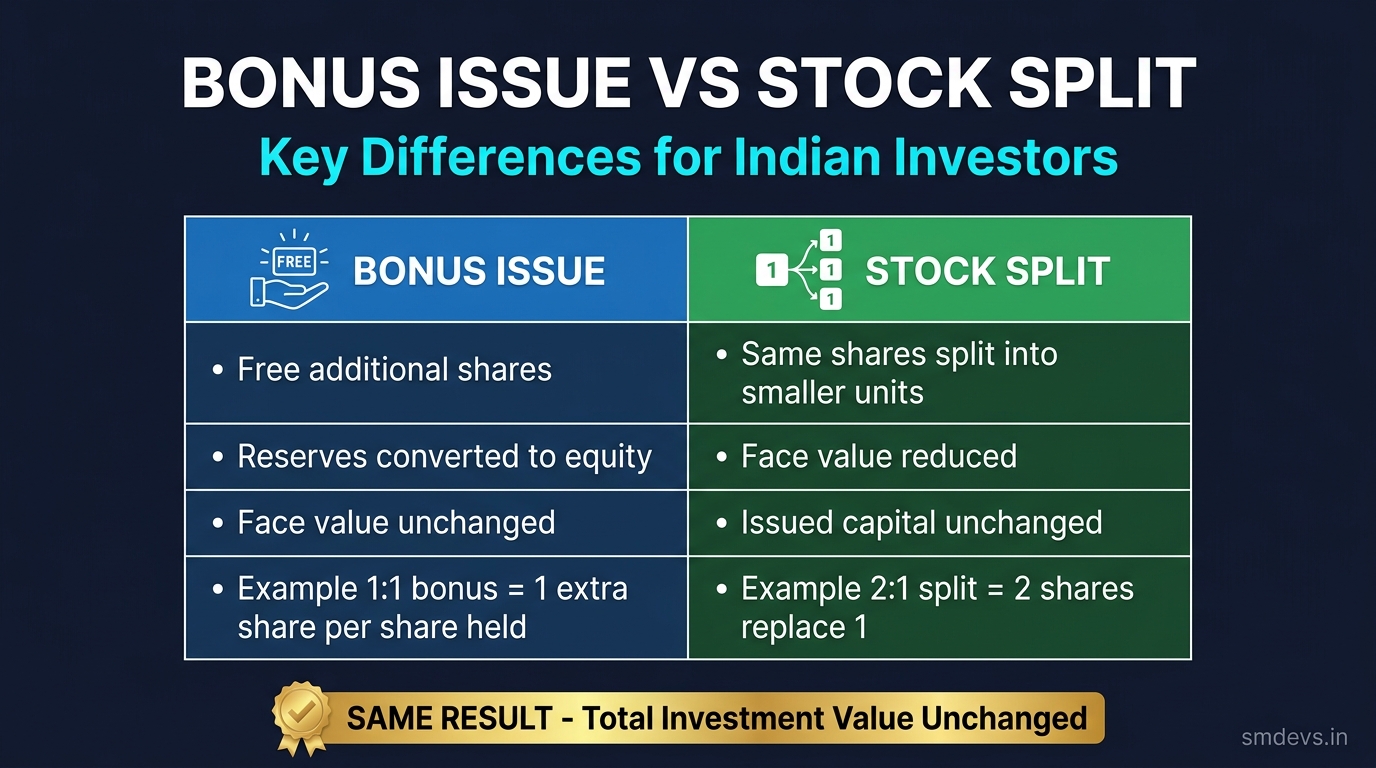
A bonus issue (also called a scrip issue or capitalisation issue) is when a company issues additional free shares to existing shareholders by converting its accumulated reserves and surplus into equity capital. No cash changes hands — the company simply distributes its reserves as shares.
Example: If you hold 100 shares of Company X and it announces a 1:1 bonus issue, you receive 100 additional shares for free. You now hold 200 shares. The share price adjusts downward proportionally (roughly halves), but your total investment value remains the same on the ex-bonus date.
Key accounting impact: Company's reserves decrease and paid-up capital increases by an equal amount. The company's balance sheet total is unchanged.
What is a Stock Split?
A stock split is when a company divides each existing share into multiple smaller-denomination shares. The total number of shares increases, but the face value reduces proportionally. The total paid-up capital and reserves remain completely unchanged.
Example: Company Y splits its shares in a 2:1 ratio. Each share with face value ₹10 becomes 2 shares with face value ₹5 each. If you held 100 shares at ₹1,000 per share, you now hold 200 shares at ₹500 per share. Total value = ₹1,00,000 both before and after.
Read our complete guide: What is a Stock Split? How It Affects Investors
Bonus Issue vs Stock Split: Side-by-Side Comparison
| Feature | Bonus Issue | Stock Split |
|---|---|---|
| What changes | New shares issued from reserves | Existing shares subdivided |
| Face Value | Remains the same (e.g., stays ₹10) | Reduces proportionally (₹10 → ₹5 in 2:1 split) |
| Company Reserves | Decreases (reserves converted to capital) | Unchanged — no accounting transfer |
| Paid-up Capital | Increases (new shares added to capital) | Unchanged — shares just subdivided |
| Share Price | Adjusts down proportionally on ex-date | Adjusts down proportionally on ex-date |
| Market Cap | Unchanged at announcement | Unchanged at announcement |
| Total Shares Outstanding | Increases | Increases |
| Investor's Total Value | Unchanged on ex-date | Unchanged on ex-date |
| Cash involved | No — free shares | No — shares divided |
| Tax on receipt | No tax when received (taxed on sale) | No tax when split happens |
Tax Implications: Bonus Shares vs Split Shares in India
Both bonus shares and split shares are not taxed when received. Tax applies only when you sell them. However, the cost-of-acquisition calculation differs significantly:
Tax on Bonus Shares
The cost of acquisition of bonus shares is considered ₹0 (zero) under Indian income tax law. This means:
- When you sell bonus shares, the entire sale price is capital gain
- Holding period for LTCG: Bonus shares must be held for more than 12 months from the date of allotment to qualify for Long-Term Capital Gains tax (10% above ₹1 lakh) vs STCG (15%)
- Example: 100 bonus shares received for free, sold at ₹200 each → ₹20,000 capital gain (entire amount)
Tax on Split Shares
The cost of acquisition of split shares is calculated proportionally from the original cost:
- If you paid ₹1,000 for 1 share and it splits into 2 shares, each share's cost = ₹500
- Capital gain = Sale price − ₹500 (your proportional cost)
- Holding period: For LTCG purposes, the original purchase date applies — not the split date. So a 3-year-old share that splits is already LTCG-eligible immediately after the split.
Key difference: Bonus shares have zero cost basis (higher tax on sale) while split shares retain the proportional original cost (lower taxable gain).
Real Indian Examples: Bonus Issue and Stock Split
| Company | Action | Ratio | Year | Impact |
|---|---|---|---|---|
| Tata Consultancy Services | Bonus Issue | 1:1 | 2018 | Shares doubled, price halved, face value ₹1 unchanged |
| Infosys | Bonus Issue | 1:1 | 2018 | Shares doubled; Signal of strong free cash flow |
| HDFC Bank | Stock Split | 1:2 | 2019 | Face value ₹2 → ₹1; price halved; liquidity improved |
| Adani Power | Stock Split | 10:1 | 2024 | Face value ₹10 → ₹1; share price made accessible to retail investors |
| MRF | Never split | — | — | Highest-priced stock in India (~₹1.5 lakh/share) — company philosophy against splits |
Note: Adani Power stock split (2024) is a good example — the face value changed from ₹10 to ₹1 (10:1 ratio). What happens during a stock split →
Why Do Companies Issue Bonus Shares?
- Signal of profitability: A bonus issue signals the company has accumulated strong reserves — a positive signal to investors
- Reward shareholders without cash outflow: Rewards long-term holders without depleting cash reserves
- Reduces share price to improve liquidity: Similar to a split — lower per-share price attracts more retail buyers
- Utilise accumulated surplus: Converts idle balance sheet reserves into active equity capital
Why Do Companies Do Stock Splits?
- Improve affordability: A ₹50,000/share stock is out of reach for small retail investors; ₹5,000/share after a 10:1 split is accessible
- Increase daily trading volume: Lower per-share price means more retail participation and higher daily turnover
- Psychological appeal: Investors perceive lower-priced shares as "affordable" even though market cap is unchanged
- Include more investors: Required for index inclusion in some indices where share price is a factor
Which is Better: Bonus Issue or Stock Split?
For the investor, both have the same immediate financial impact — total portfolio value is unchanged at the time of the corporate action. The differences matter more for:
- Tax planning: Split shares have a proportional cost basis (better for taxation on sale). Bonus shares have zero cost (entire sale price is gain).
- Long-term investors: Both are positive signals — companies only split stocks or issue bonuses when confident about the future
- Company fundamentals: A bonus issue reduces reserves, which slightly weakens the balance sheet. A split has no balance sheet impact at all.
For a fundamental investor, a stock split is marginally preferable from a balance sheet perspective. For an income investor, the bonus issue is preferred since cost basis of ₹0 doesn't matter if you plan to hold forever.
FAQs: Bonus Issue vs Stock Split
What is the difference between bonus issue and stock split?
In a bonus issue, the company issues additional free shares by converting its accumulated reserves into paid-up equity capital — face value stays the same, but reserves decrease. In a stock split, existing shares are subdivided into smaller units — face value decreases proportionally, but reserves and paid-up capital stay unchanged. Both increase total shares outstanding and reduce price per share proportionally, leaving total investment value unchanged.
Is stock split taxable in India?
A stock split itself is not taxable in India. No tax is charged when the split happens. Tax applies only when you sell the split shares. The capital gain is calculated as: Sale price − (Original purchase price ÷ Split ratio). For LTCG eligibility, the original purchase date (not the split date) counts.
Are bonus shares taxable in India?
Bonus shares are not taxable when allotted. The cost of acquisition of bonus shares is zero under Indian tax law. When you sell them, the entire sale proceeds count as capital gain. If held for over 12 months, LTCG tax of 10% applies above ₹1 lakh. If held under 12 months, STCG of 15% applies.
What is the ratio 1:1 in bonus issue?
A 1:1 bonus ratio means you receive 1 bonus share for every 1 share you hold. If you had 500 shares, you get 500 additional shares free — total becomes 1,000 shares. The share price adjusts to approximately half on the ex-bonus date, keeping total value the same.