Key Takeaways
- When a company announces a stock split, investors often have many questions: Will my portfolio value change? When will I see more shares in my demat account? Should I buy the stock before the split? W
What Happens When a Stock Splits?
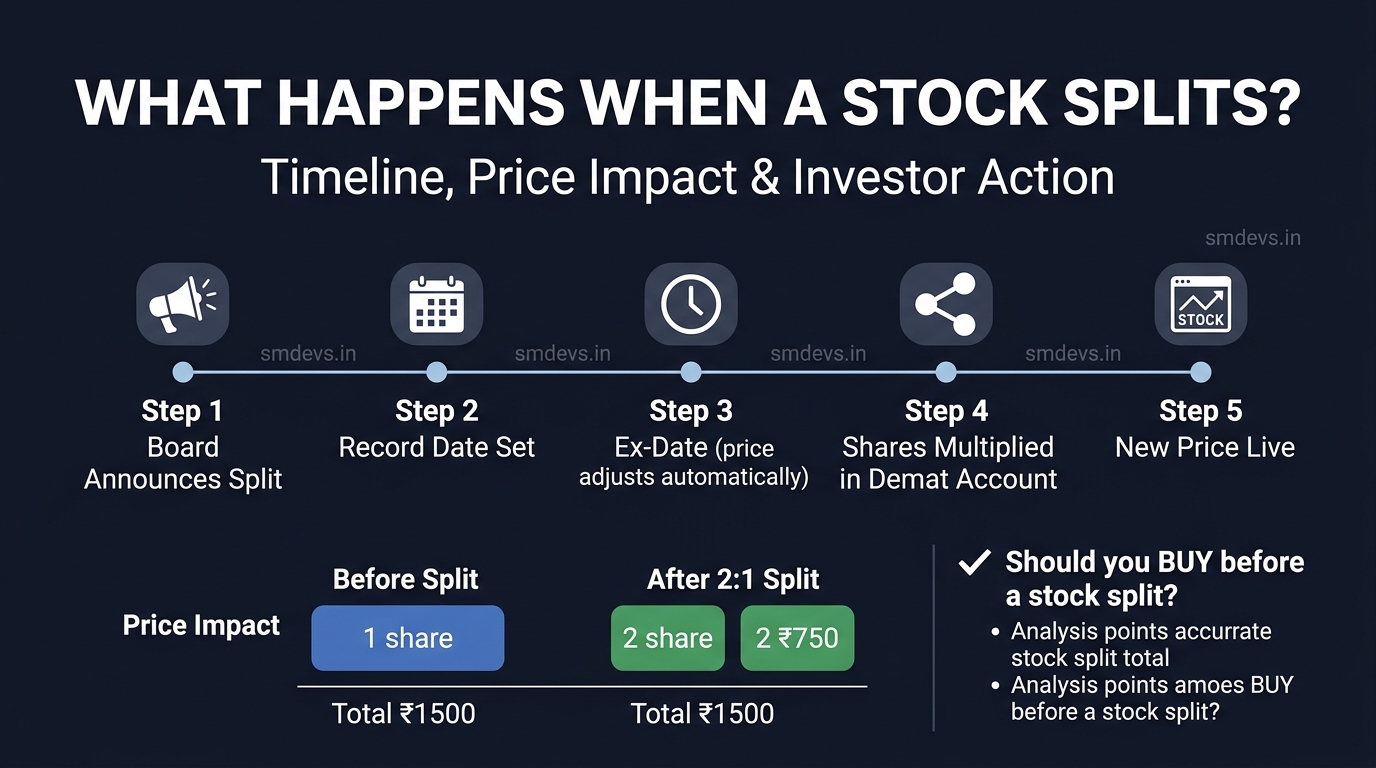
When a stock splits, each existing share is divided into a specified number of smaller shares. The total number of shares increases, the price per share decreases proportionally, and your total investment value remains exactly the same at the moment of the split.
Example of a 2:1 split (also written as 1:2):
| Before Split | After 2:1 Split | |
|---|---|---|
| Shares held | 100 | 200 |
| Price per share | ₹1,500 | ₹750 |
| Total value | ₹1,50,000 | ₹1,50,000 ✅ |
| Face value | ₹10 | ₹5 |
For a deeper understanding of what a stock split is and why companies do it, read our guide: What is a Stock Split?
Step-by-Step Timeline: What Happens From Announcement to Credit
Step 1: Board Meeting Announcement
The company's Board of Directors meets and approves the stock split. This is announced to BSE/NSE via a regulatory filing. The announcement includes the split ratio (e.g., 2:1, 5:1, 10:1) and the proposed Record Date.
Share price often rises on the announcement date — not because the company became more valuable, but because of retail investor excitement and improved liquidity expectations.
Step 2: Shareholder Approval (if required)
For listed companies in India, stock splits require shareholder approval via postal ballot or Extraordinary General Meeting (EGM). The resolution typically passes easily since a split is viewed positively by shareholders. This step takes 2–4 weeks after the board announcement.
Step 3: SEBI / Exchange Approval & Record Date Confirmation
After shareholder approval, the company files with BSE/NSE and SEBI. The exchanges confirm the Record Date — the date on which shareholders must hold the stock to receive the split shares.
Step 4: Ex-Date (1 Trading Day Before Record Date)
The Ex-Date is the most important date for investors:
- If you buy the stock on or after the ex-date, you will NOT receive the split shares
- If you hold the stock before the ex-date (i.e., buy before ex-date and hold through record date), you receive the split shares
- On the ex-date morning, the exchange automatically adjusts the opening price — the stock opens at the post-split price (e.g., if it closed at ₹1,500 and it's a 2:1 split, it opens at ~₹750)
Step 5: Record Date
The company takes a snapshot of all shareholders on this date. Everyone who holds shares in their demat account on the Record Date is eligible for the split shares.
Step 6: New Shares Credited to Demat Account
After the Record Date, the registrar and transfer agent (RTA — typically NSDL or CDSL) credits the additional shares to eligible shareholders' demat accounts. This typically happens within 2–5 trading days after the Record Date.
You'll see your share count change in your broker app (Zerodha Kite, Upstox, Groww, etc.) — but the total portfolio value remains the same.
What Happens to Your Orders and Positions?
Pending Limit Orders
Any pending buy or sell limit orders placed at the old price are automatically cancelled by the exchange on the ex-date. You must re-place orders at the new adjusted price after the split. Always check for cancelled orders on ex-date morning.
F&O Positions (Futures & Options)
If you hold Futures or Options contracts on a splitting stock:
- The exchange adjusts lot size and strike prices proportionally
- A stock with lot size 500 in a 2:1 split becomes lot size 1,000 at half the strike price
- Open positions are carried over at adjusted levels — no action required
- Check NSE's official corporate action adjustment circulars for exact adjusted values
SIP and Mutual Fund Holdings
If the splitting stock is held inside a mutual fund scheme, the NAV (Net Asset Value) of the fund is NOT affected — mutual funds hold many stocks, and the split's price adjustment is automatic. Your fund's NAV and unit count remain unchanged.
Why Do Companies Split Stocks?
Companies split stocks for several strategic reasons:
1. Make Shares More Affordable
Stocks priced at ₹10,000+ per share are out of reach for small retail investors. A 10:1 split brings the price to ₹1,000 — suddenly accessible to crores of Indian retail investors who couldn't buy before. More buyers = more liquidity = healthier trading volumes.
2. Increase Daily Trading Volume and Liquidity
Lower-priced stocks attract more retail participation. Higher trading volume reduces bid-ask spreads, making the stock easier and cheaper to trade for everyone — institutional and retail investors alike.
3. Signal Confidence About the Future
Companies don't split stocks when they're struggling. A split is an implicit signal from management that they expect continued strong performance — the price fell so high that it needs splitting. Historically, stocks that announce splits outperform the broader market in the 1-year period post-split.
4. Psychological Pricing Appeal
Investor psychology treats a ₹500 stock as "cheaper" than a ₹5,000 stock — even though shares in a company represent ownership, not absolute price. Lower nominal prices attract more retail participation.
Recent Stock Splits in India (2023–2026)
| Company | Split Ratio | Year | Face Value Change |
|---|---|---|---|
| Adani Power | 10:1 | 2024 | ₹10 → ₹1 |
| Mazagon Dock Shipbuilders | 2:1 | 2024 | ₹10 → ₹5 |
| Tata Motors | 5:1 | 2024 | ₹2 → ₹1 |
| Vedanta | 1:1 bonus | 2023 | — |
| Bajaj Auto | 5:1 | 2023 | ₹10 → ₹2 |
Always verify current data on NSE India or BSE India corporate actions section.
Also read: Bonus Issue vs Stock Split: Key Differences
Should You Buy a Stock Before or After a Stock Split?
This is the most common investor question. The honest answer:
Before the Split — What Research Shows
- Stocks often rise 2–3% in the days after a split announcement (excitement + increased awareness)
- Studies (including Fama et al.) show split stocks outperform the market by ~8% in the 12 months following the split — NOT because of the split itself, but because companies that split stocks tend to be growing companies
- However, by the time the split is publicly announced, much of the news is already priced in
The Right Way to Think About It
- Do NOT buy a stock just because it's splitting — the split itself creates no value
- DO consider buying if the stock is fundamentally strong and the split simply makes it more accessible
- A split is a signal — investigate why the stock price got high enough to warrant a split. That growth story matters far more than the split itself
- After the split, the stock is more affordable — but the valuation (P/E ratio) is unchanged. You're not getting a discount.
FAQs: What Happens When a Stock Splits
Does the stock price fall after a split?
Yes — but proportionally. In a 2:1 split, the price halves on the ex-date. This is an automatic exchange adjustment, not a market-driven fall. Your total holdings value is unchanged. The stock then trades freely at the new price, and may go up or down from there based on fundamentals and market sentiment.
What happens to my demat account when a stock splits?
Your share count increases proportionally (e.g., 100 shares → 200 in a 2:1 split) within 2–5 trading days after the Record Date. The value per share is adjusted automatically. Your total portfolio value in rupees remains the same. Your broker app may show a temporary discrepancy during the credit processing window.
Why do companies split stocks?
Companies split stocks to: (1) make shares more affordable for retail investors when the price has risen to high levels, (2) increase daily trading volume and liquidity, (3) signal management confidence about future growth, and (4) attract a broader investor base. A split itself creates no fundamental value — it's purely cosmetic from a financial standpoint.
What is the difference between a 2:1 split and a 1:2 split?
In Indian market terminology, a "2:1 split" means each existing share splits into 2 new shares (sometimes written as 1:2 where the new face value replaces the old). A 2:1 split doubles your shares and halves the price. Always check the face value in the company's official announcement to confirm the exact ratio — e.g., "face value changes from ₹10 to ₹5" confirms a 2:1 (doubling) split.