Key Takeaways
- Always match content format to search intent — informational queries need guides, not landing pages
- Analyze the top 5 results before writing to understand depth, format, and gaps
- Answer the query directly in the first 2 sentences of each section — extractable for AI Overviews
- FAQ schema markup is the highest-ROI structured data optimization for content
- Publish on a sustainable cadence — one excellent article per week beats three thin ones
Writing content that ranks on Google in 2026 is fundamentally different from content creation 5 years ago. With AI-generated content flooding every topic at scale, Google's systems have become dramatically better at identifying content that demonstrates genuine expertise, first-hand experience, and comprehensive treatment of a topic — and separating it from content that merely assembles facts without adding real value.
This guide gives you the complete, current framework for writing SEO content that consistently ranks, gets cited by AI platforms, and genuinely serves readers.
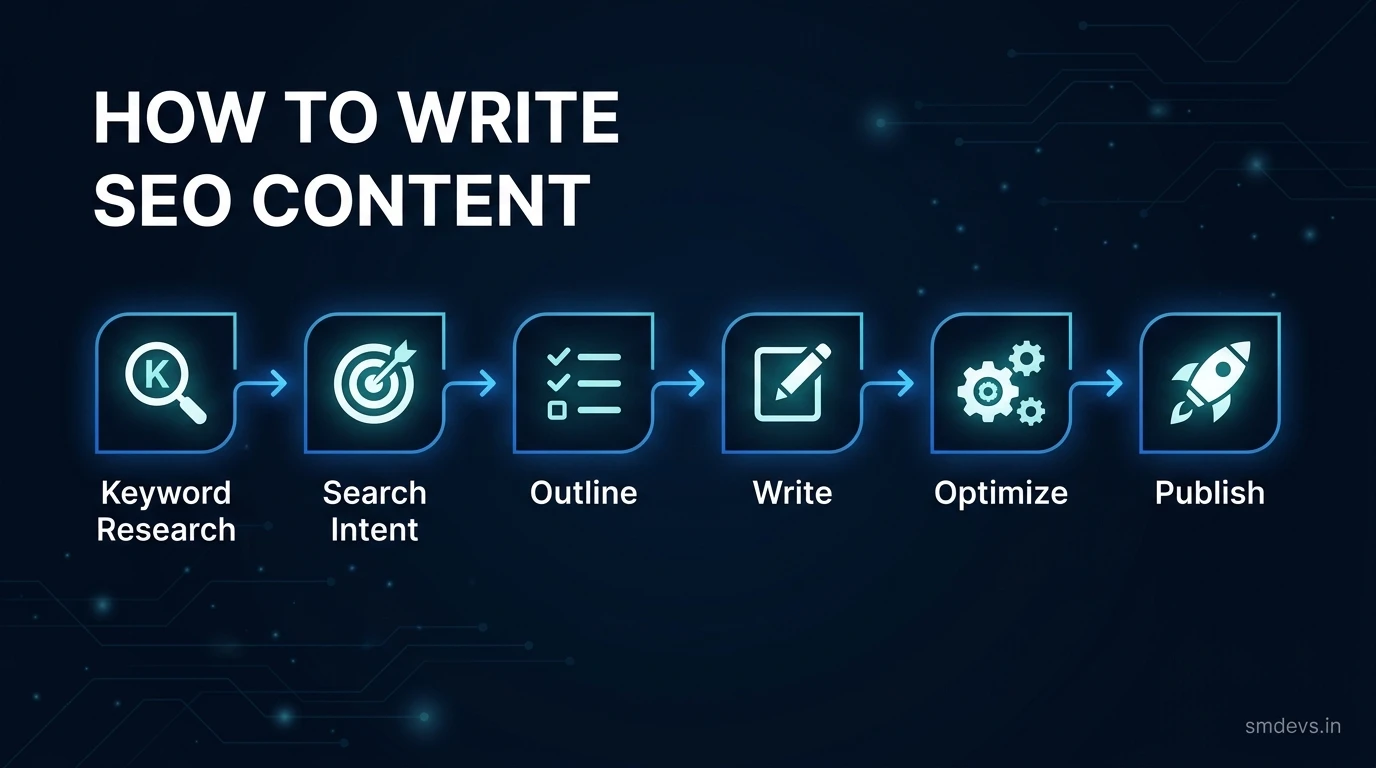
Step 1 — Keyword Research and Search Intent Alignment
Before writing a single word, you need to answer two questions precisely: what query are you targeting, and what does the person searching that query actually want?
Finding your target keyword:
- Use Google's autocomplete and "People Also Ask" boxes to understand the full landscape of related queries around your topic.
- Check GSC's Performance report for queries already driving impressions to your existing content — these signal real demand from your current audience.
- Use our Keyword Intent Analyzer to quickly assess intent classification for any query.
Understanding search intent — the four types:
- Informational: The user wants to learn something — "what is RSI indicator", "how does MACD work". Content format: comprehensive guide, how-to article, explainer. This is where most blog content lives.
- Commercial: The user is evaluating options — "best SEO tools 2026", "RSI vs MACD which is better". Content format: comparison, review, list of options with pros/cons.
- Transactional: The user wants to buy or sign up — "buy Nifty call option", "sign up for SEO tool". Content format: landing page, product page, pricing page.
- Navigational: The user wants to find a specific site — "Google Search Console login". Do not try to rank for navigational queries with blog content.
Mismatching content format to intent is one of the most common reasons pages with good content fail to rank. A detailed product review will not rank for an informational query, and a broad educational article will not rank for a transactional query — regardless of how well-written it is.
Step 2 — Analyse the Current Top Results
Before outlining your article, spend 20 minutes studying the pages currently ranking in positions 1–5 for your target query. Your goal is to understand:
- Average content depth: How long are the ranking articles? What topics do they all cover? Use this as your minimum content floor.
- Content format: Are the results listicles, how-to guides, comparison tables, or deep tutorials? Google's ranking of these formats reveals the dominant preferred format for this intent.
- Gaps and differentiators: What does every existing result miss? What question does the user likely still have after reading the current top results? Your answer to that question is your content's competitive angle.
- SERP features: Are there featured snippets, People Also Ask boxes, or video carousels? Each SERP feature tells you what content format Google wants for that query and gives you a specific optimization target.
Step 3 — Create a Comprehensive Outline
A strong outline is the difference between content that comprehensively covers a topic and content that meanders. Your outline should map to the full scope of the reader's needs for this topic:
- Primary H2 sections: The main topics your article covers. Each should address a distinct subtopic or question related to the main keyword.
- H3 subsections: Breaking down complex H2 sections into digestible components.
- Supporting elements: Identify which sections need tables (comparison data), lists (steps, features), or visuals (process diagrams, infographics).
- FAQ section: Map the "People Also Ask" questions for your target query to a FAQ section at the bottom. These questions are Google's clearest signal of what users want to know — and FAQ schema markup makes them eligible for featured snippets.
Key Takeaways
- Match content format exactly to search intent. An information-intent query needs an educational guide, not a product page.
- Comprehensive beats long. Cover every relevant subtopic with genuine depth — not word count padding. 1,500 words that fully answers the question beats 3,000 words of filler.
- The first 100 words must state your primary keyword and establish relevance. Google weighs early content heavily for relevance assessment.
- Structured data (FAQ schema) is a multiplier — it makes your content eligible for featured snippets and Google AI Overviews citations.
- Internal links are compulsory. Link to 3–5 relevant pages on your site in every article to distribute authority and improve crawlability.
Step 4 — Writing the Content
Title and H1
Your title tag and H1 are the most important ranking signals on the page. Rules:
- Include the primary keyword near the start — "How to Write SEO Content That Ranks" not "A Complete Guide to Writing Content for SEO"
- Title tag: 50–60 characters (truncated in SERPs beyond 60)
- H1 can be slightly longer than the title tag but should contain the same primary keyword
- Use a power word that signals the content's value: "Complete," "Step-by-Step," "2026 Guide," "Proven," "Beginner's"
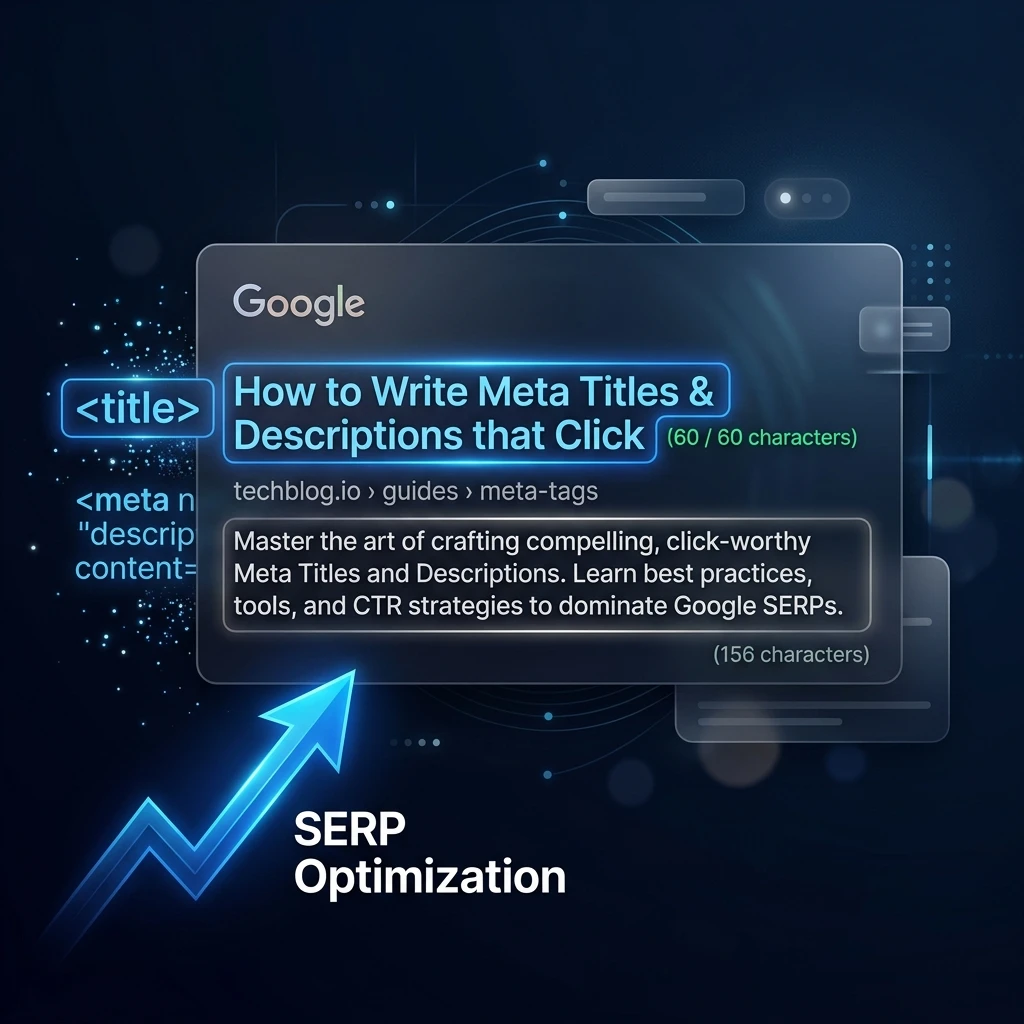
Meta Description
Not a ranking factor, but critical for CTR. Best practices:
- 140–160 characters
- Include the primary keyword naturally (Google bolds matching terms in the SERP snippet)
- Include a soft call to action: "Learn how," "Discover," "Find out"
- Mention a specific benefit or outcome the reader gets from reading
The Opening (First 100–150 Words)
This section is critical. It determines whether the user stays or bounces, and Google pays close attention to how quickly your content establishes relevance to the query.
- State the primary keyword in the first 1–2 sentences naturally
- Immediately establish why this topic matters to the reader — the specific problem it solves or the specific gain it delivers
- Briefly preview what the article covers
- Avoid lengthy preambles — get to the point within 3–4 sentences
Body Content Structure
- Use H2 and H3 headings for every major section. This is critical for readability, featured snippet eligibility, and Google's ability to understand your content structure.
- Answer the query directly and early. If someone asks "what is X," answer it in the first H2 before providing supporting context. This improves featured snippet eligibility.
- Use specific examples, not vague generalities. "Increasing traffic by 40% in 3 months" is infinitely more credible and useful than "significantly improving your traffic."
- Include data tables for comparison information. Tables are machine-readable and frequently featured in search snippets for "vs" and "comparison" queries.
- Use numbered lists for step-by-step processes. Numbered lists signal a structured how-to format to Google and are frequently featured in "how to" snippets.
E-E-A-T Signals in Your Writing
Every article should demonstrate at least some first-hand experience:
- Reference specific tools you have actually used ("When we ran this test on three client sites...")
- Include specific data or results from your actual work or research
- Cite authoritative primary sources for factual claims (link to Google documentation, academic research, official reports)
- Add an author byline with credentials relevant to the topic
Full details on implementing all four E-E-A-T pillars: E-E-A-T Checklist 2026.
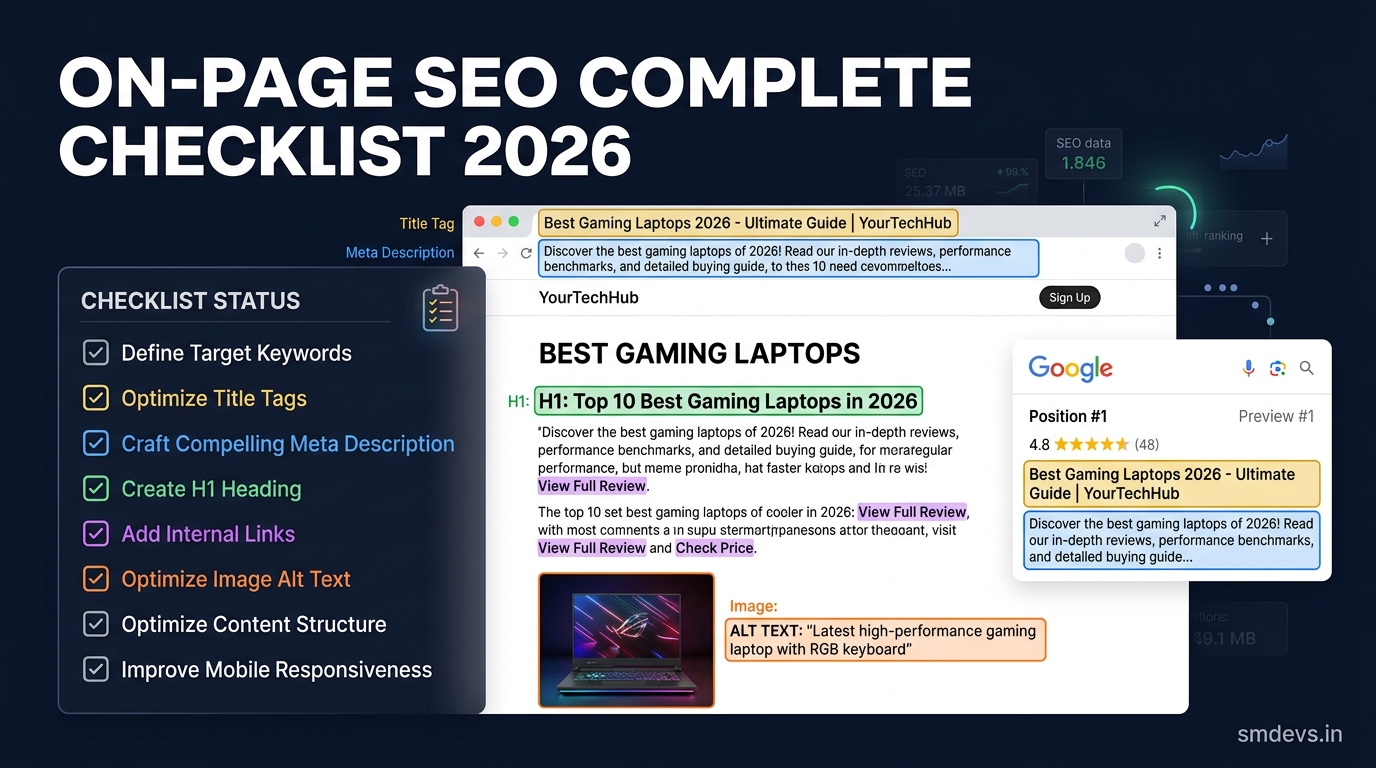
Step 5 — On-Page Optimization Checklist
| Element | Requirement | Priority |
|---|---|---|
| Title Tag | Primary keyword in first 60 chars | Critical |
| Meta Description | Primary keyword, 140–160 chars, CTA | High |
| H1 | One per page, contains primary keyword | Critical |
| First 100 words | Primary keyword appears naturally | High |
| H2 headings | Keyword variants in 2–3 H2s naturally | Medium |
| Image alt text | Descriptive, includes keyword where natural | Medium |
| Internal links | 3–5 links to relevant pages on your site | High |
| External links | 1–3 links to authoritative sources | Medium |
| URL slug | Short, keyword-containing, hyphenated | High |
| Schema markup | Article + FAQ schema at minimum | High |
| Content length | Comprehensive — match or exceed top competitors | High |
| Reading level | Clear, jargon-explained, accessible | Medium |
Step 6 — Publish, Monitor, Iterate
Publishing is not the end — it is the beginning. Monitor your content's performance in GSC after 4–8 weeks:
- Which queries is the page ranking for? Are there unexpected queries that suggest a topic expansion opportunity?
- What is the average position? If it's stuck at 15–25, identify the specific sections that competitors outperform you on and strengthen them.
- What is the CTR? If impressions are high but CTR is low (under 2%), rewrite the title and meta description.
- Update the content every 6–12 months to keep statistics, examples, and recommendations current.
Frequently Asked Questions
How long should SEO content be?
Content should be as long as necessary to comprehensively answer the query — no longer. The right length is determined by your competitor analysis: check the average word count of the top 5 results for your target query and aim to match or modestly exceed it. For most competitive informational queries, this falls between 1,500–4,000 words. Padding articles with irrelevant filler content to reach an arbitrary word count actively hurts quality signals. Comprehensive at 1,800 words beats padded at 3,000 words every time.
Should I use AI to write SEO content?
AI tools can be valuable for content creation — for research assistance, structuring outlines, drafting sections, or overcoming writer's block. However, published AI-generated content without human expertise, real examples, and genuine E-E-A-T signals is exactly what Google's Helpful Content system is designed to identify and suppress. The rule: use AI as a writing assistant, not as a ghostwriter. Every published piece must demonstrate real expertise, specific examples, and genuine value that a human expert contributed — not just assembled from existing web content.
How many keywords should I target per article?
One primary keyword per article, with 3–8 semantically related secondary keywords naturally incorporated throughout the content. Targeting multiple primary keywords in one article almost always results in the article ranking for none of them well — you are diluting your relevance signal across multiple topics. Write a dedicated article for each primary keyword. Secondary keywords are related terms and questions that naturally appear when you comprehensively cover the primary topic.
How often should I publish new content?
Consistency matters more than frequency. Publish on a cadence you can sustain with genuine quality — one thoroughly researched, expert-level article per week consistently outperforms publishing three thin articles per week. Google's crawl frequency adjusts to match your publishing patterns — a site that publishes high-quality content every 3–4 days will be crawled more frequently than one publishing daily content of declining quality.
Your Next Step
Use our On-Page SEO Checker to audit any page you've already published for optimization gaps. For the keyword research foundation, see the Keyword Research Process infographic. And build the content architecture that compounds authority over time with the Topic Cluster Strategy guide.