Key Takeaways
- Demat account holds your securities; trading account is used to buy and sell — you need both
- Discount brokers (Zerodha, Upstox, Angel One) offer zero brokerage on equity delivery vs. 0.5% at full-service brokers
- Account opening is completely online in 15–30 minutes with Aadhaar e-KYC
- Required documents: PAN card, Aadhaar, bank account details, photograph, signature
- Your shares are safe even if your broker shuts down — they're held in CDSL/NSDL in your name
A demat account — short for dematerialized account — is the digital equivalent of a physical locker where you store your share certificates. In India, all stock market investments are held in electronic (dematerialized) form in a demat account, maintained by a Depository Participant (DP) registered with either CDSL (Central Depository Services Limited) or NSDL (National Securities Depository Limited), the two depositories authorized by SEBI.
Without a demat account, you cannot buy shares, apply for IPOs, hold mutual fund units in demat form, or invest in government securities through the stock exchange. Opening a demat account is the first essential step for anyone beginning their stock market investment journey in India.
Demat Account vs. Trading Account — Key Difference
These two terms are often confused but serve different purposes:
- Demat Account: Holds your securities in electronic form — shares, bonds, ETFs, government bonds. Think of it as a bank account for your investments. It does not allow you to buy or sell; it only stores what you own.
- Trading Account: Used to place buy and sell orders on the stock exchange (NSE, BSE). It is the interface through which you transact. Every buy order debited to your trading account results in shares being credited to your linked demat account.
Most brokers offer both accounts together as a 2-in-1 account. For full stock market access (including F&O trading), some also include a linked bank account for a 3-in-1 account setup.
Key Takeaways
- You need both a demat AND trading account to invest in stocks. The demat account holds; the trading account transacts.
- There are two types of brokers: full-service brokers (higher fees, advisory services) and discount brokers (flat ₹20 per order, no advisory). For self-directed investors, discount brokers are almost always better value.
- Zerodha, Upstox, and Angel One are India's largest discount brokers by active client count (2026). All are SEBI-registered and use CDSL or NSDL as the depository.
- Opening a demat account is completely free with most discount brokers — annual maintenance charges (AMC) typically start at ₹0–300 per year for basic accounts.
- The entire process is online and takes 15–30 minutes — no physical document submission or branch visits required.
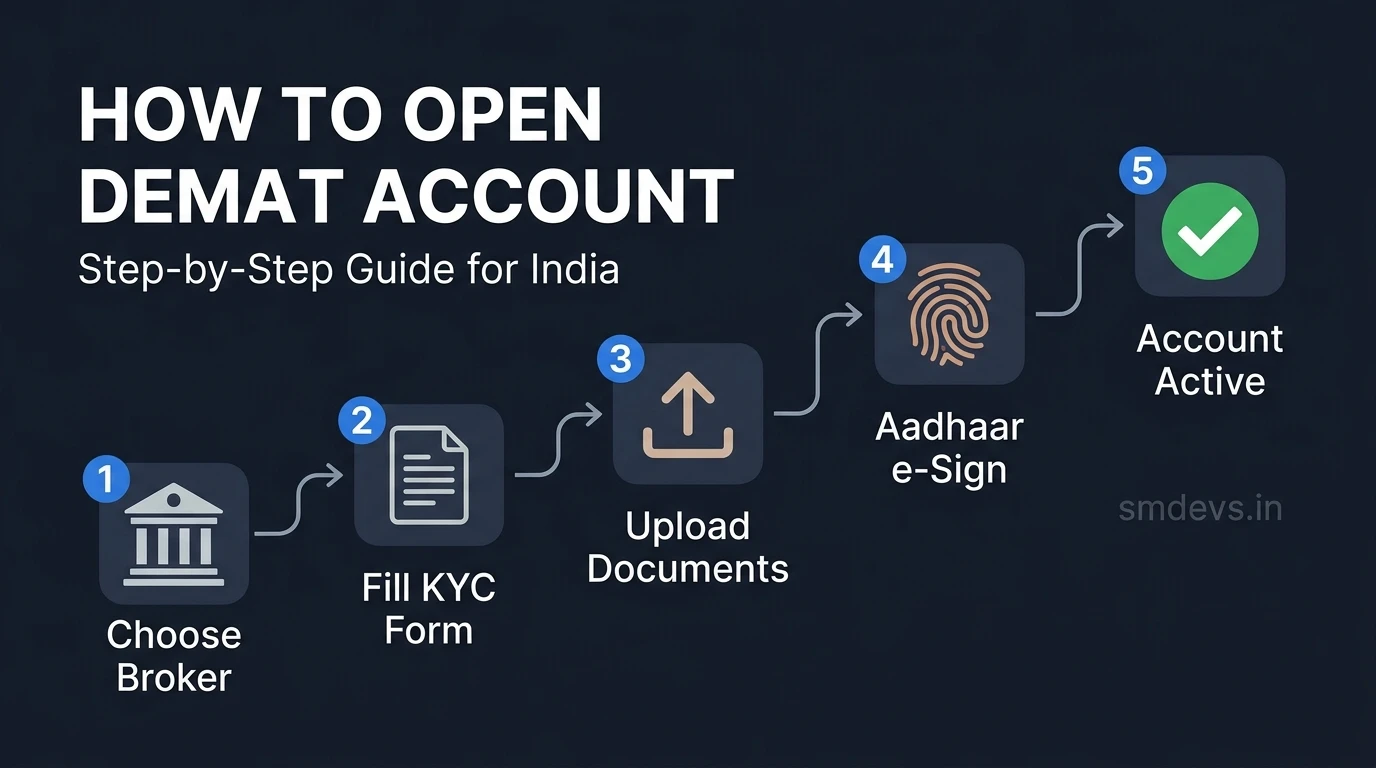
Step-by-Step: How to Open a Demat Account in India
Step 1 — Choose Your Broker
Select a SEBI-registered broker. Key factors to compare:
| Factor | Discount Brokers | Full-Service Brokers |
|---|---|---|
| Brokerage (equity delivery) | ₹0 (Zerodha, Upstox, Angel One) | 0.2–0.5% of trade value |
| Brokerage (intraday) | Flat ₹20 per order or 0.03% | 0.05–0.1% of trade value |
| AMC (Annual Maintenance) | ₹0–300/year | ₹300–700/year |
| Research & Advisory | None (self-directed) | Yes (calls, reports, recommendations) |
| Platform quality | Generally better (tech-first companies) | Variable |
| Best for | Self-directed, cost-conscious investors/traders | New investors wanting guidance |
Step 2 — Visit the Broker's Website or App
Most Indian discount brokers (Zerodha, Upstox, Angel One, Groww) have a completely digital account opening process. Visit their website or download their app. Look for "Open Account" or "Open Demat Account."
Step 3 — Enter Your Mobile Number and Email
You'll receive an OTP on your registered mobile (linked to your Aadhaar) to verify your identity at the first step. Use a mobile number that is linked to your Aadhaar — this is required for the e-KYC process.
Step 4 — Complete KYC (Know Your Customer)
KYC verification requires the following documents — all uploaded digitally:
- PAN Card: Mandatory for all investments in India. Your PAN number links your investment account to your tax records.
- Aadhaar Card: Used for address and identity verification through UIDAI's e-KYC process. Your Aadhaar-linked mobile number must be active.
- Bank Account Details: Cancelled cheque or bank statement showing your account number and IFSC code. Your bank account is linked for fund transfers to/from your trading account.
- Photograph: A recent clear photograph — usually a selfie captured in-app.
- Signature: Digital signature captured on screen or on white paper photographed clearly.
- Income Proof (for F&O trading only): If you want to trade futures and options, SEBI requires income/net worth proof: recent salary slip, ITR (Income Tax Return), bank statement (last 6 months), or CA-certified net worth statement.
Step 5 — Aadhaar e-Sign Verification
After submitting documents, you'll be asked to verify your identity through Aadhaar e-Sign — a UIDAI-authorized digital signature process. You'll receive an OTP on your Aadhaar-linked mobile number. Enter the OTP to complete the e-sign. This step legally authenticates your account opening application without requiring a physical signature on paper.
Step 6 — In-Person Verification (IPV)
SEBI mandates In-Person Verification for account opening. Most brokers satisfy this through a brief video IPV (In-Person Verification) — you'll be asked to show your original PAN card to your phone camera and speak a few words. This 2–3 minute video call is usually scheduled or completed instantly through the app.
Step 7 — Account Activation
After completing all steps, your account application goes for review. For most users, the demat and trading account are activated within:
- Same day (if application completed before 2 PM on a working day)
- Next working day (if completed after 2 PM or on weekends)
You'll receive your Client ID (demat account number), login credentials, and fund transfer instructions via email and SMS.
Charges and Fees to Understand
| Charge | Amount | Who Pays |
|---|---|---|
| Account Opening Fee | ₹0 (most discount brokers) | One-time |
| Annual Maintenance Charge (AMC) | ₹0–300/year | Annual |
| Brokerage — Equity Delivery | ₹0 (discount brokers) | Per trade |
| Brokerage — Intraday/F&O | ₹20 flat or 0.03% | Per trade |
| STT (Securities Transaction Tax) | 0.1% buy+sell (delivery); 0.025% sell (intraday) | Per trade (mandatory) |
| Exchange Transaction Charges | ~0.00345% (NSE equity) | Per trade |
| DP Charges (on selling shares) | ₹13.5 + GST per scrip per day (CDSL/NSDL) | On each sell transaction |
| GST on Brokerage | 18% of brokerage amount | Per trade |
Frequently Asked Questions
Can I have more than one demat account?
Yes — SEBI allows you to have multiple demat accounts with different brokers. There is no legal restriction. Many investors maintain 2–3 demat accounts: one for long-term investment holdings, one for active trading, and one for IPO applications. However, each account has its own AMC charges, and holding too many accounts you don't actively use is unnecessary. Most investors do well with a single demat account from a reputable discount broker.
What happens to my shares if my broker shuts down?
Your shares are safe even if your broker shuts down. This is the key advantage of the demat system — your shares are held directly in the depository (CDSL or NSDL) under your unique Beneficiary Owner (BO) ID, not with the broker. If a broker shuts down, closes, or is declared insolvent, SEBI and the depository facilitate the transfer of your holdings to a new broker of your choice. Your investments are not the broker's assets — they are yours, held in your name in the depository.
Is it safe to open a demat account online?
Yes, provided you open an account with a SEBI-registered broker (verify SEBI registration on the SEBI website). The major discount brokers (Zerodha, Upstox, Angel One, Groww) are all SEBI-registered, CDSL/NSDL-registered, and have robust security infrastructure. The Aadhaar e-KYC process used by all major brokers is authorized by UIDAI and is the same process used by banks for digital account opening. Never share your login credentials, OTPs, or TPIN with anyone — including people claiming to be from your broker.
Can NRIs open a demat account in India?
Yes — Non-Resident Indians (NRIs) can open a demat account in India, but through a different process than residents. NRIs need an NRE (Non-Resident External) or NRO (Non-Resident Ordinary) bank account, and must open a Portfolio Investment Scheme (PIS) account with a bank authorized by RBI. NRI demat accounts have specific investment restrictions under FEMA regulations. Not all brokers support NRI accounts — check with your chosen broker about their NRI account capabilities before proceeding.
What is the minimum amount needed to start investing after opening a demat account?
There is no regulatory minimum investment amount in Indian equity markets. Once your demat account is active, you can start investing with as little as the price of one share of your chosen company — which could be as low as ₹5–10 for some small-cap stocks. For quality large-cap stocks, one share might cost ₹500–5,000. Most brokers allow you to start SIP in mutual funds with as little as ₹100 per month. The practical recommendation: start with at least ₹5,000–10,000 so transaction costs don't eat into your returns disproportionately.
Your Next Step
Once your demat account is open, start your investment education with the Fundamental Analysis guide before selecting your first stocks. Use the SIP Calculator to plan your regular investment amounts. And always apply the Trading Risk Management rules — even for long-term investors, position sizing and risk awareness matter from day one.