Key Takeaways
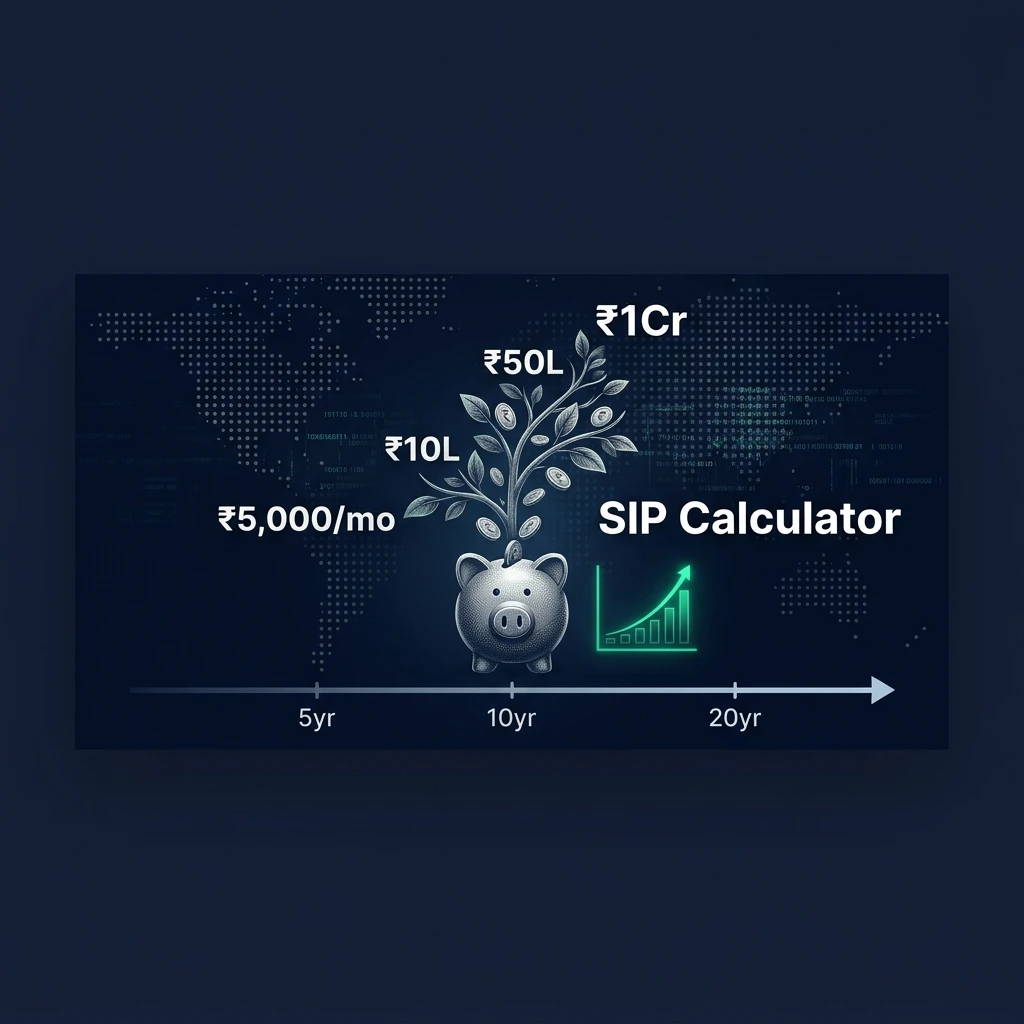
- A SIP (Systematic Investment Plan) is a method of investing a fixed amount in mutual funds at regular intervals — typically monthly — instead of a lump sum.
- The SIP formula uses compound interest: Future Value = P × [((1+r)^n − 1)/r] × (1+r), where P = monthly investment, r = monthly return rate, n = months.
- A Step-Up SIP increases your monthly contribution by a fixed % each year, compounding the compounding effect significantly.
- Historical Indian equity mutual funds have returned 10–14% CAGR over long periods. Use 10–12% for conservative projections.
- Use our free SIP Calculator to instantly compute your expected corpus, total investment, and wealth gained — with step-up simulation.
What Is a SIP (Systematic Investment Plan)?
A Systematic Investment Plan (SIP) is a method of investing in mutual funds where you commit a fixed amount at regular intervals — typically monthly — rather than investing a large lump sum at once. SIP is the most popular way Indians invest in equity mutual funds, and for good reason: it imposes financial discipline, averages out market volatility through rupee cost averaging, and harnesses the power of compounding to build substantial wealth over time.
With a SIP, your fixed monthly amount buys more mutual fund units when markets are low and fewer units when markets are high — automatically averaging your cost per unit over time. This makes SIP far less dependent on timing the market correctly, which even professional investors struggle to do consistently.
The SIP Return Formula
SIP returns are calculated using a modified compound interest formula that accounts for equal periodic investments:
Future Value = P × [((1 + r)^n − 1) / r] × (1 + r)

Where:
P = Monthly SIP amount (in ₹)
r = Monthly return rate = Annual rate ÷ 12
n = Total number of months (Years × 12)
Worked Example — ₹5,000/month for 10 years at 12% annual return
P = ₹5,000
r = 12% ÷ 12 = 1% = 0.01
n = 10 × 12 = 120 months

FV = 5,000 × [((1.01)^120 − 1) / 0.01] × 1.01
FV = 5,000 × [(3.3004 − 1) / 0.01] × 1.01
FV = 5,000 × [230.04] × 1.01
FV = ₹11,61,695 ≈ ₹11.62 Lakhs

Total invested = ₹5,000 × 120 = ₹6,00,000
Wealth gained  = ₹11,62,000 − ₹6,00,000 = ₹5,62,000
Your ₹6 lakh investment becomes ₹11.62 lakh — nearly double — purely through compounding. Try different amounts and time horizons using our free SIP Calculator to instantly compute your projected corpus.
SIP Returns at Different Amounts and Time Horizons (12% Annual)
| Monthly SIP | 5 Years | 10 Years | 15 Years | 20 Years |
|---|---|---|---|---|
| ₹2,000 | ₹1.64 L | ₹4.64 L | ₹10.07 L | ₹19.98 L |
| ₹5,000 | ₹4.08 L | ₹11.62 L | ₹25.23 L | ₹49.96 L |
| ₹10,000 | ₹8.17 L | ₹23.23 L | ₹50.46 L | ₹99.91 L |
| ₹25,000 | ₹20.42 L | ₹58.08 L | ₹1.26 Cr | ₹2.50 Cr |
| ₹50,000 | ₹40.83 L | ₹1.16 Cr | ₹2.52 Cr | ₹4.99 Cr |
Notice how dramatically the corpus grows between 10 and 20 years — this is compounding accelerating in the later years. The final years of a long SIP contribute far more wealth than the early years, which is why starting early is so valuable.
What Is a Step-Up SIP? (And Why It's Powerful)
A Step-Up SIP (also called a Top-Up SIP) is a variation where you increase your monthly SIP amount by a fixed percentage every year — typically 10–15% — matching it to your annual income growth. Instead of investing the same ₹5,000 every month for 20 years, you start at ₹5,000 and increase by 10% each year.
Step-Up SIP vs Regular SIP Comparison
| Scenario | Starting SIP | Step-Up | 20-Year Corpus | Total Invested |
|---|---|---|---|---|
| Regular SIP | ₹5,000/mo | None | ₹49.96 L | ₹12.00 L |
| Step-Up SIP | ₹5,000/mo | +10%/year | ₹1.01 Cr | ₹34.36 L |
| Step-Up SIP | ₹5,000/mo | +15%/year | ₹1.63 Cr | ₹63.71 L |
The difference is staggering. A 10% annual step-up more than doubles the final corpus compared to a flat SIP — going from ₹49.96 lakh to over ₹1 crore — while the total amount invested only increases from ₹12 lakh to ₹34 lakh. The extra corpus is entirely from the compounding of the increased contributions over time.
Use our Step-Up SIP Calculator to simulate exactly how much corpus you will build with any starting amount and annual step-up percentage.
Realistic SIP Return Rates for Indian Mutual Funds
| Fund Category | Historical 10-Year CAGR | Conservative Estimate | Best for |
|---|---|---|---|
| Large-cap equity funds | 12–15% | 10–12% | Core long-term SIP, moderate risk |
| Flexi-cap / Multi-cap funds | 13–17% | 11–13% | Diversified growth with flexibility |
| Mid-cap equity funds | 15–20% | 12–15% | Higher growth, higher volatility |
| Small-cap equity funds | 18–25% | 12–15% | Aggressive growth, long horizon (10+ yr) |
| Debt / Liquid funds | 5–8% | 5–7% | Capital preservation, short horizon |
| Hybrid / Balanced funds | 10–13% | 9–11% | Balanced risk-return for moderate investors |
Important disclaimer: Past returns do not guarantee future performance. For planning purposes, use 10–12% for equity SIPs and 6–7% for debt SIPs. Always consult a SEBI-registered investment advisor before making investment decisions.
How to Use the SIP Calculator
- Go to our free SIP Calculator
- Enter your monthly SIP amount (e.g., ₹10,000)
- Enter the expected annual return rate (e.g., 12%)
- Enter the investment duration in years (e.g., 15 years)
- For Step-Up SIP, enter your annual step-up percentage (e.g., 10%)
- The calculator instantly shows: Total invested, Expected corpus, Wealth gained, and a year-by-year growth chart
SIP vs Lump Sum: Which Is Better?
| Factor | SIP | Lump Sum |
|---|---|---|
| Market timing risk | Low — averages across market cycles | High — full exposure at entry point |
| Ideal for | Salaried investors, regular income earners | Investors with large surplus during market dips |
| Return in bull markets | Slightly lower (buying at higher prices too) | Higher (full corpus benefits from the rise) |
| Return in volatile markets | Higher (rupee cost averaging works best) | Lower (catch falling prices but miss rebounds) |
| Discipline | Enforced automatically | Requires willpower to invest at the right time |
For most investors with a regular income, SIP is the better choice because it removes the stress and risk of trying to time the market. Lump sum investment is most effective when made during significant market corrections — but consistently identifying those moments requires experience and emotional discipline most investors do not have.
What is a SIP calculator?
A SIP calculator is a tool that computes the expected future value of a Systematic Investment Plan based on three inputs: monthly investment amount, expected annual return rate, and investment duration in years. It uses the compound interest formula for periodic investments to project how your monthly contributions will grow into a larger corpus over time. Our free SIP Calculator also includes a Step-Up SIP option to simulate annual increases in your monthly contribution.
How is SIP return calculated?
SIP returns are calculated using the formula: FV = P × [((1 + r)^n − 1) / r] × (1 + r), where P is the monthly SIP amount, r is the monthly return rate (annual rate divided by 12), and n is the total number of months. This formula applies compound interest to each monthly installment — the first installment compounds for the full duration, while the last installment earns interest for only one month. The total future value is the sum of all these compounded amounts.
What is a Step-Up SIP?
A Step-Up SIP (also called Top-Up SIP) is a SIP where you increase your monthly contribution by a fixed percentage every year. For example, starting with ₹5,000/month and increasing by 10% each year means you invest ₹5,500 in Year 2, ₹6,050 in Year 3, and so on. Step-Up SIP is powerful because both your investment amount and the returns on that amount compound simultaneously — the combined effect over 15–20 years can more than double the corpus compared to a flat SIP with the same starting amount.
What is a good SIP return rate in India?
Historically, Indian large-cap equity mutual funds have delivered 12–15% CAGR over 10-year periods. For conservative planning purposes, using 10–12% per annum for equity SIPs is recommended. Debt funds typically return 5–8%. Hybrid funds fall in between at 9–11%. Always use conservative return assumptions in your planning — it is better to be pleasantly surprised than to rely on optimistic projections that may not materialise. Past performance does not guarantee future results.
How much should I invest in SIP per month?
The right SIP amount depends on your financial goal, time horizon, and expected return rate. A common approach: decide on a target corpus (e.g., ₹1 crore in 20 years at 12% return), then work backwards using the SIP formula to find the required monthly investment (approximately ₹10,000/month in this case). A general guideline is to invest at least 20% of your monthly income — but even ₹500/month started early is far better than waiting to invest a larger amount later. Use our SIP Calculator to reverse-engineer the monthly amount needed for your specific goal.