Key Takeaways
- Intrinsic value is what a stock is genuinely worth based on fundamentals — independent of its current market price.
- A stock trading below its intrinsic value is potentially undervalued (a buying opportunity); above intrinsic value, it may be overvalued.
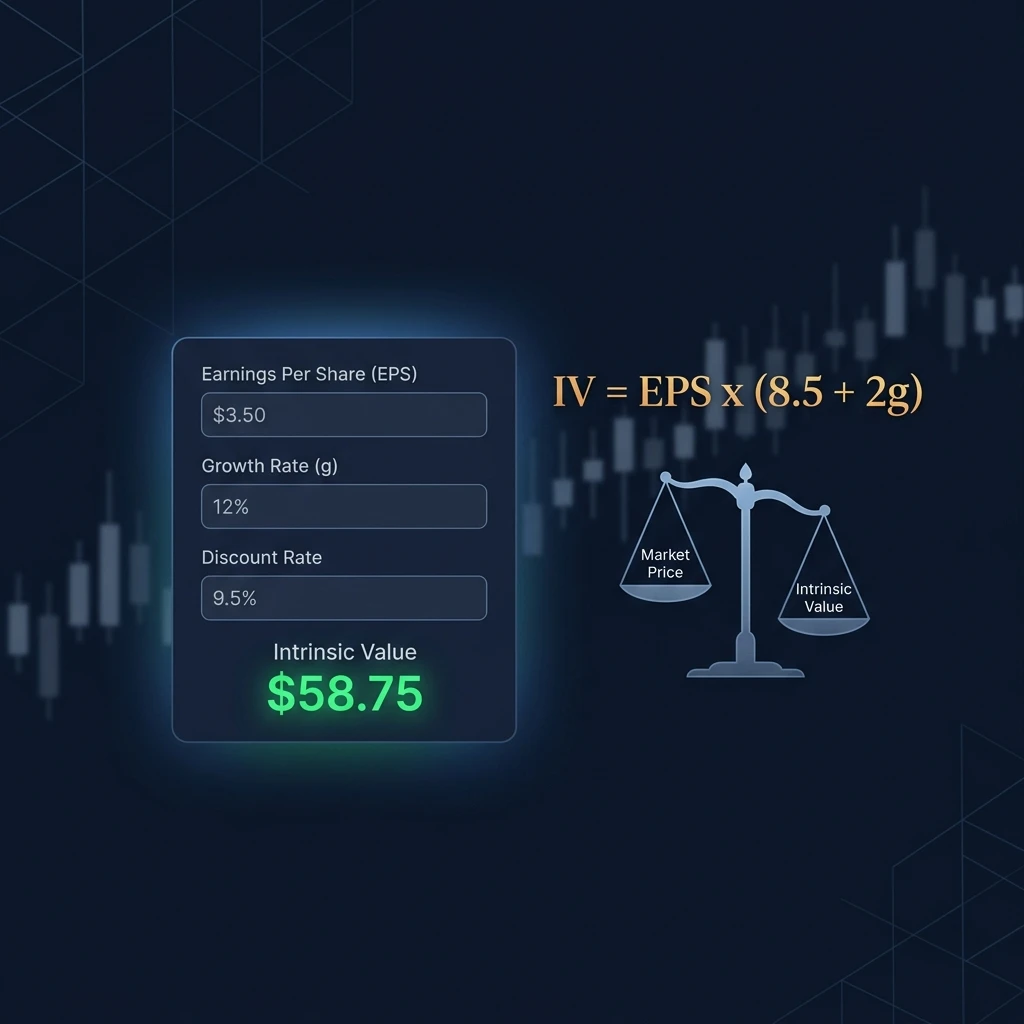
- The two most widely used methods are the DCF (Discounted Cash Flow) model and Benjamin Graham's simplified formula: IV = EPS x (8.5 + 2g).
- Margin of Safety: value investors buy at a 20–30% discount to intrinsic value to protect against miscalculations.
- Use our free Intrinsic Value Calculator to compute the fair value of any stock without building a complex spreadsheet.
What Is Intrinsic Value of a Stock?
The intrinsic value of a stock is what the business is genuinely worth based on its fundamentals — earnings, growth rate, cash flows, and assets — independent of what the market is currently willing to pay for it. It represents the "true value" of a company if you strip away market sentiment, investor emotion, and short-term price fluctuations.
When a stock's market price is below its intrinsic value, value investors consider it undervalued — a potential buying opportunity. When the market price is above intrinsic value, the stock may be overvalued — potentially a sell signal or a stock to avoid.
This concept was formalized by Benjamin Graham (Warren Buffett's mentor) in The Intelligent Investor and Security Analysis, and it remains the foundation of value investing practiced by many of the world's most successful investors.
Why Market Price and Intrinsic Value Differ
The stock market is not a perfect pricing machine. In the short term, prices are driven by fear, greed, news sentiment, institutional buying/selling, and market momentum — all of which have nothing to do with a company's underlying business value. This creates regular divergences between price and value.
As Benjamin Graham described it, in the short run the market is a "voting machine" (reflecting popularity and sentiment), but in the long run it is a "weighing machine" (reflecting genuine business value). Intrinsic value calculation attempts to determine what a stock will eventually be worth when the weighing machine has done its job.
Method 1: The DCF (Discounted Cash Flow) Model
The DCF model is the most rigorous and widely used method for calculating intrinsic value. It is based on a fundamental financial principle: a rupee received in the future is worth less than a rupee today (the time value of money). The DCF discounts all future cash flows a company will generate back to their present value.
The DCF Formula
Intrinsic Value = Sum of (Future Cash Flow / (1 + Discount Rate)^Year) + Terminal ValueWhere:
- Future Cash Flow: Expected free cash flow for each projected year (typically 5–10 years)
- Discount Rate: The required rate of return — often the company's WACC (Weighted Average Cost of Capital) or a target return rate (e.g., 12–15% for Indian equity investors)
- Terminal Value: The estimated value of all cash flows beyond the projection period
DCF Worked Example (Indian Stock — Simplified)
Assume: A fictional company "XYZ Ltd." with current free cash flow of ₹100 crore, expected to grow at 15% per year for 5 years, then 8% perpetually. Discount rate: 12%.
| Year | Free Cash Flow (₹ Cr) | Discount Factor (12%) | Present Value (₹ Cr) |
|---|---|---|---|
| 1 | 115 | 0.893 | 102.7 |
| 2 | 132.3 | 0.797 | 105.4 |
| 3 | 152.1 | 0.712 | 108.3 |
| 4 | 174.9 | 0.636 | 111.2 |
| 5 | 201.1 | 0.567 | 114.0 |
| Sum of 5-year PV | 541.6 | ||
Terminal Value: Year 6 cash flow = ₹201.1 Cr x 1.08 = ₹217.2 Cr. Terminal Value = ₹217.2 / (0.12 - 0.08) = ₹5,430 Cr. Present Value of Terminal Value = ₹5,430 x 0.567 = ₹3,078.8 Cr.
Total Intrinsic Value (Enterprise Value) = ₹541.6 + ₹3,078.8 = ₹3,620.4 Crore
Divide by the number of outstanding shares to get intrinsic value per share. If XYZ has 50 crore shares outstanding: IV per share = ₹3,620.4 / 50 = ₹72.4 per share. If the market price is ₹55, the stock appears undervalued by ~24%.
DCF Limitations to Be Aware Of
- Garbage in, garbage out: DCF is highly sensitive to your growth rate and discount rate assumptions. A 2% change in growth rate can shift the output by 30–50%. Always run multiple scenarios (bull, base, bear case).
- Not suitable for negative cash flow companies: New-age tech companies, startups, or turnaround situations often have negative FCF. DCF does not work for these — use price-to-sales or other relative valuation methods instead.
- Terminal value dominates: In most DCF models, 70–80% of the total intrinsic value comes from the terminal value calculation. This means your perpetual growth rate assumption is the single most impactful variable. Be conservative.
Method 2: Benjamin Graham's Intrinsic Value Formula
For investors who want a quick, simple approximation without a full DCF model, Benjamin Graham developed a shorthand formula. It is less precise than DCF but provides a useful sanity check:
Intrinsic Value = EPS x (8.5 + 2g)Where:
- EPS: Earnings Per Share (trailing twelve months)
- 8.5: The base P/E ratio Graham assigned to a zero-growth company
- g: Expected annual EPS growth rate (as a whole number, e.g., 10 for 10%)
Graham Formula Worked Example
TCS Limited (illustrative numbers):
- EPS (TTM): ₹115
- Expected 5-year EPS growth rate: 12%
Intrinsic Value = 115 x (8.5 + 2 x 12)
Intrinsic Value = 115 x (8.5 + 24)
Intrinsic Value = 115 x 32.5
Intrinsic Value = ₹3,737.50 per share
If TCS is trading at ₹3,200, it appears modestly undervalued using this formula. If trading at ₹4,500, it appears overvalued.
Important note: Graham's formula was developed in a US interest rate environment different from today's. Many analysts adjust the base P/E (8.5) based on current bond yields. For India's typical 6–7% risk-free rate environment, a base P/E of 7–8 is more conservative and appropriate.
The Margin of Safety: Why Buying at Intrinsic Value Is Not Enough
Even the most careful intrinsic value calculation involves assumptions that could be wrong — your growth estimate might be optimistic, a competitor might emerge, or the economy might contract. To protect against these uncertainties, value investors apply a Margin of Safety: they only buy when a stock's market price is significantly below the calculated intrinsic value.
Graham recommended a 33% margin of safety for most investments. This means: if your intrinsic value calculation gives you ₹100 per share, you should only buy at ₹67 or below. This buffer absorbs the risk of your assumptions being slightly off while still leaving room for profit.
| Calculated IV | Margin of Safety | Maximum Purchase Price |
|---|---|---|
| ₹100 | 20% | ₹80 |
| ₹100 | 33% | ₹67 |
| ₹100 | 50% | ₹50 |
A larger margin of safety is appropriate for: companies with less predictable earnings, industries undergoing disruption, companies with high debt levels, or any situation where your future cash flow projections are highly uncertain.
How to Use the Intrinsic Value Calculator
Instead of building a DCF spreadsheet manually, use our free Intrinsic Value Calculator. Enter the company's earnings per share (EPS), expected growth rate, and your required rate of return — and the tool computes the intrinsic value per share instantly using both DCF and Graham methodology.
Where to find the inputs:
- EPS: Find on the company's quarterly results page, NSE/BSE filings, or financial sites like Screener.in or Tickertape.in
- Growth rate: Use analyst consensus estimates or compute the CAGR of the last 3–5 years' EPS as a conservative baseline
- Discount rate: Use 12–15% for most Indian equity investments (reflects the opportunity cost vs. equity market returns)
For a complete risk management framework, pair intrinsic value analysis with our Risk/Reward Calculator — ensuring the upside to your intrinsic value target justifies the downside risk from your stop-loss level.
Common Mistakes in Intrinsic Value Calculation
- Using too-high growth rates: Many investors project 25–30% growth for companies that have grown at 15%. Even Reliance and TCS rarely sustain 20%+ EPS growth over 10 years. Conservative estimates of 8–15% are more reliable.
- Ignoring debt: A company with ₹5,000 crore in debt has a much lower intrinsic value per share than a debt-free company with identical earnings. Subtract net debt from enterprise value before dividing by shares outstanding.
- Treating IV as exact: Intrinsic value is a range, not a precise number. The same stock modelled at 12% vs 14% discount rate can yield IV estimates 20% apart. Present your calculation as a range (e.g., ₹85–₹105) rather than a single point estimate.
- Applying DCF to loss-making companies: For companies with negative FCF, switch to revenue multiples, EV/EBITDA, or sector-specific valuation methods.
What is intrinsic value of a stock?
The intrinsic value of a stock is its true, fundamental worth based on the company's earnings, growth potential, and cash flows — independent of current market price. It represents what the business would be worth to a rational, informed investor with complete information. When a stock's market price is below intrinsic value, it may be undervalued; when above, it may be overvalued. Calculating intrinsic value is the core practice of value investing, as formalized by Benjamin Graham and applied by investors like Warren Buffett.
What is the Benjamin Graham intrinsic value formula?
Benjamin Graham's intrinsic value formula is: IV = EPS x (8.5 + 2g). Where EPS is the trailing twelve-month earnings per share, 8.5 is the base P/E ratio Graham assigned to a zero-growth company, and g is the expected annual EPS growth rate expressed as a whole number (e.g., 12 for 12% growth). The formula provides a quick approximation of fair value. For today's Indian market with higher inflation and interest rates, a more conservative base P/E of 7–8 is appropriate. This formula works best for stable, profitable companies with predictable earnings growth.
What is the margin of safety in value investing?
The margin of safety is the gap between a stock's calculated intrinsic value and the price at which you buy it. If a stock has an intrinsic value of ₹100 but you buy at ₹67, your margin of safety is 33%. This buffer protects you against errors in your calculation, adverse business developments, or market-wide downturns. Benjamin Graham recommended a minimum 33% margin of safety for most investments. A larger margin is appropriate for companies with more uncertain earnings, higher debt, or businesses in rapidly changing industries.
What is the difference between intrinsic value and market price?
Market price is what investors are currently willing to pay for a stock — driven by supply, demand, sentiment, news, and short-term momentum. Intrinsic value is what the business is fundamentally worth based on its earnings power and growth prospects. In the short run, market price can diverge significantly from intrinsic value due to investor emotion and market volatility. In the long run, prices tend to converge toward intrinsic value as the business's fundamentals are reflected in financial results. Value investors exploit this divergence by buying when market price is well below intrinsic value.