Key Takeaways
- Only pages ranking in the top 10 for a query can realistically be cited in AI Overviews
- Direct, extractable answers in the first 2 sentences of each section maximize citation probability
- FAQ schema creates individual citation opportunities for each question-answer pair
- Comparison tables and numbered step lists are the most AI-extractable content formats
- Being cited in AI Overviews without a click still builds brand authority at massive scale
Google AI Overviews — the AI-generated answer boxes that now appear at the top of many Google search results — represent the most significant change to the Google SERP in over two decades. Since their full rollout in May 2024, AI Overviews have appeared for hundreds of millions of queries daily, fundamentally changing the traffic dynamics of search.
For website owners and SEO practitioners, AI Overviews present both a threat (zero-click searches increasing) and a massive opportunity: being cited as a source in an AI Overview is the new "position zero" — potentially more visible and more trust-inducing than even the top organic result. This guide explains exactly what AI Overviews are, how Google selects which sources to cite, and specific optimization tactics you can implement today.
What Are Google AI Overviews?
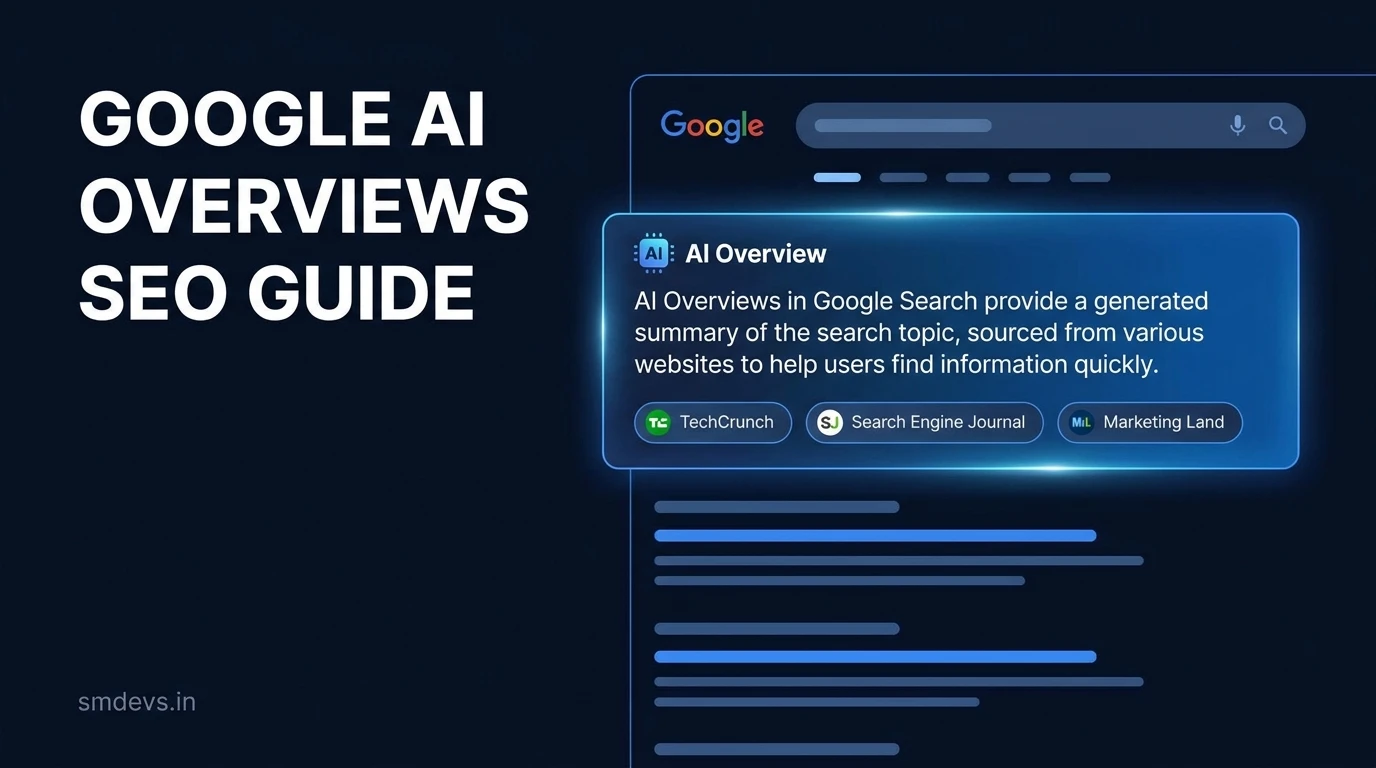
Google AI Overviews (formerly Search Generative Experience / SGE) are AI-generated summaries that appear at the top of certain Google search results pages, above the traditional "10 blue links" organic results. They synthesize information from multiple web pages and present a direct answer to the user's query, with source citations displayed as small pills or links alongside the generated text.
When AI Overviews appear:
- Complex informational queries that benefit from synthesis: "how does compound interest work," "what is the difference between ETF and mutual fund"
- Multi-step how-to queries: "how to set up Google Search Console," "how to calculate position size in trading"
- Comparison queries: "RSI vs MACD which is better," "swing trading vs day trading"
- Questions with nuanced answers that require multiple perspectives
When AI Overviews typically do NOT appear:
- Navigational queries ("YouTube," "Facebook login")
- Highly time-sensitive queries (news, today's stock price, live scores)
- YMYL queries where Google is cautious (medical diagnoses, legal advice)
- Very simple queries with obvious single answers
- Transactional queries ("buy iPhone 16," "book hotel Mumbai")
Key Takeaways
- Only indexed pages that already rank well can appear in AI Overviews. Traditional SEO is the non-negotiable prerequisite.
- Structured content wins. Numbered steps, clear definitions, comparison tables, and FAQ sections are most extractable by AI systems.
- Answer questions directly in the first 2 sentences of each section. AI extracts the clearest, most direct answers — not verbose context-heavy writing.
- FAQ schema is your highest-ROI AI Overview optimization. Each FAQ question-answer pair is individually indexable and citable.
- Being cited in an AI Overview even without a click builds brand authority. Users see your domain name associated with the answer — a powerful trust signal at scale.
How Google Selects Sources for AI Overviews
Research by multiple SEO organizations (BrightEdge, Authoritas, Search Engine Land) has identified the following patterns in AI Overview source selection:
Factors that increase AI Overview citation probability:
- Existing top-10 ranking for the query: The vast majority of AI Overview citations come from pages already ranking in the top 10 for the same query. Getting into the top 10 organically is therefore the primary goal.
- Domain authority (high DR/DA): Authoritative domains are significantly more likely to be cited. Pages from .gov, .edu, and established industry publications appear disproportionately often.
- Content that directly answers the question: AI Overview citations skew heavily toward content that answers the specific query in a direct, extractable way — not content that buries the answer in 500 words of preamble.
- Structured data implementation: Pages with FAQPage, HowTo, and Article schema are cited more frequently — these schemas make content machine-readable at a structural level.
- Content freshness: Recently updated content is preferred for queries where currency matters. Adding a "Last Updated" date and regularly refreshing statistics and examples improves freshness signals.
- Topical coverage depth: Pages that comprehensively cover a topic (not just surface-level) provide more extractable content across multiple aspects of the query.
Step-by-Step AI Overviews Optimization
Step 1 — Target the Right Queries
Not all queries trigger AI Overviews. Focus your optimization on informational and how-to queries in your niche — these are the highest AI Overview trigger rate categories. Check manually which of your target queries show AI Overviews by searching from an incognito window.
Step 2 — Achieve Top-10 Rankings First
There is no shortcut for this step. If your page isn't ranking in the top 10 for the target query, it almost certainly won't be cited in the AI Overview. Use the standard SEO playbook: target a specific keyword, write comprehensive content, build backlinks, optimize on-page elements.
Step 3 — Structure Your Content for AI Extraction
Restructure your content so every major question has a direct answer in the first 1–2 sentences of its section:
- Before (not AI-extractable): "RSI, or the Relative Strength Index, was developed by J. Welles Wilder in 1978 and first described in his groundbreaking book on technical trading systems. The indicator measures..."
- After (AI-extractable): "RSI (Relative Strength Index) is a momentum oscillator that measures the speed and magnitude of price changes on a scale from 0 to 100, helping traders identify overbought and oversold conditions."
The second version gives the AI a complete, self-contained answer it can extract and present. The first requires reading several sentences before the complete answer emerges.
Step 4 — Implement FAQ Schema on Every Key Page
FAQ schema markup makes your FAQ questions and answers directly machine-readable. Google's AI Overview system can extract individual Q&A pairs as citation sources. This means a 10-question FAQ section creates 10 individual potential citation opportunities from a single page.
Format: Use JSON-LD FAQPage schema with each question-answer pair clearly defined. See the existing implementation on our blog detail pages for a working example.
Step 5 — Use Comparison Tables and Numbered Lists
Structured data formats are highly extractable by AI systems:
- Comparison tables: Directly answer "X vs. Y" queries in an extractable format
- Numbered step lists: Directly answer "how to" queries with extractable step sequences
- Definition blocks: A bolded term followed immediately by a clear definition is highly extractable for "what is X" queries
Step 6 — Include Specific Data and Statistics
AI systems prefer specific, citable facts over vague generalizations. "Traffic increased by 40%" is more citable than "traffic increased significantly." Include: specific percentages, time periods, statistics from authoritative sources (with citations), and concrete examples with numbers.
Step 7 — Build E-E-A-T Signals
AI systems are trained to prefer authoritative, trustworthy sources. Ensure every key page has: a credentialed author byline, citations to primary sources, an updated publication date, HTTPS and full trust signals, and a strong backlink profile from relevant authoritative sites.
Measuring AI Overview Performance
Currently, Google Search Console does not provide dedicated AI Overview metrics. Available measurement approaches:
- Manual SERP checks: Regularly search your target queries to check if your content is being cited
- GSC click monitoring: Watch for unexpected changes in CTR or click volume for queries where AI Overviews appear — AI Overview citations can drive referral traffic even from zero-click positions
- Brand monitoring tools: Track when your domain name is mentioned in AI-generated content across platforms
- GA4 referral traffic: Monitor sessions originating from google.com with AI Overview referral parameters
Frequently Asked Questions
Will Google AI Overviews hurt my website traffic?
The evidence is mixed and query-dependent. For simple informational queries with one clear answer, AI Overviews do reduce click-through rates — users get the answer without clicking. However, for complex topics, the AI Overview often cites multiple sources and includes "More to explore" links that drive clicks. Sites cited in AI Overviews as authoritative sources can actually gain traffic from the citation itself, as users click through to explore the full source. Long-term, focus on being cited (building authority and brand recognition) rather than avoiding AI Overviews — they are Google's strategic direction and will only expand.
How can I opt my site out of Google AI Overviews?
As of 2026, Google does not provide a direct opt-out mechanism for AI Overview inclusion. The closest options are: using a noindex meta tag (which prevents any Google indexing, not just AI Overviews), or using the robots.txt disallow directive (same effect). Both would remove you from traditional search results as well — almost certainly not the desired outcome. Google has indicated they are exploring more granular opt-out controls, but these are not available in the standard GSC interface. The strategic recommendation is to optimize for AI Overview inclusion rather than attempting exclusion.
Do I need to change my content strategy for AI Overviews?
Your core content strategy shouldn't change dramatically — the content attributes that make pages rank in traditional search (comprehensiveness, expertise, clear structure, E-E-A-T signals) are the same attributes that make content AI-citable. The specific additions are: more direct, extractable answers at the start of each section; more extensive FAQ sections with schema markup; and more specific data and statistics throughout. Think of AI Overview optimization as an incremental refinement of your existing SEO content strategy, not a replacement of it.
Which industries see the most AI Overview traffic impact?
Industries with high informational query volume see the most impact from AI Overviews: health and medical information, financial education and investing, technology how-to content, educational resources, and legal information. These are also YMYL categories where Google is most selective about AI Overview sources — meaning sites with strong E-E-A-T in these areas have significant advantages as preferred citation sources.
Your Next Step
Start with FAQ schema implementation on your 5 highest-traffic pages — this is the highest-ROI AI Overview optimization you can do in under an hour. For the broader GEO strategy, see the GEO Guide. And ensure your content meets E-E-A-T standards with the E-E-A-T Checklist 2026.