Key Takeaways
- GEO = optimizing content to be cited by AI search systems (Google AI Overviews, ChatGPT, Perplexity)
- GEO is built ON TOP of SEO — unindexed, low-ranking pages cannot be cited by AI
- Structured content (numbered lists, comparison tables, direct definitions) is most extractable
- FAQ schema creates individual citation opportunities for each Q&A pair
- Being cited in AI Overviews even without a click builds brand authority at massive scale
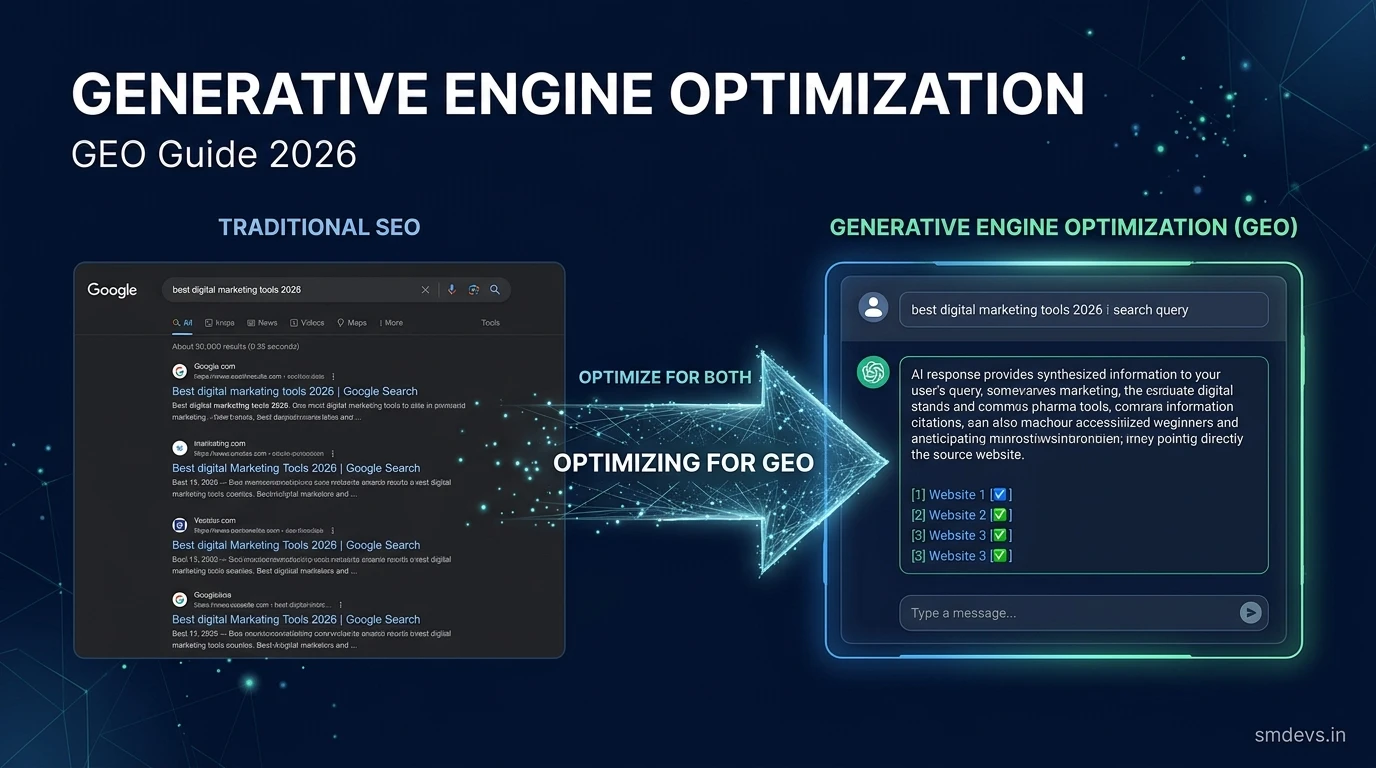
Generative Engine Optimization (GEO) is the emerging discipline of optimizing content specifically to be cited, referenced, and surfaced by AI-powered search and answer engines — including Google AI Overviews, ChatGPT, Perplexity, Bing Copilot, and Google Gemini. As AI systems increasingly mediate the first layer of information retrieval, the ability to appear as a cited source in AI-generated answers is becoming as strategically important as ranking on page one of traditional search results.
The key insight: GEO is not a replacement for SEO. It is an extension of it — the same content quality signals that make pages rank well in traditional search also make them more likely to be cited by AI systems, but with some additional optimizations specific to how large language models retrieve and present information.
How AI Search Engines Retrieve and Cite Content
Understanding GEO requires understanding how AI search systems work. Systems like Google AI Overviews and Perplexity use a retrieval-augmented generation (RAG) architecture:
- Retrieval: The AI system retrieves a set of potentially relevant web pages from a traditional search index (Google's index, Bing's index, or their own crawls).
- Ranking: Retrieved pages are ranked by relevance to the query — using many of the same signals as traditional search (authority, relevance, trust).
- Generation: The AI reads the content of the top-ranked retrieved pages and synthesizes an answer, often including citations or source links.
- Presentation: The answer is presented to the user with source citations — the pages that contributed most significantly to the answer.
This means: if your page isn't in Google's index, it cannot be cited by Google AI Overviews. The prerequisite for GEO is excellent traditional SEO — specifically, having indexed, authoritative pages that rank well for relevant queries.
Key Takeaways
- GEO is built on top of SEO — not separate from it. Pages that rank well in traditional search are far more likely to be cited in AI answers.
- Structured, factual content is most likely to be cited. AI systems prefer content with clear definitions, numbered lists, comparison tables, and specific data — not vague, opinion-heavy writing.
- Schema markup dramatically increases AI citability. FAQ, HowTo, Article, and Table schema help AI systems understand and extract your content structure.
- E-E-A-T signals are amplified for AI citation. AI systems are trained to prefer authoritative, expert sources — credentialed authorship and authoritative backlinks matter even more for AI visibility.
- Conversational, question-answering content performs best in AI Overviews. Content that directly answers specific questions in clear language is most likely to be extracted into an AI answer.
Google AI Overviews — What We Know About Citation Factors
Google AI Overviews (formerly Search Generative Experience / SGE) appear at the top of certain Google search results, synthesizing information from multiple web pages. Research on AI Overview citations has revealed several patterns:
Pages most likely to be cited in AI Overviews:
- Pages already ranking in positions 1–10 for the query — the existing top organic results form the citation pool
- Pages with high domain authority (strong backlink profiles)
- Pages that directly and explicitly answer the query in the first paragraph
- Pages with structured data (especially FAQ schema) that makes content machine-readable
- Pages with tables, lists, and step-by-step instructions — structured formats that AI can extract cleanly
- Pages with strong E-E-A-T signals — credentialed authors, authoritative citations, factual accuracy
- Pages with comprehensive coverage of the topic — the more subtopics covered, the more citation opportunities
Pages less likely to be cited:
- Pages with thin or vague content that doesn't directly answer specific questions
- Pages with poor readability — long paragraphs, no headings, no lists
- Pages with primarily opinion or analysis rather than factual, extractable answers
- Pages with low domain authority and few backlinks
- Pages blocked by robots.txt from being crawled
GEO Optimization Strategies
1. Answer Questions Directly and Early
AI systems extract answers to specific questions. Content that buries the answer deep in the article — requiring the AI to parse multiple paragraphs of context first — is less likely to be cited than content that states the answer clearly in the first 1–2 sentences of the relevant section.
Format for AI extraction:
- H2: "What is [Topic]?"
- Paragraph 1: Direct, complete answer in 2–3 sentences
- Paragraph 2+: Supporting context, examples, nuance
2. Use Statistics and Specific Data
AI systems prefer content with specific, verifiable data over vague statements. Replace "traffic can increase significantly" with "traffic increased by 40% within 90 days." Replace "many traders use RSI" with "RSI is used by approximately 73% of technical analysts according to the 2024 CFA Institute survey." Cite your sources — AI systems weight content with verifiable citations more heavily.
3. Implement Comprehensive Schema Markup
Schema markup makes your content machine-readable at a structural level — telling AI systems exactly what type of content each element is. Priority schema types for GEO:
- FAQPage: Makes your FAQ section eligible for direct extraction into AI answers. Each Question-Answer pair is individually indexed and citable.
- HowTo: Step-by-step instructions become extractable as structured action sequences — ideal for AI systems answering "how to" queries.
- Article: Signals authorship, publication date, and article type — all trust signals for AI citation systems.
- Table data: Well-formatted HTML tables are frequently extracted by AI systems for comparison queries.
4. Build Topical Authority
AI systems don't just evaluate individual pages — they evaluate sources. A domain that comprehensively covers all aspects of a topic (a "topic cluster") signals to AI systems that it is an authoritative, trustworthy source for that topic. Build topic clusters around your core subjects rather than publishing isolated, unrelated articles.
Full topic cluster strategy: Topic Cluster Strategy guide.
5. Optimize for Conversational Queries
AI search queries tend to be more conversational and specific than traditional keyword searches. "How do I reduce my CLS score in Next.js" rather than "CLS fix." Your content should include natural language variations of the main query — both formal definitions and the colloquial way real people ask about it.
6. Maintain Content Freshness
AI systems prefer current, up-to-date information — especially for rapidly evolving topics. Update statistics, examples, and tool recommendations at least annually. Add a "last updated" date to your articles — both for user trust and as a freshness signal.
GEO vs. Traditional SEO — Key Differences
| Factor | Traditional SEO | GEO |
|---|---|---|
| Goal | Rank in top 10 of SERP | Be cited in AI-generated answers |
| Click model | User clicks your link directly | AI may answer without a click (zero-click risk) |
| Content format preference | Comprehensive guides, long-form | Direct answers, structured data, specific facts |
| Schema markup importance | High | Critical |
| Authority signal | Backlinks, domain rating | Backlinks + E-E-A-T + topical depth |
| Measurability | GSC clicks, impressions, position | Brand mentions in AI outputs, referral traffic from AI platforms |
| Traffic risk | Losing ranking to competitors | AI answers the query fully — zero-click searches increase |
The Zero-Click Challenge
One legitimate concern about AI Overviews is zero-click searches — where the AI answers the query so completely that the user has no reason to click through to any website. For purely informational queries with simple answers, this is a real phenomenon.
How to mitigate zero-click risk:
- Focus on complex topics that require more than a paragraph to fully address — these always require click-throughs for full understanding
- Include content elements that require a visit to use: tools, calculators, interactive elements, downloadable resources
- Target commercial-intent queries where the AI is less likely to fully answer — users comparing options or evaluating purchases need to visit sites
- Build brand recognition through AI citations — even zero-click AI answers that mention your brand as a source build brand awareness and trust
Frequently Asked Questions
What is the difference between SEO and GEO?
SEO (Search Engine Optimization) is the practice of optimizing content to rank well in traditional search engine results pages (the blue links). GEO (Generative Engine Optimization) is the emerging practice of optimizing content to be cited, referenced, or used as a source by AI-powered search systems like Google AI Overviews, ChatGPT, and Perplexity. GEO builds on the foundation of SEO — you cannot be cited by AI systems if your pages aren't in the search index and aren't ranking. Think of GEO as an additional layer on top of a strong SEO foundation.
How do I know if my content is appearing in Google AI Overviews?
Currently, Google does not provide a dedicated report in Google Search Console for AI Overviews impressions or citations. The best approaches to track AI Overview visibility are: manually searching your target queries and checking if your content is cited; using AI Overview tracking tools that monitor SERP features; tracking referral traffic from Google's AI search in GA4 (sessions from google.com that arrive with query parameters suggesting AI search); and monitoring branded mentions of your domain in AI-generated answers using brand monitoring tools.
Should I worry that AI will replace traditional SEO traffic?
AI Overviews will reduce click-through rates for some query types — particularly simple informational queries with a clear, definitive answer. However, complex queries, commercial queries, local queries, and queries requiring current or specialized information continue to drive clicks. The long-term direction is toward a hybrid model where AI answers simple queries and links to authoritative sources for complex ones. Sites with strong E-E-A-T, topical authority, and quality content are better positioned in this environment, not worse — because they are exactly the sources AI systems prefer to cite.
Which AI platforms are most important to optimize for?
In order of current search volume and citation impact: (1) Google AI Overviews — integrated into the world's largest search engine, affecting billions of queries daily. (2) Perplexity — the fastest-growing dedicated AI search engine, with a user base that skews toward researchers and professionals who are highly likely to click through citations. (3) ChatGPT with web browsing — Microsoft's Bing integration means ChatGPT search citations are indexed from Bing's index. (4) Microsoft Copilot — integrated into Windows and Microsoft 365, with growing enterprise use. Optimizing for Google AI Overviews (through strong traditional SEO + structured data) covers most of the GEO opportunity.
Your Next Step
Implement FAQ schema on your key pages immediately — this is the highest-ROI GEO action available right now. See the E-E-A-T Checklist to strengthen AI citation signals. Build topical authority with the Topic Cluster Strategy. And ensure your technical SEO foundation is solid with a free audit from our SEO Structure Analyzer.