Key Takeaways
- Topical authority = Google recognizing your site as a comprehensive expert source on a specific topic
- Built through topic clusters: one comprehensive pillar page + 8–15 in-depth cluster articles, all internally linked
- Differs from Domain Authority (backlinks) — topical authority can outrank higher-DA sites with fewer links
- Each new well-linked article strengthens authority of ALL related articles — a compounding effect
- AI systems prefer topically authoritative sources — GEO and SEO benefits are both accelerated
Topical authority is the degree to which a website is recognized by search engines as a comprehensive, expert source on a specific subject. It is the collective signal that emerges when a domain consistently publishes high-quality, interconnected content covering all significant aspects of a topic — creating the impression (accurately measured by Google's algorithms) that this site is a definitive resource for its niche.
In 2026, topical authority is one of the most powerful long-term SEO assets a website can build. It is also increasingly important for AI search citation: AI systems like Google AI Overviews and Perplexity preferentially cite sources that demonstrate deep, comprehensive coverage of a topic — not those with a single excellent article.
Why Topical Authority Matters More in 2026
Several converging trends have made topical authority more important than ever:
- Google's Helpful Content updates: Post-HCU, Google has significantly increased the weighting of site-wide quality signals. A domain with deep topical expertise is rewarded across all its content — not just on the specific pages that have the most backlinks.
- AI search citation patterns: Research shows that AI systems cite topically authoritative sources far more often than single-article specialists. A site covering all aspects of "SEO" is cited for more queries than a site with one excellent article on meta tags.
- Keyword Difficulty is site-relative: A topically authoritative site can rank for competitive keywords that would be impossible for a newer, less established site — even without additional backlinks. Google trusts established topical authorities.
- Internal link authority flow: A comprehensive topic cluster distributes PageRank efficiently across all cluster pages through internal links — lifting the entire cluster's average ranking, not just individual pages.
Key Takeaways
- Topical authority is earned by comprehensively covering your topic, not by covering many unrelated topics. A laser-focused niche site outperforms a general site on every specific topic.
- Topic clusters are the structural implementation of topical authority. One comprehensive pillar page, surrounded by 8–15 in-depth cluster articles, all internally linked.
- Content gaps are opportunities. Every subtopic in your niche that isn't on your site is a gap that competitors can exploit and that reduces your topical authority score.
- Topical authority compounds. Each new, well-linked piece of content strengthens the authority of every related piece — making each subsequent article easier to rank than the previous one.
- Backlinks amplify but don't replace topical authority. A topically authoritative site with moderate backlinks often outranks a less comprehensive site with more backlinks.
Topical Authority vs. Domain Authority
| Factor | Domain Authority (DA/DR) | Topical Authority |
|---|---|---|
| What it measures | Quantity and quality of backlinks to the domain | Depth and breadth of content coverage on a topic |
| Measured by | Third-party tools (Ahrefs DR, Moz DA) | No direct metric — inferred from content coverage and ranking patterns |
| How to build | Earn high-quality backlinks | Publish comprehensive, interconnected content on your core topics |
| Time to impact | Months to years (depends on link velocity) | 3–9 months of focused content publishing |
| Who has the advantage | Established sites with large link profiles | Focused niche sites with comprehensive topic coverage |
| Durability | Can be lost with algorithm updates targeting link schemes | Very durable — genuine expertise is algorithmically robust |
Building Topical Authority — The Topic Cluster Model
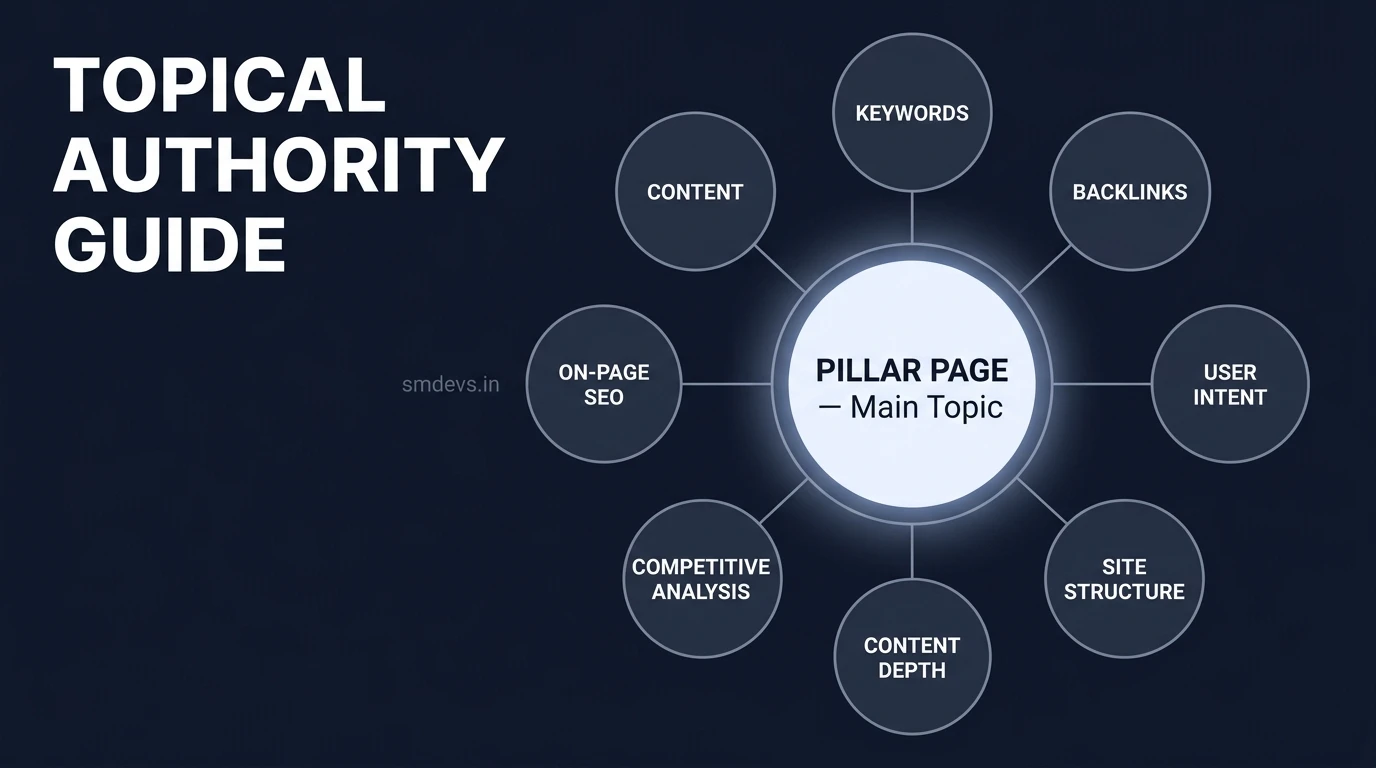
The topic cluster model is the most proven content architecture for building topical authority. It consists of:
1. The Pillar Page: A comprehensive, long-form guide that covers the main topic broadly but in sufficient depth to be genuinely useful on its own. The pillar page links out to all cluster articles on specific subtopics. Example: "The Complete Guide to Technical Analysis" — a 5,000+ word resource covering all major concepts with links to individual in-depth articles on each.
2. Cluster Articles: 8–15 in-depth articles each covering a specific subtopic of the pillar topic in much greater depth than the pillar page does. Each cluster article links back to the pillar page. Examples: "RSI Indicator Guide," "MACD Indicator Guide," "Candlestick Patterns Guide," "Chart Patterns Guide" — all linking back to the Technical Analysis pillar and to each other where relevant.
3. Internal Linking: Every cluster article links to the pillar page. The pillar page links to every cluster article. Related cluster articles link to each other where content is complementary. This creates a dense, thematically coherent link network that signals the topical relationship to Google.
Full strategy: Topic Cluster Strategy Guide.
How to Audit Your Current Topical Authority
- Map your content to topics: List all existing content pieces and group them by topic cluster. Identify which topics have 5+ articles (strong topical coverage) and which have only 1–2 (weak coverage).
- Identify content gaps: For each topic cluster, list every significant subtopic you haven't yet covered. These are your highest-priority new content opportunities.
- Check internal linking density: Use a site crawler (Screaming Frog) to check that all cluster articles link to their pillar and that the pillar links to all cluster articles. Missing internal links are easy wins.
- Audit competitor coverage: Use Ahrefs or SEMrush to see which subtopics your competitors rank for that you don't have content on. These are evidence-based content gap opportunities.
- Check GSC for "cannibalization": Multiple pages competing for the same keyword indicate poor internal linking and unclear topic architecture — consolidate or differentiate these.
The Semantic SEO Connection
Google's algorithms understand semantic relationships between concepts — not just individual keywords. When your site consistently covers all major entities (people, places, concepts, tools) related to a topic, Google's Knowledge Graph progressively associates your domain with that topic's entity space.
Practical implications:
- Use the correct terminology, definitions, and entity names that your audience and Google's Knowledge Graph recognize
- Include related concepts naturally in your content — if writing about RSI, mention Welles Wilder, momentum oscillators, overbought/oversold, and divergence naturally
- Use consistent terminology across all articles in a cluster — variation in how you refer to key concepts creates semantic confusion
- Cover entities that Google's People Also Ask data shows users care about — these reveal what's in Google's semantic model for a topic
Frequently Asked Questions
How many articles do I need to build topical authority?
There is no fixed number — it depends on the breadth and depth of your chosen topic. A narrow niche topic (e.g., "candlestick patterns") may require 10–15 articles to achieve comprehensive coverage. A broad topic (e.g., "SEO") may require 50+ articles organized into multiple sub-clusters. The test is coverage completeness: can a user find a thorough answer to every significant question within your niche on your site? If yes, you've achieved meaningful topical authority for that niche.
Does topical authority help with AI search citations?
Yes — significantly. Research by BrightEdge and Authoritas shows that AI Overview citations are heavily skewed toward topically authoritative domains. AI systems are trained to prefer sources that demonstrate deep, comprehensive knowledge of a topic — exactly what topical authority represents. A site with 20 interconnected, high-quality articles on technical analysis is far more likely to be cited for trading-related queries than a site with one excellent article on RSI. Topical authority is therefore a dual-benefit strategy: it improves traditional search rankings AND AI citation probability simultaneously.
How long does it take to build topical authority?
Meaningful topical authority signals typically emerge within 3–6 months of consistent, focused content publishing — assuming proper internal linking and reasonable content quality. Sites with existing domain authority (backlink profile) see this accelerate. New sites with zero authority may take 9–18 months before topical authority translates into significantly improved rankings. The process compounds: the first 10 articles produce modest results, but articles 20–30 see dramatically better ranking performance because the established topical foundation makes each new piece easier to rank.
Can a general blog build topical authority?
General blogs that cover many unrelated topics rarely achieve meaningful topical authority in any of them. Topical authority requires depth and coherence — a blog covering SEO, cooking, travel, and personal finance equally will not be recognized as a topical authority in any of these areas. The most effective approach for general bloggers is to choose 1–3 core topics and build comprehensive topic clusters around each, while limiting content on unrelated topics to minimal coverage. Over time, even a "general" blog should identify which 2–3 topics drive 80% of organic traffic and double down on those.
Your Next Step
Map your existing content to topic clusters and identify your three biggest content gaps. Start filling those gaps with dedicated, well-researched articles that link to existing related content. Use the full Topic Cluster Strategy guide for the complete architecture framework. And ensure the technical SEO foundation supports your topical authority build with a check through our SEO Structure Analyzer.