Key Takeaways
- You've done your keyword research. Your blog post is well-written. You've optimised the title and meta description. And yet your article sits on page 4 while a mediocre competitor ranks #1. The proble
What is Search Intent?
Search intent (also called user intent or query intent) is the underlying goal or purpose a user has when typing a search query into Google. It is the answer to the question: "What does this person actually want to find?"
Google's primary mission is to satisfy search intent — to show the user the content that best matches what they're trying to accomplish. Its entire algorithm is built around this goal. When you fail to match search intent, Google won't rank your page highly, because your content doesn't satisfy the user's underlying need — regardless of how well-written it is.
Google explicitly mentions intent matching in its Search Quality Rater Guidelines and has described it as critical to understanding what makes a high-quality result.
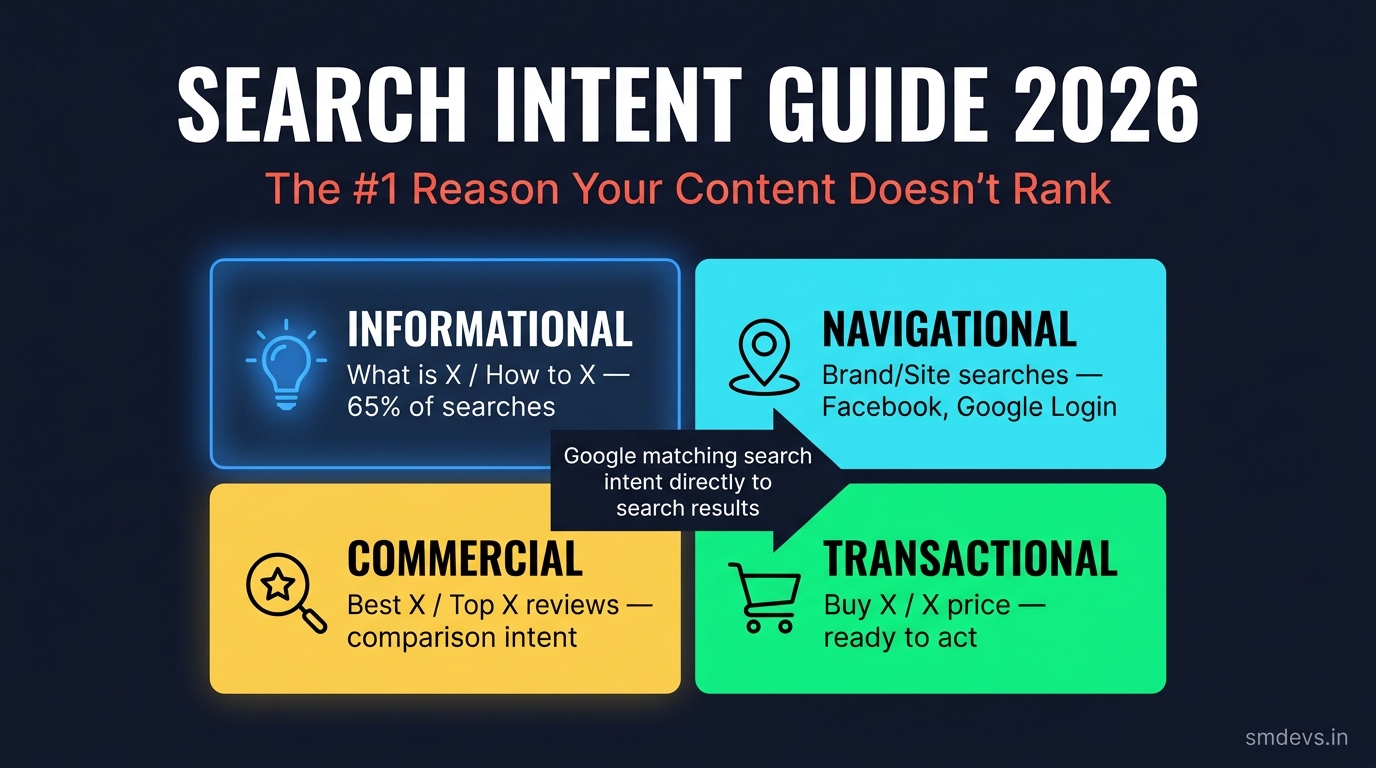
The 4 Types of Search Intent
1. Informational Intent — "I want to learn"
The user wants information or an answer to a question. They are in research mode, not buying mode.
Examples:
- "What is schema markup?"
- "How does RSI indicator work?"
- "What is Nifty 50?"
- "Why do companies pay dividends?"
What Google shows: Blog posts, guides, explainers, Wikipedia articles, knowledge panels, featured snippets, People Also Ask boxes.
Content format that ranks: Educational articles — comprehensive, well-structured, with clear headings and answers. Our blogs at smdevs.in primarily target informational intent, building topical authority on trading and SEO topics.
2. Navigational Intent — "I want to go to a specific place"
The user already knows what site or page they want — they're using Google as a navigation tool.
Examples:
- "Zerodha login"
- "Google Search Console"
- "NSE India website"
- "smdevs schema validator"
What Google shows: The official website, with sitelinks. Sometimes the log-in page directly.
Content format that ranks: You can only rank for navigational queries about your own brand. Trying to rank for "Zerodha login" with a non-Zerodha site is nearly impossible and not the right strategy.
3. Commercial Investigation Intent — "I want to compare before I decide"
The user is researching products/services with purchase intent but isn't ready to buy yet. They're evaluating options.
Examples:
- "Best schema validator tool 2026"
- "Zerodha vs Upstox comparison"
- "Top dividend stocks India"
- "Best mutual fund for SIP 2026"
What Google shows: Comparison articles, "Best of" listicles, review articles, comparison tables.
Content format that ranks: Detailed comparison guides with tables, pros/cons, specific recommendations, and clear opinions. Generic "all are good" articles don't rank for commercial investigation queries — Google knows users want a recommendation.
4. Transactional Intent — "I want to do or buy something now"
The user is ready to take action — buy, sign up, download, or use a tool immediately.
Examples:
- "schema validator online free" (tool usage)
- "pivot point calculator" (tool usage)
- "open demat account Zerodha" (signup intent)
- "buy Nifty 50 ETF" (purchase intent)
What Google shows: Tool pages, product pages, sign-up pages — NOT blog posts. When someone searches "schema validator," they want to USE a validator, not read about what schema is.
Content format that ranks: The actual tool, product page, or service page. This is exactly why our Schema Validator tool and Pivot Calculator rank well — they match transactional intent perfectly.
Why Search Intent is the #1 Ranking Factor (The Google Proof)
In 2019, Google redesigned its entire ranking algorithm around a framework called BERT (Bidirectional Encoder Representations from Transformers) — a language model that helps Google understand the nuance of what words mean in context. In 2021, they added MUM (Multitask Unified Model) which understands queries across content types.
The result: Google is now extraordinarily good at identifying when a page doesn't match the user's underlying intent — even if it contains all the right keywords. A blog post about "what is a schema validator" will NOT rank for "schema validator" when the user's intent is to USE one. Google detects this mismatch and demotes the page.
The practical implication: No amount of keyword optimisation overcomes an intent mismatch. If your content format doesn't match the dominant intent of your target keyword, you will not rank — period.
How to Identify Search Intent for Any Keyword
Method 1: Google the Keyword and Analyse the SERP
The most reliable method. Search your target keyword and examine the top 5 results:
- What FORMAT are the top results? (Guide, listicle, comparison, tool page, product page?)
- What TYPE of content dominates? (Long-form article, short answer, video, calculator?)
- What ANGLE do most results take? (Beginner-friendly, technical, comparison, how-to?)
The SERP IS Google's intent classification. Match it.
Method 2: Analyse the "People Also Ask" Box
The PAA questions reveal what related questions people have — showing you the full scope of informational intent around your keyword. Answer these questions in your content to serve intent comprehensively.
Method 3: Check URL Patterns of Top Results
- URLs containing /blog/, /guide/, /what-is/ → informational intent
- URLs containing /tool/, /calculator/, /validator/ → transactional intent
- URLs containing /vs/, /compare/, /best/ → commercial investigation intent
- URLs that are the homepage or main brand page → navigational intent
Common Search Intent Mistakes and How to Fix Them
| Mistake | Example | Fix |
|---|---|---|
| Writing a blog post for transactional intent | Writing "What is Schema Validator?" to rank for "schema validator" | Build an actual schema validator tool for the transactional keyword; write the educational blog for "what is schema markup" |
| Making a product page for informational intent | Pushing your "Buy Mutual Fund" page for "how does mutual fund SIP work?" | Create a comprehensive educational guide for the informational keyword; let the product page target transactional keywords |
| Wrong format for commercial intent | Writing a generic informational guide for "best dividend stocks India 2026" | Restructure as a comparison/recommendation article with a clear winner table and specific picks |
| Too long for navigational intent | Writing a 3,000 word article for "HDFC Bank login" | Don't target navigational queries for other brands — redirect effort to non-navigational keywords |
Search Intent and AI Overviews in 2026
Google's AI Overviews have further concentrated the importance of intent matching. The AI overview appears at the top of results for many informational queries — "stealing" the traditional position 1 click. This has made informational keyword traffic harder to capture.
The escape: Transactional and commercial investigation intent queries are far less likely to have AI Overviews (Google doesn't want to replace your tool usage or buying decision with an AI answer — that would harm its advertising revenue). This is a strategic reason to invest in tool pages (transactional) and detailed comparison guides (commercial) alongside informational blog content.
Also read: Is AI Killing SEO in 2026? for the full picture on how AI Overviews are changing traffic patterns.
FAQs: Search Intent
What are the 4 types of search intent?
The 4 types are: (1) Informational — user wants to learn or research ("what is X"), (2) Navigational — user wants to go to a specific website ("X login"), (3) Commercial Investigation — user is comparing options before buying ("best X for Y"), and (4) Transactional — user wants to take immediate action like buying or using a tool ("X tool free online"). Most blog traffic comes from informational intent; tools and product pages capture transactional intent.
Why does search intent matter for SEO?
Google's algorithm is fundamentally built to match search results to user intent. When your content format doesn't match the dominant intent of a keyword — even if it contains the right keywords — Google will not rank it on page 1 because it doesn't satisfy what users actually want. Intent mismatch is the #1 reason well-written, keyword-optimised content fails to rank.
How do I find the search intent for my keyword?
The most reliable method: Google your target keyword and analyse the top 5–10 results. What format are they (articles, tools, product pages, comparison guides)? What angle do they take (beginner, advanced, comparison)? This SERP analysis IS Google's intent classification — the algorithm has already decided what intent best matches this query. Match that format and angle in your content.