Key Takeaways
- Google AI Overviews now appear in nearly half of all searches. ChatGPT, Perplexity, and Gemini are answering questions that used to drive millions of clicks to websites. Zero-click searches have hit 6
The Data: What Is Actually Happening to Google Traffic?
Let's start with the hard numbers that sparked this conversation:
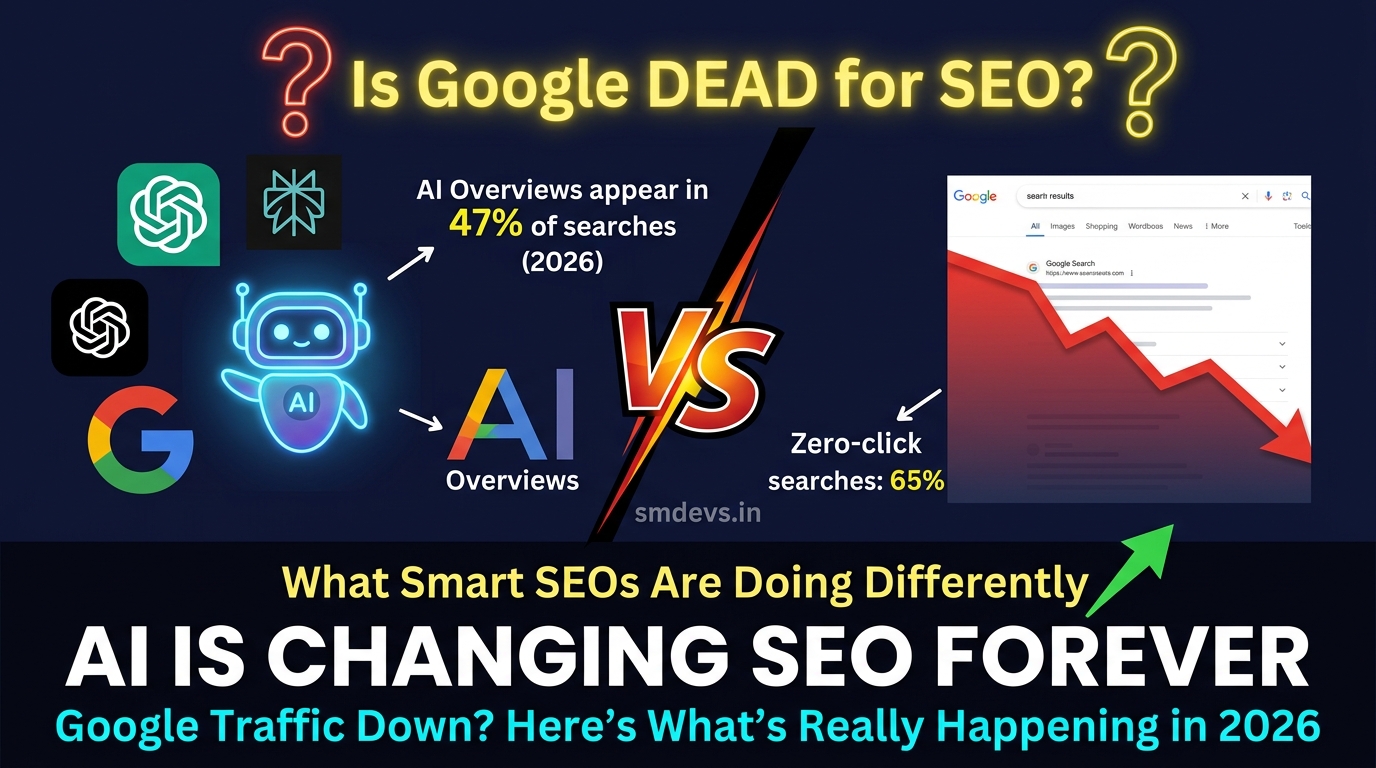
- Google AI Overviews (formerly Search Generative Experience) appear in approximately 47% of all Google searches as of mid-2026 — up from 15% in early 2024
- Zero-click searches — queries where users get their answer directly on the SERP without clicking any result — now account for approximately 65% of all Google searches (SparkToro, 2025)
- ChatGPT receives approximately 100 million daily active users and processes over 10 million search-intent queries per day
- Perplexity AI grew from 10 million to 100 million monthly users in 12 months
- Multiple large publishers have publicly reported 15–40% year-over-year drops in Google organic traffic in 2025–2026
This is real. Traffic is shifting. But the conclusion many people draw — "SEO is dead" — is both wrong and unactionable.
What Type of SEO Traffic Is Actually Declining?
Not all organic traffic is affected equally. The decline is concentrated in specific query types:
Traffic That Is Declining
- Simple factual queries: "What is the capital of France?" "What is the melting point of gold?" "How many days in a year?" — Google's AI Overview or a featured snippet answers these without a click
- Definition queries: "What is inflation?" "What is domain authority?" — AI gives a paragraph answer. Users don't click unless they want to go deeper
- Simple how-to queries: "How to convert PDF to Word?" — A 2-sentence AI answer is enough for most users
- Navigational queries for known brands: Users now type "Zerodha login" directly into the browser address bar — Google never sees it
Traffic That Is Growing or Stable
- Complex comparison queries: "Best DSLR camera under ₹50,000 in India 2026" — Users want detailed, up-to-date comparisons from humans who've tested them
- Tool and calculator pages: Our free tools (schema validator, pivot calculator, intrinsic value calculator) — AI can't replace interactive tools
- Commercial investigation queries: "Zerodha vs Upstox 2026 — which is better?" — High buying intent, users want current info
- Local search: "Best CA in Pune" — highly geographic, still drives clicks
- Long, detailed guides with original insights: AI surfaces these but users still click to read the full content
- Brand queries: Users searching for YOUR brand by name — this only grows with authority
The AI Overview Effect: What It Actually Does to Your Rankings
Here's the counterintuitive finding from early data: pages cited in Google AI Overviews often receive more clicks, not fewer.
When Google's AI Overview cites your page as a source, it creates a "citation link" that some users click to verify or go deeper. Sites in the AI Overview citation carousel see click-through rates that can match or exceed traditional position-3–5 rankings.
How to get cited in AI Overviews:
- Structure content with clear H2/H3 questions and concise answers (AI Overviews prefer clearly structured content)
- Use schema markup — FAQ schema and HowTo schema increase citation probability
- High E-E-A-T signals — Google cites authoritative sources in AI Overviews preferentially
- Comprehensive, accurate content — AI pulls from pages that thoroughly cover a topic
The New Search Landscape: Where Traffic Is Going
| Traffic Source | Direction (2024–2026) | What's Working |
|---|---|---|
| Google organic — simple queries | 📉 Declining | Schema markup to capture featured snippets |
| Google organic — complex queries | ➡️ Stable | Deep, comprehensive, unique content |
| Google AI Overview citations | 📈 Growing | Structured content, E-E-A-T, FAQ schema |
| ChatGPT / Perplexity citations | 📈 New channel | Authoritative, cited sources; Wikipedia presence |
| Direct traffic (brand searches) | 📈 Growing | Brand building, social media, newsletters |
| Google Discover | 📈 Growing | Strong visuals, trending topics, click-worthy titles |
What Smart SEOs Are Doing Differently in 2026
1. Optimising for AI Citations (AEO — Answer Engine Optimisation)
The new game is not just ranking on page 1 — it's getting cited as a source in AI answers. This requires:
- Concise, factually accurate answers to common questions in your niche
- Structured data (FAQ schema, Article schema, HowTo schema) — use our free Schema Validator to verify
- Being the authoritative source that AI models trust — building genuine backlinks from reputable sites
- Keeping content fresh and up-to-date — AI models are trained on recent data and prefer current sources
2. Targeting Zero-Click-Proof Keywords
Zero-click happens when the SERP answers the query completely. Zero-click-proof queries are those where the answer is too complex, too personal, or too nuanced to fit in a snippet:
- Comparison queries: "X vs Y — which should I choose?"
- Opinion-based: "Is [tool/service] worth it?"
- Data-heavy: "[Industry] statistics India 2026" — users want the full data
- Tool-dependent: "Calculate my [tax/profit/returns]" — requires an interactive tool, not a text answer
3. Building Brand + Email List
Organic search traffic has always been borrowed traffic — Google can change the algorithm and send it elsewhere. In 2026, smart publishers are investing in:
- Email newsletters — owned audience Google cannot take away
- Brand recognition — users searching for your brand by name regardless of algorithm changes
- Social media communities — WhatsApp channels, Telegram groups, YouTube for Indian audiences
4. Creating What AI Cannot Replace
AI can summarise. AI cannot:
- Provide original research and proprietary data
- Give real tested reviews with original photos
- Offer interactive tools (calculators, validators, generators)
- Share personal experience and case studies
- Give hyper-local advice that requires on-the-ground knowledge
Sites built on these strengths are largely insulated from AI traffic cannibalization.
Is SEO Dead? The Honest Answer
No — but lazy SEO is dead. Thin content, keyword stuffing, AI-generated articles with no original insight, listicles recycling information available everywhere — this type of content is being displaced rapidly by AI answers.
SEO built on genuine topical authority, original tools, unique insights, and strong E-E-A-T is not just surviving — it's one of the few content strategies that also gets surfaced in AI answers.
The sites that are thriving in 2026 are not doing less SEO — they are doing better SEO.
FAQs: AI and SEO in 2026
Is SEO still worth it in 2026?
Yes — with adjustments. Simple informational content targeting basic factual queries is increasingly captured by AI zero-click answers. But complex guides, interactive tools, comparison content, and content with original data continue to drive significant organic traffic. The focus has shifted to creating content AI cannot replace: original research, interactive tools, expert-level analysis, and content requiring first-hand experience.
Will ChatGPT replace Google search?
Not fully — at least not yet. Google still processes approximately 8.5 billion searches per day (2026) vs ChatGPT's estimated 10 million search-intent queries. Google has also integrated AI into search (AI Overviews) while maintaining the traditional search results. The more likely future is a hybrid model where AI answers simple queries and traditional search results serve complex, commercial, and local queries.
How do I get my website cited in Google AI Overviews?
Focus on: (1) Clear, structured content with direct answers to common questions, (2) FAQ schema markup, (3) Strong E-E-A-T signals (author credentials, citations, authoritative backlinks), (4) Comprehensive, accurate, up-to-date content, (5) HTTPS and Core Web Vitals compliance. Sites that rank in positions 1–3 for a query are most likely to be cited in AI Overviews, so ranking still matters.