Key Takeaways
- A stop loss is a pre-set price level at which your trade automatically exits to limit your loss if the market moves against you.
- Stop losses are the most important risk management tool in trading — they protect your capital from catastrophic losses that wipe out accounts.
- The two main types are stop-market orders (instant execution at market price) and stop-limit orders (execute only at your specified price or better).
- Placing your stop loss just below the nearest support level (or above resistance for short trades) is the most technically sound approach.
- Use our Risk/Reward Calculator to verify your stop placement delivers at least 1:1.5 RR before entering any trade.
What Is a Stop Loss in Trading?
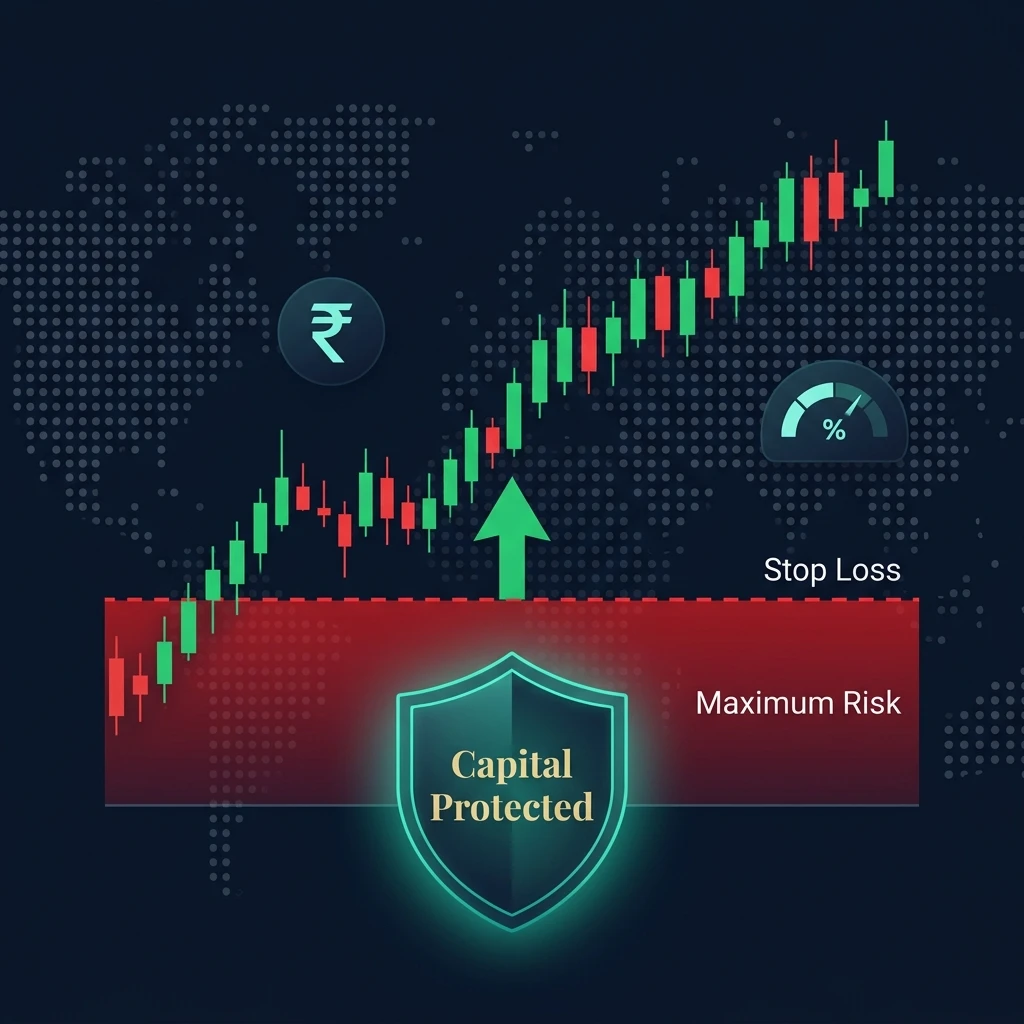
A stop loss is an order placed with your broker to automatically exit a trade when the price reaches a specified level — limiting your loss on that position. It is the most fundamental risk management tool in trading, acting as a safety valve that prevents any single bad trade from causing catastrophic damage to your account.
Without a stop loss, a losing trade can keep losing until you manually exit — which many traders delay due to hope or denial, often resulting in losses far larger than they originally planned to accept. A stop loss removes emotion from the exit decision: when the price hits your level, the trade closes automatically, regardless of what you are thinking or feeling at that moment.
Why Stop Losses Are Non-Negotiable
Every professional trader uses stop losses. Every trader who blows up an account ignores them. The mathematics are simple:
| Loss on a Trade | Return Needed to Break Even |
|---|---|
| 10% loss | 11.1% gain required |
| 25% loss | 33.3% gain required |
| 50% loss | 100% gain required |
| 75% loss | 300% gain required |
| 90% loss | 900% gain required |
As losses grow, recovery becomes mathematically harder — not linearly but exponentially. A 50% drawdown requires a 100% gain just to break even. This is why cutting losses early with a stop loss is the single most important habit in trading: it keeps losses manageable and recovery mathematically achievable.
Types of Stop Loss Orders
1. Stop-Market Order
A stop-market order triggers when price reaches your stop level and immediately executes at the best available market price. It guarantees execution but not the exact price — in fast-moving markets, you may get filled slightly worse than your stop level (called slippage).
Best for: Liquid instruments like Nifty futures, Bank Nifty, and large-cap stocks where slippage is minimal. Use when getting out quickly matters more than the exact exit price.
2. Stop-Limit Order
A stop-limit order triggers at your stop price but only executes at your specified limit price or better. It guarantees the price you pay but does not guarantee execution — if the market gaps through your limit, the order may not fill and the trade stays open.
Best for: Situations where you cannot accept a worse price than your limit, and you understand the risk of non-execution. Generally riskier than stop-market for most traders because a missed stop in a fast-moving market can lead to a much larger loss than the slippage you were trying to avoid.
3. Trailing Stop Loss
A trailing stop moves automatically in the direction of profit, maintaining a fixed distance (in points or percentage) from the highest price reached in your favour. When price reverses by the trailing amount, the stop triggers and exits the trade.
Best for: Locking in profits on trending trades while letting winners run. Especially useful for swing trades in strongly trending markets where you want to stay long as long as the trend holds without manually adjusting your stop every day.
How to Set a Stop Loss: 4 Methods
Method 1 — Support and Resistance (Best Method)
Place your stop just below the nearest significant support level (for long trades) or just above resistance (for short trades). This is the most technically sound method because support levels are points where price has historically reversed — if price breaks below them convincingly, the trade thesis is invalidated.
Example: You buy Nifty at 23,500 after it bounces off S1 support at 23,400. Your stop goes to 23,350 — just below the support zone. If Nifty breaks 23,400 with force, S1 has failed as support and your trade is wrong.
Calculate today's Nifty S1, S2, and PP levels before the market opens using our free Pivot Point Calculator.
Method 2 — Percentage-Based Stop
Risk a fixed percentage of your account per trade — typically 1–2%. If your account is ₹5,00,000 and you risk 1% per trade, your maximum loss per trade is ₹5,000. Work backwards from this to determine your stop-loss distance in points.
Stop Distance = Max Risk Amount ÷ Lot Size
Example: ₹5,000 risk ÷ 75 (Nifty lot size) = 66.6 points stop distance
If the technically appropriate stop is further than 66.6 points from your entry, the trade is too large for your account at that position size. Either reduce lot size or skip the trade.
Method 3 — ATR-Based Stop (Average True Range)
The ATR measures a market's average daily volatility. Placing your stop at 1.5x to 2x the ATR ensures your stop is wide enough to absorb normal price noise without being triggered randomly, while still cutting the trade if something genuinely wrong happens.
Stop Distance = 1.5 × ATR(14)
Example: If Nifty 14-period ATR = 180 points
Stop = 1.5 × 180 = 270 points below entry
ATR-based stops adjust automatically to current market volatility — they widen during high-volatility periods and tighten when markets are calm.
Method 4 — Swing High/Low Stop
For swing trades, place the stop just below the most recent significant swing low (for longs) or above the most recent swing high (for shorts). A break of the swing low means the market is making lower lows — invalidating a bullish trade thesis.
Stop Loss Placement With Risk/Reward Verification
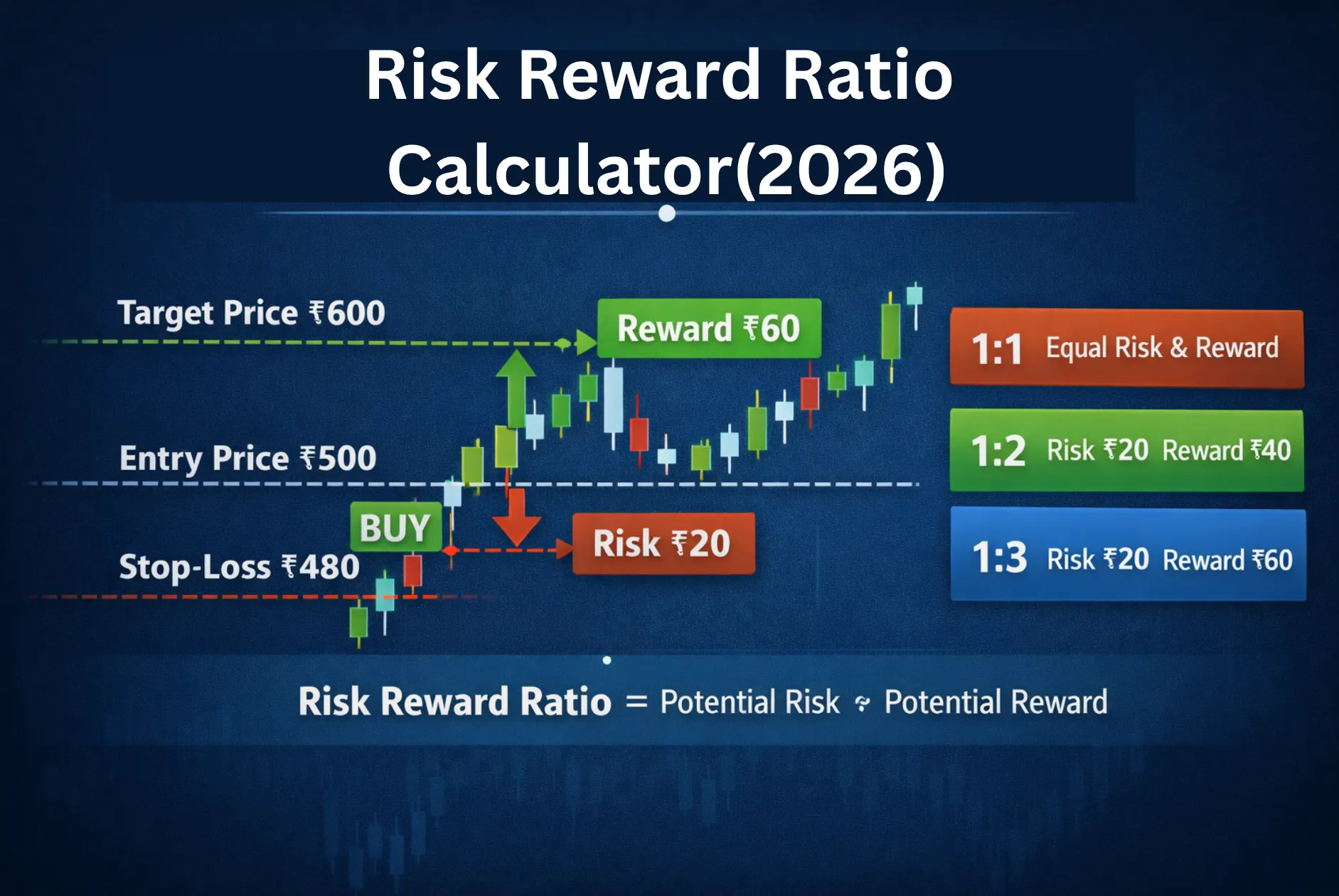
Once you have determined your stop-loss level, always verify the trade's risk-reward ratio before entering. For any stop placement to be worthwhile, the potential reward must justify the risk.
Use our free Risk/Reward Calculator to enter your entry price, stop-loss, and target and instantly see your RR ratio. Minimum acceptable: 1:1.5. Never enter a trade where the potential reward is less than the risk you are taking.
Also use our Position Size Calculator to calculate the exact number of lots you should trade based on your account size and your stop-loss distance — ensuring you never risk more than 1–2% of capital per trade regardless of the stop placement.
Common Stop Loss Mistakes to Avoid
- Placing stops at round numbers: Round numbers (23,000; 22,500; 50.00) are watched by everyone and are frequently hunted by market makers. Place stops a few points beyond round numbers — 22,985 instead of 23,000.
- Moving the stop in the wrong direction: Never widen your stop to avoid being stopped out. Your stop defines how much you are wrong. Moving it is admitting you will accept being more wrong. This is the fastest path to catastrophic losses.
- Stop loss too tight: A stop placed within normal price noise will be triggered randomly even when your trade direction is correct. Use ATR to set stops outside normal volatility.
- No stop at all: "I'll watch the trade and exit manually" is not a risk management strategy. Markets can move 5–10% in minutes on news events. An unprotected position is a loaded gun.
- Same stop for all trades: Stop distance should vary based on the instrument's volatility, your entry quality, and the distance to the nearest support/resistance — not be a fixed number of points applied to every trade.
Stop Loss for Intraday vs Swing Trading
| Parameter | Intraday Trading | Swing Trading |
|---|---|---|
| Stop type | Stop-market (speed matters) | Stop-market or stop-limit |
| Stop distance | 5–20 points (Nifty/BNF) | 50–200 points or 2–5% |
| Based on | Intraday pivot levels, 15-min chart support | Daily chart swing lows, weekly support |
| Review frequency | Active during session | Adjust trailing stop daily at close |
| Square off | Mandatory before market close | Hold until stop hit or target reached |
What is a stop loss in trading?
A stop loss is an order placed with your broker that automatically closes your trade when the price reaches a specified level, capping the maximum loss on that position. It is the primary risk management tool in trading. Without a stop loss, a losing trade can continue losing indefinitely until manually closed — which traders often delay, resulting in far larger losses than planned. Stop losses remove emotion from loss-cutting decisions: when price reaches the predetermined level, the position exits automatically.
Where should I place my stop loss?
The best stop-loss placement is just beyond a significant technical level — below the nearest support level for long trades, or above resistance for short trades. This approach is technically sound because a break of support invalidates the bullish trade thesis. You can also use ATR-based stops (1.5–2x the 14-period ATR) to set a stop that accommodates normal price volatility without being triggered randomly. Always avoid placing stops at obvious round numbers, which are frequently targeted by market makers. After setting your stop, verify the trade has at least a 1:1.5 risk-reward ratio before entering.
What is the difference between a stop-market and stop-limit order?
A stop-market order triggers when price reaches your stop level and immediately executes at the best available market price — guaranteed execution but not guaranteed price (slippage possible). A stop-limit order triggers at the stop price but only executes at your specified limit price or better — guaranteed price but not guaranteed execution (if price gaps past your limit, the order won't fill). For most traders, stop-market orders are safer because they guarantee exit, while stop-limit orders risk leaving a position open during a fast-moving market decline if the limit price is not available.
What percentage should a stop loss be?
Your stop loss should be sized so that the total loss on the trade if stopped out equals 1–2% of your total trading capital — not a fixed percentage of the share price. For example, if your account is ₹5,00,000 and you risk 1% per trade, your maximum loss per trade is ₹5,000. Your stop-loss distance in points then depends on how many lots you trade. This approach ensures no single trade can significantly damage your overall capital, regardless of the instrument or position size.
Can a stop loss fail?
Yes — stop losses can fail to execute at your intended price in two situations: (1) Market gaps: if a stock or index opens far beyond your stop level due to overnight news, your stop-market order will execute at the opening market price (which could be much worse than your stop), and a stop-limit order may not execute at all. (2) Circuit breakers: extreme market events can trigger trading halts, temporarily preventing execution. Stop losses significantly reduce risk but cannot eliminate it entirely — they are protection against normal adverse moves, not against extreme gap events. This is why position sizing (never risking more than 1–2% per trade) is equally important.