Key Takeaways
- Risk of Ruin is the mathematical probability of losing your entire trading account given your current risk parameters
- Even profitable systems with a positive edge can have high Risk of Ruin if position sizes are too large
- The formula: RoR = ((1 - Edge) / (1 + Edge)) ^ (Capital / Risk Per Trade)
- Reducing risk per trade from 5% to 1% can drop Risk of Ruin from 45% to under 1%
- Pair position sizing with the Break-Even Calculator and Risk-Reward Calculator to build a complete risk framework
What Is Risk of Ruin in Trading?
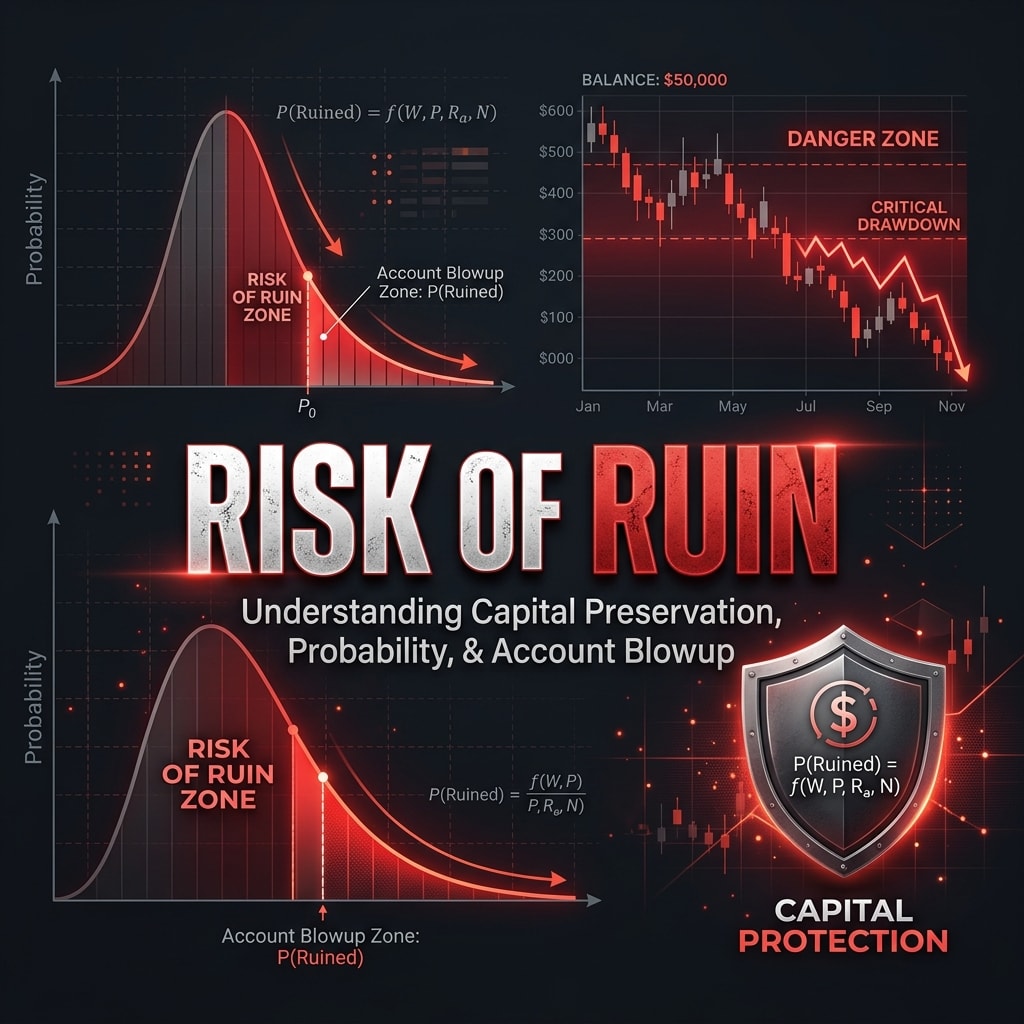
Risk of Ruin (RoR) is the mathematical probability that a trader will lose their entire trading account — or lose enough capital to become unable to continue trading — given their current risk per trade, win rate, and system edge. It is a statistical reality, not a worst-case fantasy.
Every trader operating without a calculated Risk of Ruin is flying blind. A system that appears profitable on a short track record can still have a greater-than-50% probability of total account destruction over a larger sample of trades. This is why experienced traders talk about position sizing and risk management before they discuss entries and exits — because entries are worthless if Risk of Ruin is high enough to guarantee you won't be around long enough to benefit from them.
The Risk of Ruin Formula
The simplified Risk of Ruin formula for fixed-fraction betting (which is how most traders risk capital) is:
RoR = ((1 - Edge) / (1 + Edge)) ^ (Capital Units / 1)Where:
- Edge = (Win Rate × Average Win) - (Loss Rate × Average Loss), expressed as a fraction of risk per trade
- Capital Units = how many "risk units" make up your account (Account Balance ÷ Risk Per Trade)
A more practical approximation for traders:
RoR ≈ ((1 - Edge%) / (1 + Edge%)) ^ NWhere N = number of risk units in your account. If you risk 2% per trade, N = 50 (100% ÷ 2%).
Risk of Ruin Table: The Numbers That Should Change How You Trade
| Win Rate | Win/Loss Ratio | Risk Per Trade | Risk of Ruin |
|---|---|---|---|
| 55% | 1.5:1 | 10% | ~32% |
| 55% | 1.5:1 | 5% | ~18% |
| 55% | 1.5:1 | 2% | ~4% |
| 55% | 1.5:1 | 1% | ~0.4% |
| 50% | 1.5:1 | 5% | ~47% |
| 45% | 2.0:1 | 5% | ~28% |
| 40% | 1.5:1 | 5% | ~81% |
The most important insight from this table: a 55% win rate system with a 1.5:1 win/loss ratio — which most traders would consider solid — still carries an 18% Risk of Ruin at 5% risk per trade. One in five traders with this system will blow their account. Reduce risk to 1% per trade and Risk of Ruin drops to 0.4%.
Why Even Profitable Systems Can Have High Risk of Ruin
This is the counterintuitive insight that kills most retail trading accounts: a positive expectancy system — one where the math says you should make money over time — can still have a near-certain probability of account destruction if the risk per trade is too large.
Consider a system with:
- 55% win rate
- 2:1 average win/loss ratio
- Positive expected value per trade: +0.10 (10% of risk per trade)
At 20% risk per trade: Risk of Ruin ≈ 68%. At 5% risk per trade: Risk of Ruin ≈ 12%. At 1% risk per trade: Risk of Ruin ≈ 0.3%.
The system is identical. The only variable is position size. Position size — not strategy — determines whether that system destroys your account or builds your wealth.
The 3 Variables That Control Your Risk of Ruin
1. Edge (Win Rate × Win/Loss Ratio)
Your edge is the mathematical advantage your system has per trade. A system with no edge (break-even) has infinite Risk of Ruin over time — you will always eventually go bust regardless of position size. Edge must be positive and statistically validated before position sizing matters.
2. Position Size (Risk Per Trade)
This is the most immediately controllable variable. Halving your position size dramatically reduces Risk of Ruin in a non-linear way. As shown in the table above, moving from 5% to 1% risk per trade reduces RoR by a factor of 10–50x depending on your edge. Use the Position Size Calculator to calculate exact position sizes for any risk percentage.
3. Number of Capital Units
The more risk units your account contains, the lower your Risk of Ruin — because you can survive a longer losing streak before account destruction. 50 risk units (risking 2% per trade) is significantly safer than 10 risk units (risking 10% per trade), even with identical system edge.
The Professional Standard: Maximum 1% Risk of Ruin
Professional trading firms and money managers typically target a Risk of Ruin below 1% as the acceptable threshold. This is not arbitrary conservatism — it's actuarial math applied to career survival.
To achieve sub-1% Risk of Ruin:
- Risk no more than 1–2% of capital per trade
- Maintain a win rate above 45% with a minimum 1.5:1 win/loss ratio
- Keep at least 50 capital units in your account at all times
- Stop trading and reassess if drawdown exceeds 20% (your statistical parameters may have changed)
Risk of Ruin and Consecutive Loss Streaks
Another way to think about Risk of Ruin is through losing streaks. At a 55% win rate, a 10-trade losing streak has approximately a 0.3% probability. That sounds low — but over a career of 5,000 trades, it becomes nearly inevitable. A trader risking 10% per trade would lose 65% of their account during that streak. A trader risking 1% per trade loses 9.6% during the identical streak.
Surviving inevitable losing streaks is one of the core functions of position sizing. The Break-Even Calculator helps identify the recovery requirement after any drawdown — showing exactly how much you need to gain after losses to return to your previous equity high.
How to Reduce Your Risk of Ruin Starting Today
- Calculate your actual win rate and win/loss ratio from the last 100+ trades
- Plug those numbers into the Risk of Ruin formula to find your current RoR
- If RoR is above 5%, reduce position size immediately to bring it below 1%
- Use the Position Size Calculator to determine the correct number of shares/lots for 1–2% account risk
- Calculate the Risk-Reward ratio for every trade before entry — only take trades with minimum 2:1
- Monitor drawdown continuously — if you exceed 15%, drop to half position size until the drawdown is recovered
Key Takeaways
- Risk of Ruin is the mathematical probability of losing your entire trading account — every trader has one and most don't know it
- Even systems with positive expectancy can have high Risk of Ruin if position sizes are too large
- The three controlling variables are: edge, position size, and number of capital units
- Reducing risk per trade from 5% to 1% typically drops Risk of Ruin by 20–50x
- The professional threshold is Risk of Ruin below 1% — achievable with 1–2% risk per trade and validated system edge
What is Risk of Ruin in trading?
Risk of Ruin is the statistical probability that a trader will lose their entire trading account given their current win rate, average profit/loss ratio, and risk per trade. It quantifies the chance of account destruction over a large number of trades. Even profitable trading systems can have a high Risk of Ruin if position sizes are too large relative to the system's edge and the number of risk units in the account.
How do you calculate Risk of Ruin?
The practical formula is RoR ≈ ((1 - Edge%) / (1 + Edge%)) ^ N, where Edge% is your net edge per trade as a percentage of risk, and N is the number of risk units in your account (account balance divided by risk per trade). Example: if you risk $100 per trade on a $5,000 account, N = 50. Calculate your Edge% from your actual win rate and win/loss ratio across 100+ trades for accuracy.
What is an acceptable Risk of Ruin for traders?
Professional traders and institutional risk managers typically target a Risk of Ruin below 1%. This is achievable for most traders by limiting risk to 1–2% of capital per trade, maintaining a minimum 45% win rate with a 1.5:1 or better win/loss ratio, and keeping at least 50 risk units in the account. A Risk of Ruin above 10% indicates position sizes that need immediate reduction.
Can you have a profitable strategy with high Risk of Ruin?
Yes — and this is the most dangerous situation in trading. A system with positive expected value (making money on average) can still have a Risk of Ruin above 50% if position sizes are too large. The math shows that a 55% win rate system with 2:1 win/loss ratio — clearly profitable in theory — carries an 18% Risk of Ruin at 5% risk per trade. Position size is independent of strategy edge and must be calculated separately.
How does position sizing reduce Risk of Ruin?
Position sizing reduces Risk of Ruin in a non-linear relationship — halving your risk per trade reduces Risk of Ruin by far more than half. This is because smaller position sizes create more capital units in your account, giving you a longer runway to survive losing streaks that are statistically inevitable in any trading system. Moving from 5% to 1% risk per trade typically reduces Risk of Ruin by 20–50 times depending on your system's edge.