Key Takeaways
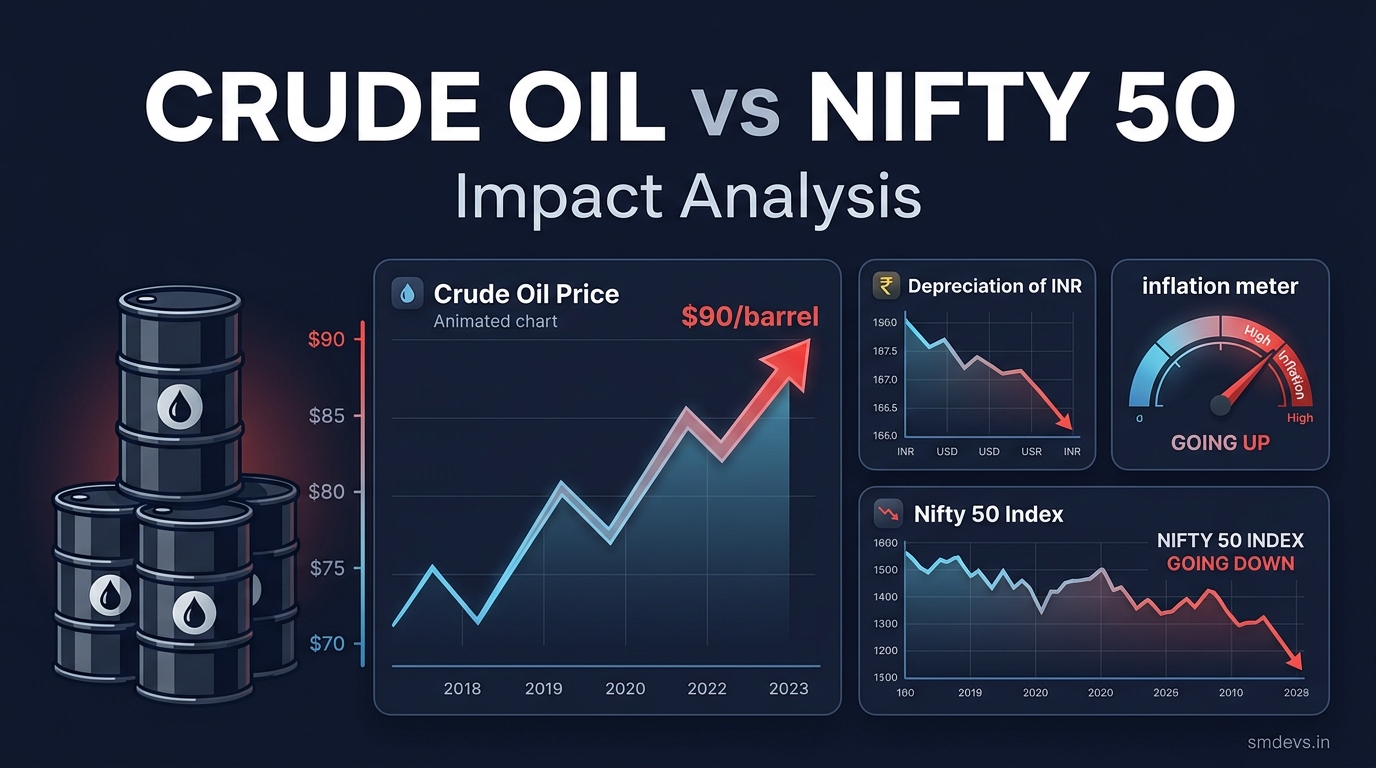
- Brent crude oil is hovering near $90 per barrel in August 2026, driven by geopolitical tensions and Middle East supply concerns. India imports over 85% of its crude oil requirements — making crude pri
Why Crude Oil Matters So Much to India
India is the world's third-largest consumer of crude oil, importing over 4.5 million barrels per day — meeting approximately 85% of its petroleum requirements. Oil is India's single largest import item, accounting for around 25–27% of total import value in a typical year.
This extreme dependence means that every $10 rise in crude oil prices adds approximately ₹80,000–90,000 crore to India's annual import bill — widening the current account deficit, pressuring the rupee, and stoking inflation.
Source: Petroleum Planning and Analysis Cell (PPAC) — Government of India
Current Situation: Brent Crude at $90/barrel (August 2026)
As of August 12, 2026, Brent crude oil is trading near $90 per barrel — a significant rise from the ~$70 lows seen earlier in 2025. The key drivers:
- Geopolitical tensions: Ongoing West Asia conflict risks to Strait of Hormuz shipping (20% of global oil supply passes through here)
- OPEC+ supply cuts: Saudi Arabia and Russia extending voluntary output cuts
- El Niño seasonal demand: Higher air conditioning demand in summer 2026 globally
- US crude inventory drawdowns: EIA data showing falling US inventories
The RBI's August 2026 MPC statement specifically cited "crude oil price volatility" as a key upside risk to India's inflation projection of 5% for FY27.
How Rising Crude Impacts the Indian Economy: Step by Step
- Import Bill Rises: Higher crude price → higher petroleum import cost → wider trade deficit
- Rupee Weakens: More USD demand to pay oil bills → rupee depreciates (currently ~₹95.40/$)
- Inflation Rises: Fuel costs are a direct CPI component (6.84%) AND raise input costs for transport, manufacturing, agriculture
- RBI Under Pressure: Rising inflation may delay or pause further rate cuts, reducing the liquidity tailwind for markets
- Corporate Margins Squeezed: Most industries use energy directly or in transport — higher fuel costs compress margins
- Government Finances Stressed: GoI may cut excise duty on fuel (as it did in 2022) to provide relief → fiscal deficit widens
Nifty 50 vs Crude: Historical Correlation
| Period | Brent Crude | Nifty 50 | Relationship |
|---|---|---|---|
| Jan–Jun 2022 | $80 → $120 (Ukraine war spike) | 18,350 → 15,183 (−17%) | Strong negative correlation |
| Jul–Dec 2022 | $120 → $80 (demand fears) | 15,183 → 18,105 (+19%) | Oil fell, markets recovered |
| 2023–2024 | $70–$85 range | 17,000 → 26,277 (+55%) | Stable oil = strong markets |
| Aug 2026 | ~$90 (rising) | 24,472 (consolidating) | Caution; capping upside |
Key insight: Crude above $85–90 historically acts as a headwind for Indian equities. Crude above $100 for sustained periods has always preceded meaningful market corrections in India.
Sector-by-Sector Impact of $90 Crude (August 2026)
Sectors That BENEFIT From High Crude
1. Oil & Gas Upstream (OMCs Producers)
- ONGC, Oil India: Higher realisation per barrel → revenue surge when crude rises
- Net realisation for ONGC (blended after cess and sharing with downstream): Improves significantly above $75/barrel
- Reliance Industries: Exploration segment benefits; refining margins (GRM) also strong at high crude
2. Metals (Indirect Commodity Play)
- High crude often signals strong global economic demand → metal prices also tend to rise in tandem
- Hindalco, Tata Steel, JSW Steel can benefit in this environment
3. Coal India
- High crude makes coal (alternative energy) more competitive — demand for coal increases, benefiting Coal India
Sectors That SUFFER From High Crude
1. Aviation (Most Impacted)
- Aviation Turbine Fuel (ATF) is 30–40% of airline operating costs — directly linked to crude
- IndiGo, Air India see margin compression immediately. At $90 crude, ATF prices rise significantly → airline P&L hit hard
- IndiGo stock typically underperforms when crude is above $85/barrel
2. Paints (Petrochemical Input)
- Major input costs for Asian Paints, Berger Paints are crude derivatives (TiO2, solvents, monomers)
- High crude = high input costs → margin compression unless companies raise prices (which they are reluctant to in competitive market)
3. Tyres
- Synthetic rubber (derived from crude) is a major input for MRF, Apollo, CEAT
- Every $10 rise in crude adds ~2–3% to tyre raw material costs
4. FMCG
- Packaging (plastics), transport, and some ingredients are crude-linked
- HUL, Nestle, Marico face margin pressure — though they can partially pass through price hikes
5. IT (Indirect — Rupee Impact)
- High crude weakens the rupee — which actually HELPS IT revenues (USD earnings worth more in INR)
- However, if crude causes global recession fears → US IT spending cuts → IT stocks fall
- Net effect: ambiguous for IT; monitor global growth signals more than crude directly
Crude Oil and the Rupee: The Critical Link
The USD/INR exchange rate moves closely with crude oil:
| Crude Level | Approximate USD/INR Impact | Mechanism |
|---|---|---|
| $70/barrel | Rupee stable / appreciating | Import bill manageable; CAD narrow |
| $85/barrel | Rupee stable with mild pressure | Higher import cost; CAD widens slightly |
| $90/barrel | ₹95+ per USD (current: ₹95.40) | Significant import cost; FPI cautious on EM |
| $100/barrel | ₹97–100+ per USD historically | CAD crisis zone; inflation concern triggers FPI outflows |
Current rupee at ₹95.40/$ is under moderate pressure but not at crisis levels. The RBI actively intervenes through forex reserves (currently ~$680 billion) to prevent sharp depreciation.
What This Means for Your Portfolio Right Now
If Crude Stays at $85–95 (Base Case)
- Market likely to consolidate in the 24,000–25,000 Nifty range
- Avoid aviation, paints, tyres on near-term weakness
- Favour ONGC, Oil India, Coal India as crude beneficiaries
- IT safe due to rupee tailwind
If Crude Spikes Above $100 (Bearish Scenario)
- Nifty likely to correct 8–12% from current levels
- RBI will likely pause rate cuts → banking sector under pressure
- Defensive allocation: Gold, FMCG (large-cap), IT (rupee hedge)
- Systematic SIP investors should continue — dip buying opportunity
If Crude Falls Below $75 (Bullish Scenario)
- Strong catalyst for Indian market re-rating
- Inflation falls → more RBI rate cuts possible → banking, auto, real estate rally
- Aviation stocks like IndiGo could surge 15–25% in weeks
Key Events to Watch This Week
- US CPI data (Aug 12): July 2026 inflation came in at 3.4% (cooled from 3.5%) — slightly positive for risk assets. If Fed signals rate cuts ahead, dollar weakens → crude may ease → positive for India
- OPEC+ meeting signals: Any hint of production increase would immediately cool crude prices
- Strait of Hormuz developments: Any military escalation would spike crude; de-escalation would ease it
- India's July WPI and CPI data: Will show if domestic inflation is rising in response to crude
FAQs: Crude Oil and Indian Markets
Why does crude oil affect India more than other countries?
India imports 85%+ of its crude oil needs, making it highly exposed to global oil price swings. Countries like the US (oil exporter) or Norway actually benefit from high crude. India, like most Asian economies, is an oil importer and suffers when prices rise.
What crude oil price is negative for Indian markets?
Historically, sustained crude above $85–90/barrel begins to materially hurt Indian markets through inflation and current account pressure. Crude above $100 for more than 2–3 months has preceded significant Indian market corrections in 2008, 2012, and 2022.
Which Indian stocks are best to hold when crude is high?
ONGC, Oil India (upstream producers), Coal India (alternative energy), Reliance Industries (refining benefits), and Gold ETFs (inflation hedge) tend to outperform when crude is high.