Key Takeaways
- Google Business Profile (GBP) is the #1 local SEO priority — fully complete every field and post 2× per week
- Reviews are a top-3 local ranking factor — train staff to ask at the moment of peak satisfaction
- NAP (Name, Address, Phone) must be exactly identical across every directory and your website
- Embed LocalBusiness schema on your homepage and all location pages
- Local links from community events, Chamber of Commerce, and local press carry strong local signals
Local SEO is the practice of optimizing your online presence to appear in search results when people nearby search for the products or services you offer. When someone types "restaurant near me," "dentist in Pune," or "plumber Mumbai" into Google, the algorithm shows them businesses that have optimized for local search signals — not just businesses with the most general SEO authority.
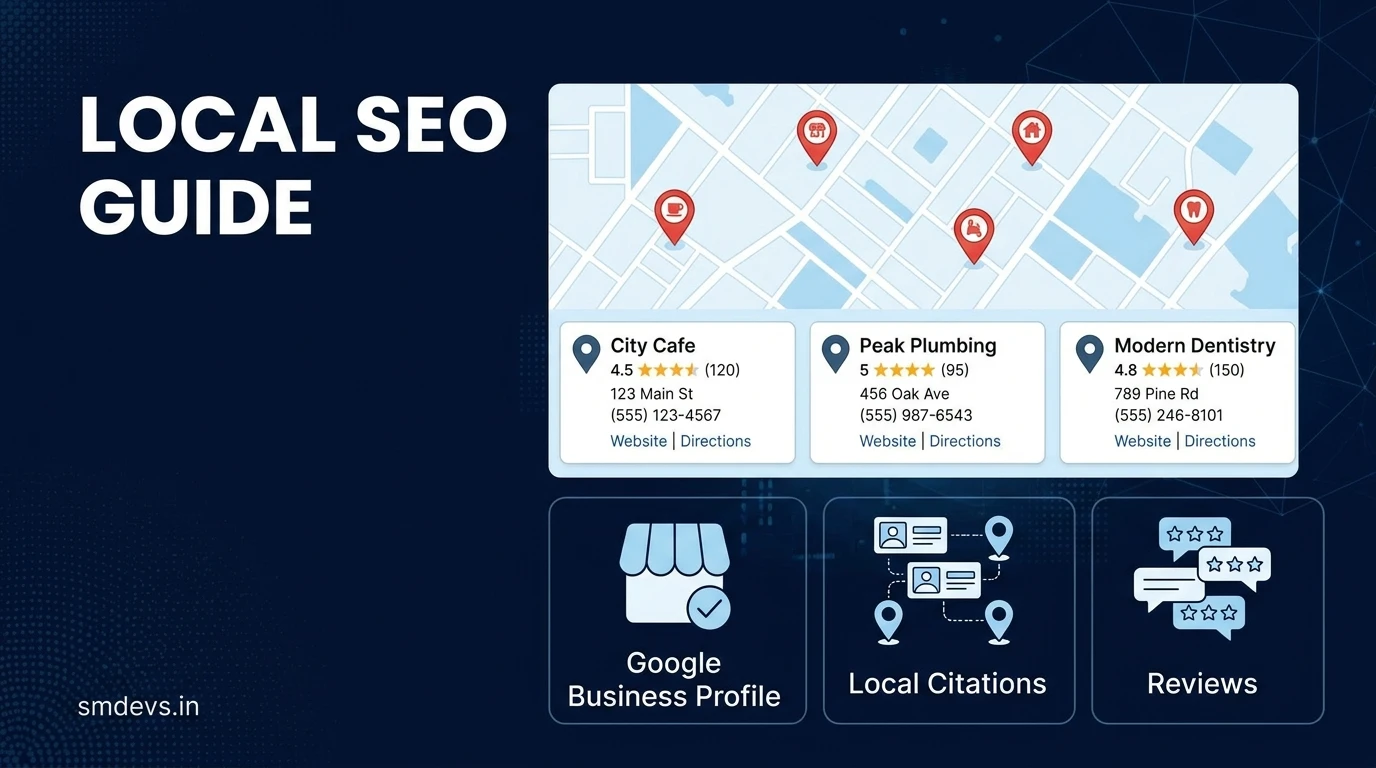
For any business that serves customers in a specific geographic area — retail stores, restaurants, clinics, law firms, service businesses, agencies — local SEO is not optional. It is the single highest-ROI marketing channel available. A business appearing in Google's "Local Pack" (the map and three business listings at the top of local search results) receives dramatically more calls, visits, and leads than one buried on page two.
How Google's Local Search Works
Google's local search algorithm uses three primary ranking factors — distinct from the general web search algorithm:
- Relevance: How well your business matches what the user is searching for. A business listed as "Indian restaurant" with detailed menu information is more relevant to "Indian food near me" than a restaurant with incomplete category information.
- Distance: How far your business is from the searcher's location (or the location specified in the query). Businesses physically closer to the searcher rank higher, all else being equal. Distance cannot be manipulated — only relevance and prominence can be optimized.
- Prominence: How well-known and trusted your business is — based on backlinks, reviews, social signals, Google Business Profile completeness, and how frequently your business appears across authoritative directories.
Key Takeaways
- Google Business Profile (GBP) is the #1 local SEO priority. A fully optimized, active GBP listing is the single most impactful local SEO action you can take.
- Reviews are a top-3 local ranking factor. Both the quantity and quality of reviews — and crucially, your response to them — directly influence your Local Pack ranking.
- NAP consistency is essential. Your business Name, Address, and Phone number must be exactly identical across every online directory, your website, and your GBP listing.
- "Near me" search volume has grown 500%+ in the last 5 years. Mobile local search is one of the highest-intent traffic sources available — these users are ready to visit or call.
- Local landing pages on your website are critical for multi-location businesses. Each location needs a dedicated, unique page optimized for its specific city/area keyword.
Step 1 — Google Business Profile Optimization
Google Business Profile (formerly Google My Business) is the free business listing that appears in Google Maps and the Local Pack. A fully completed, actively managed GBP listing is the foundation of local SEO.
Complete every field:
- Business name: Use your exact legal business name — do not insert keywords (this violates GBP guidelines and can result in suspension).
- Primary and secondary categories: Choose the most specific primary category that describes your business. Add all relevant secondary categories. Categories directly influence which queries your listing appears for.
- Address: Must be exact and verifiable — use the same format across all platforms.
- Phone number: Use a local phone number with area code, not a toll-free number. Local numbers signal genuine local presence.
- Website URL: Link to your homepage or a specific local landing page.
- Business hours: Keep hours precisely accurate — including special hours for holidays. Incorrect hours trigger negative reviews.
- Description: Write a 250–300 word description covering your services, areas served, and what makes your business unique. Include your primary local keyword naturally (not stuffed).
- Photos: Upload 10+ high-quality photos: exterior, interior, team, products, and in-action shots. GBP listings with photos receive 42% more requests for directions and 35% more click-throughs.
- Services/Products: Add all services with descriptions and pricing where applicable. These feed into the relevance algorithm.
- Q&A section: Pre-populate frequently asked questions yourself rather than leaving them to customers.
Active management:
- Post to GBP at least 2× per week — events, offers, new products, blog posts. Active posts signal a living, maintained business to Google.
- Respond to every review — positive and negative — within 24–48 hours.
- Update holiday hours before every holiday.
Step 2 — Reviews Strategy
Reviews are one of the most powerful and most neglected local SEO levers. Google uses review signals — total count, average rating, review velocity (how regularly new reviews arrive), and keywords within review text — as direct ranking inputs for the Local Pack.
How to get more reviews ethically:
- Ask in person: Train your staff to request reviews at the moment of highest customer satisfaction — just after a successful service delivery, a great meal, or a resolved support issue.
- SMS/email follow-up: Send a brief follow-up 24–48 hours after a service with a direct link to your Google review page (easily generated in your GBP dashboard).
- QR codes: Display a QR code at your location linking to your review page — on receipts, menus, waiting areas.
- Email signature: Add a "Review us on Google" link to your business email signature.
Critical: Respond to all reviews. Responding to positive reviews shows appreciation; responding to negative reviews demonstrates professionalism and often converts dissatisfied customers. More importantly, review responses are indexed by Google and can contain relevant local keywords naturally.
Step 3 — NAP Consistency and Local Citations
A local citation is any online mention of your business's Name, Address, and Phone number (NAP). Citations appear on business directories, review sites, social media, local news, and industry-specific platforms. Google cross-references your NAP data across these sources to validate that your business is real and trustworthy.
Priority citations for Indian businesses:
- Justdial, Sulekha, IndiaMART (high-authority Indian directories)
- Yelp India, Zomato (restaurants), Practo (healthcare), Housing.com (real estate)
- Facebook Business Page, LinkedIn Company Page
- Bing Places for Business (separate from Google — do this separately)
- Apple Maps Connect
- Industry-specific directories relevant to your niche
NAP consistency rule: If your GBP lists "123 MG Road, Suite 4, Bengaluru, Karnataka 560001" — every directory, your website contact page, and every other online mention must use the exact same format. Even small variations ("MG Rd" vs. "MG Road", "Bangalore" vs. "Bengaluru") can create trust conflicts in Google's local algorithm.
Step 4 — Local SEO on Your Website
Your website must reinforce the local signals in your GBP listing:
- Location-specific landing pages: Create a dedicated page for each location or service area you serve (e.g., /seo-agency-mumbai, /plumber-andheri). Each page should be unique — different content, not just city name substitutions.
- Local keyword usage: Include "[service] in [city/area]" keywords naturally in your title tags, H1s, and content. Example: "Best CA Firm in Pune | Tax Filing & GST Services"
- Embed Google Maps: Embed a Google Maps widget showing your location on your Contact page — this reinforces your location association to Google's crawler.
- LocalBusiness schema: Implement LocalBusiness JSON-LD schema on your homepage and location pages with full NAP data, business hours, and service area — making your local data machine-readable.
- Contact page: Must display your full NAP (exactly matching GBP), hours, and a clear map.
Step 5 — Local Link Building
Local backlinks from relevant, geographically relevant sources carry strong local authority signals:
- Sponsoring local events (schools, sports clubs, community events) and getting a link from the event page
- Being featured in local news coverage
- Joining your local Chamber of Commerce (usually includes a directory listing with a backlink)
- Partnering with complementary local businesses for referral links
- Getting listed in local government business directories
Frequently Asked Questions
How long does local SEO take to show results?
Local SEO typically shows measurable improvements faster than traditional SEO — often within 4–8 weeks for GBP optimization, and 2–3 months for more competitive Local Pack positions. However, building a dominant local presence with strong reviews, consistent citations, and local content takes 6–12 months of sustained effort. The GBP optimization actions (completing your profile, adding photos, starting to post, and responding to reviews) provide the fastest initial lift.
Can I rank in Google Maps without a physical address?
Google Business Profile requires a physical address for most business types. However, service-area businesses (plumbers, electricians, cleaners, consultants who travel to customers) can hide their address and instead specify a service radius or list of service cities. These service-area business listings can rank in the Local Pack for their specified service areas. If you primarily work from home, you can use a home address and mark it as hidden from public display while still verifying with Google.
Do negative reviews hurt local rankings?
Negative reviews impact two things: your star rating average (which influences click-through rate from the Local Pack) and user trust. However, a business with 200 reviews averaging 4.2 stars typically outperforms a competitor with 10 reviews averaging 4.9 stars — review volume and velocity matter more than a perfect score. The correct response to negative reviews is always a prompt, professional, empathetic reply — not suppression attempts. A well-handled negative review with a professional response can actually build trust with potential customers observing the exchange.
How important is Google Business Profile posting?
GBP posts (Google Posts) are moderately important — they appear directly in your listing in search results and Maps, providing additional content that can mention services, events, and promotions. More importantly, regular posting signals to Google that your business is active and engaged, which positively influences ranking. Businesses that post regularly tend to maintain and improve their Local Pack positions. Aim for 2–3 posts per week, each with a real photo and a clear message. Posts expire after 7 days for standard posts, 6 months for events.
Your Next Step
Start by verifying and fully completing your Google Business Profile today. Then implement LocalBusiness schema on your website and run a citation audit to find NAP inconsistencies. For the broader SEO foundation that supports your local presence, see our SEO Audit Checklist infographic and the Complete SEO Guide.