Key Takeaways
- Backlinks remain a top-3 Google ranking factor — quality completely dominates quantity
- One DR 80 link outweighs hundreds of low-authority links
- Best strategies: linkable assets, guest posting, broken link building, HARO, skyscraper technique
- Never buy links — it violates Google guidelines and risks devastating manual penalties
- Anchor text distribution matters — maintain a natural mix of branded, generic, and partial-match
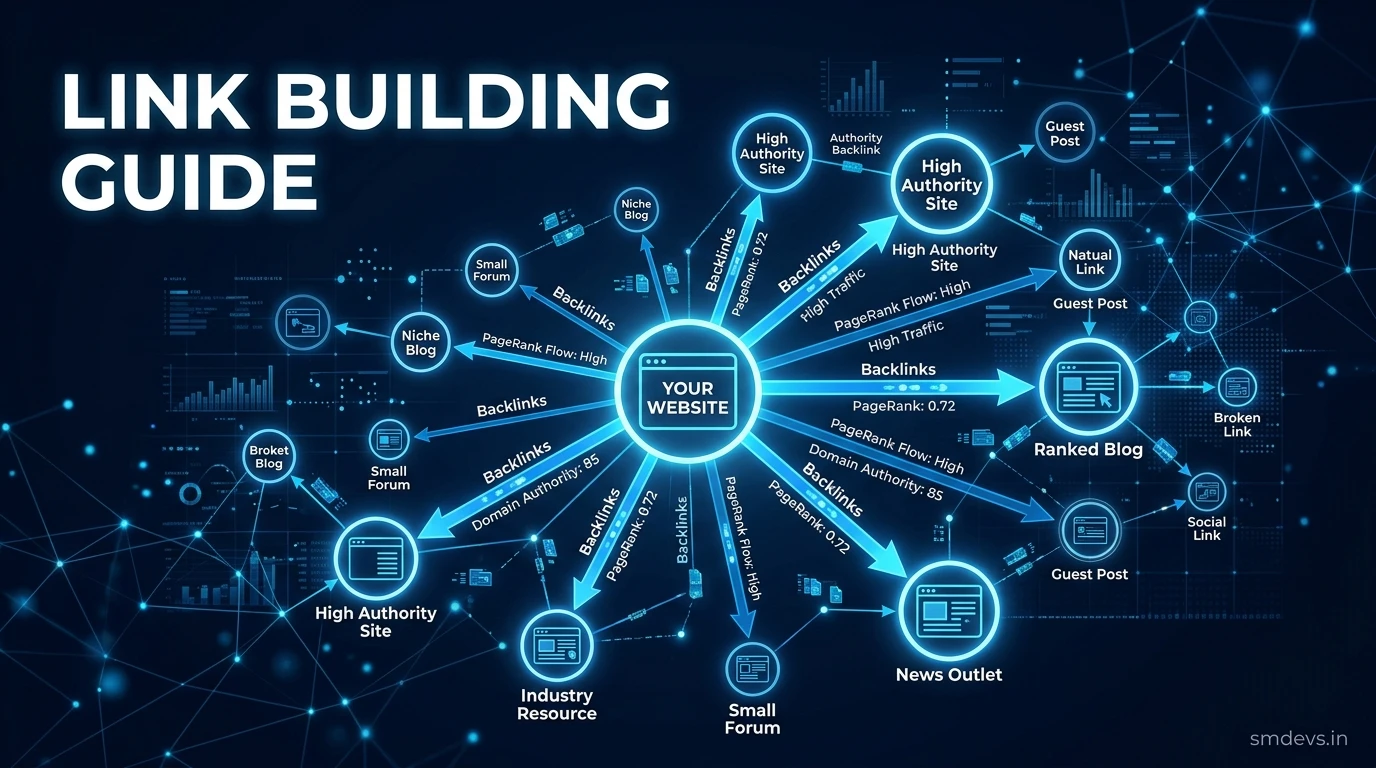
Backlinks — links from other websites pointing to yours — remain one of Google's top three ranking factors after more than two decades of algorithm evolution. Despite every Google update, every AI integration, and every new ranking signal that has been added over the years, the fundamental importance of backlinks has not diminished. If anything, the quality bar has risen: a handful of genuinely authoritative, contextually relevant backlinks now outweigh hundreds of low-quality links.
This guide covers everything you need to know about link building — what makes a backlink valuable, the most effective strategies for earning links in 2026, what to avoid, and how to measure your progress.
Why Backlinks Matter
When another website links to yours, it is effectively casting a vote of confidence in your content. Google treats these "votes" as signals of authority and trustworthiness. Pages with more high-quality backlinks rank higher because, in Google's logic, content that many credible sources choose to reference is more likely to be genuinely valuable than content nobody links to.
This principle has remained the core of Google's PageRank algorithm — first described in the original 1998 Google paper — and continues to be the most reliable proxy for authority that exists at web scale.
The evidence is clear: In virtually every competitive niche, the pages ranking in the top 3 positions have significantly more high-quality backlinks than the pages ranking positions 4–10. Link building is not optional for competitive SEO.
Key Takeaways
- One link from a high-authority, relevant site is worth more than 100 low-quality links. Quality completely dominates quantity in modern link building.
- Anchor text matters. Descriptive, keyword-relevant anchor text passes stronger relevance signals than generic text ("click here").
- Links must be earned, not bought. Google's guidelines explicitly prohibit buying links. Paid links that violate these guidelines risk manual penalties that can devastate rankings.
- Content is the prerequisite. Nobody links to mediocre content. You must have genuinely link-worthy pages before you can build links to them.
- Topical relevance amplifies link value. A link from a site in your industry is worth more than a link from an unrelated site with a higher authority score.
What Makes a Backlink Valuable?
1. Domain Authority / Domain Rating
The overall authority of the linking domain, measured by third-party tools like Ahrefs (Domain Rating / DR) and Moz (Domain Authority / DA). Higher-authority sites pass more PageRank. A link from a DR 80 site carries vastly more weight than one from a DR 15 site.
2. Topical Relevance
A link from a site that covers the same topics as yours is more valuable than a link from an unrelated high-authority site. Google's Reasonable Surfer model gives more weight to links that appear to be natural editorial choices — and a finance site naturally linking to your finance guide is more natural than a cooking site linking to it.
3. Link Placement
In-content links (within the main body text of an article) are significantly more valuable than sidebar links, footer links, or navigation links. In-content links appear as genuine editorial recommendations; footer links are often treated as paid or navigational links with reduced authority.
4. Anchor Text
The clickable text of the link sends a relevance signal to Google. Anchor text categories:
- Exact match: "keyword research guide" — sends the strongest relevance signal but should make up only 5–10% of your anchor text profile to avoid over-optimization.
- Partial match: "complete guide to keyword research" — natural-sounding, good signal.
- Branded: "SM Developers" or "smdevs.in" — the most natural profile. Should make up 30–40% of a healthy anchor text profile.
- Generic: "click here," "read more," "this article" — minimal relevance signal but natural.
- Naked URL: "https://smdevs.in/..." — natural, moderate signal.
5. Dofollow vs. Nofollow
Dofollow links pass PageRank directly to the linked page. Nofollow links (rel="nofollow") instruct Google not to follow the link and traditionally do not pass PageRank. In 2019, Google introduced additional link attributes — rel="sponsored" for paid links and rel="ugc" for user-generated content — and moved to treating these as "hints" rather than absolute directives. Focus on building dofollow links; nofollow links still have value for brand awareness and referral traffic.
The 8 Most Effective Link Building Strategies in 2026
1. Create Linkable Assets
The foundation of all successful link building. A linkable asset is any piece of content so genuinely useful that other sites naturally want to reference it: original research with data, comprehensive guides, free tools, infographics, calculators, glossaries, or industry reports.
Without linkable assets, every other link building strategy becomes significantly harder — you are asking people to link to average content instead of exceptional resources.
Examples of high-performing linkable assets: Original surveys with industry data, free tools (calculators, analyzers), definitive guides (1,500+ words covering a topic more comprehensively than anything else), and visual explainers (infographics, process diagrams).
2. Guest Posting
Writing articles for other websites in exchange for a byline and a link back to your site. Still one of the most effective link building strategies when done correctly — targeting genuinely authoritative, relevant sites and writing genuinely useful content for their audience.
How to guest post effectively:
- Target sites with a real audience and relevant topical coverage — not "write for us" link farms
- Pitch unique, data-driven, or opinion-driven articles — not generic how-to pieces every site already has
- Write for the host site's audience, not for the link — quality guest posts that serve the reader build relationships that lead to more links over time
- Include your contextual link naturally within the body content, not only in the author bio
3. Broken Link Building
Find broken external links on authoritative sites in your niche, then reach out to the site owner to suggest your relevant content as a replacement. This works because you are providing value — helping them fix a broken user experience — rather than just asking for a link.
Process: Use tools like Ahrefs, Check My Links (Chrome extension), or Screaming Frog to find broken links on relevant sites. Create or identify content on your site that would serve as a natural replacement. Reach out with a friendly, specific email noting the broken link and suggesting your resource.
4. HARO and Media Outreach (Digital PR)
HARO (Help a Reporter Out) connects journalists and bloggers seeking expert sources with people who can provide quotes or data for their articles. When a journalist quotes you, they typically link back to your site. Responding consistently to relevant HARO queries can generate high-authority links from media outlets — one of the most powerful link types available.
Broader digital PR extends this concept: creating newsworthy stories, original research, or compelling data studies that journalists want to cover — generating editorial links from news sites, industry publications, and blogs without direct outreach.
5. Resource Page Link Building
Many websites maintain "resources" or "links" pages that curate the best tools, guides, or references for their audience. Find resource pages in your niche and suggest adding your content if it genuinely belongs there.
Search Google for: "best [topic] resources" site:[niche-related domain], or "useful [topic] links" intitle:resources. Contact the site owner with a specific, brief, polite suggestion — including why your resource would genuinely serve their readers.
6. Skyscraper Technique
Identify the most-linked-to piece of content on a topic in your niche. Create a significantly better version — more current, more comprehensive, better designed, with original data. Then reach out to all sites linking to the original piece to inform them of the superior resource.
This works because sites already demonstrated willingness to link to this topic — you are simply offering them a better option.
7. Testimonials and Reviews
If you use a product or service and genuinely enjoy it, offer to provide a testimonial. Many companies feature testimonials on their website with a link back to the reviewer's site. This is a fast, low-effort way to earn relevant links, though the link quality depends entirely on the domain authority of the company's site.
8. Internal Link Building (Often Overlooked)
Not external, but crucial: internal links that point from high-authority pages on your site to pages you want to rank better. Internal links distribute PageRank across your site, help Google discover new content, and send relevance signals through anchor text. Every new post you publish should link to 3–5 relevant existing pages — and every existing page should link to new relevant content when it's published.
What to Avoid — Black Hat Link Building
- Buying links: Paying for backlinks violates Google's guidelines and risks manual penalties that can remove your site from search results entirely.
- Link farms and PBNs (Private Blog Networks): Artificially created networks of sites that link to each other. Google has become very effective at identifying and devaluing these.
- Comment spam: Posting links in blog comment sections at scale. Almost universally nofollow and entirely ineffective.
- Reciprocal link schemes: "I'll link to you if you link to me" at scale is a link scheme that can trigger penalties.
- Low-quality directory submissions: Mass submissions to irrelevant directories provide no value and may dilute your link profile.
How to Measure Your Link Building Progress
| Metric | Tool | What It Tells You |
|---|---|---|
| Number of referring domains | Ahrefs, Moz, our Link Profile Analyzer | Total unique sites linking to you — most important backlink metric |
| Domain Rating / Authority | Ahrefs DR, Moz DA | Overall link authority of your domain |
| New links acquired | Google Search Console, Ahrefs | Link velocity — how fast you are building |
| Lost links | Ahrefs, GSC | Links that disappeared — may need reclamation |
| Anchor text distribution | Ahrefs, our Link Profile Analyzer | Check for over-optimization of exact-match anchors |
| Organic ranking changes | Google Search Console | Ultimately what link building is for |
Frequently Asked Questions
How many backlinks do I need to rank on page one?
There is no universal number — it depends entirely on the competition for your target keyword. For low-competition long-tail keywords in a small niche, you may rank with zero backlinks if your content is comprehensive and your technical SEO is clean. For competitive head keywords in established industries, top-ranking pages may have thousands of referring domains. Use Ahrefs or Moz to analyze the backlink profiles of the pages currently ranking in the top 5 for your target keyword — that tells you the actual benchmark for your specific competitive landscape.
How long does it take to see results from link building?
Backlink effects on rankings typically appear within 4–12 weeks of Google discovering and processing the new link. However, the compounding effects of a link building campaign — where increased authority from new links lifts multiple pages simultaneously — take 6–12 months to fully materialize. Link building is a long-term strategy; evaluate results over quarters and years, not days and weeks.
Should I disavow low-quality backlinks?
In most cases, no. Google has become very effective at ignoring low-quality links without them causing active harm. Manual disavow (using Google Search Console's disavow tool) is only recommended if: (1) you have received a manual penalty specifically citing unnatural links, (2) you can identify a large spike of clearly spammy links that could have been created by a competitor (negative SEO), or (3) your site has a legacy of black hat link building that needs cleaning up. Randomly disavowing links without clear evidence of harm risks disavowing legitimate links and hurting your rankings.
Is link building still worth doing in 2026?
Yes — more than ever for competitive keywords. While Google's algorithms have become more sophisticated, the fundamental role of backlinks as an authority signal has not diminished. What has changed is the quality bar: low-quality link building (directories, comment spam, link farms) is now worthless or harmful, while high-quality link building (earned editorial links from relevant authority sites) is as powerful as it has ever been. Sites that invest in consistent, quality link building maintain a compounding competitive advantage over those that rely on content alone.
Your Next Step
Audit your current backlink profile with our free Link Profile Analyzer. Then review the Backlink Building Strategy infographic for a visual reference of the highest-priority tactics. And build the link-worthy content foundation with the Topic Cluster Strategy guide.