Key Takeaways
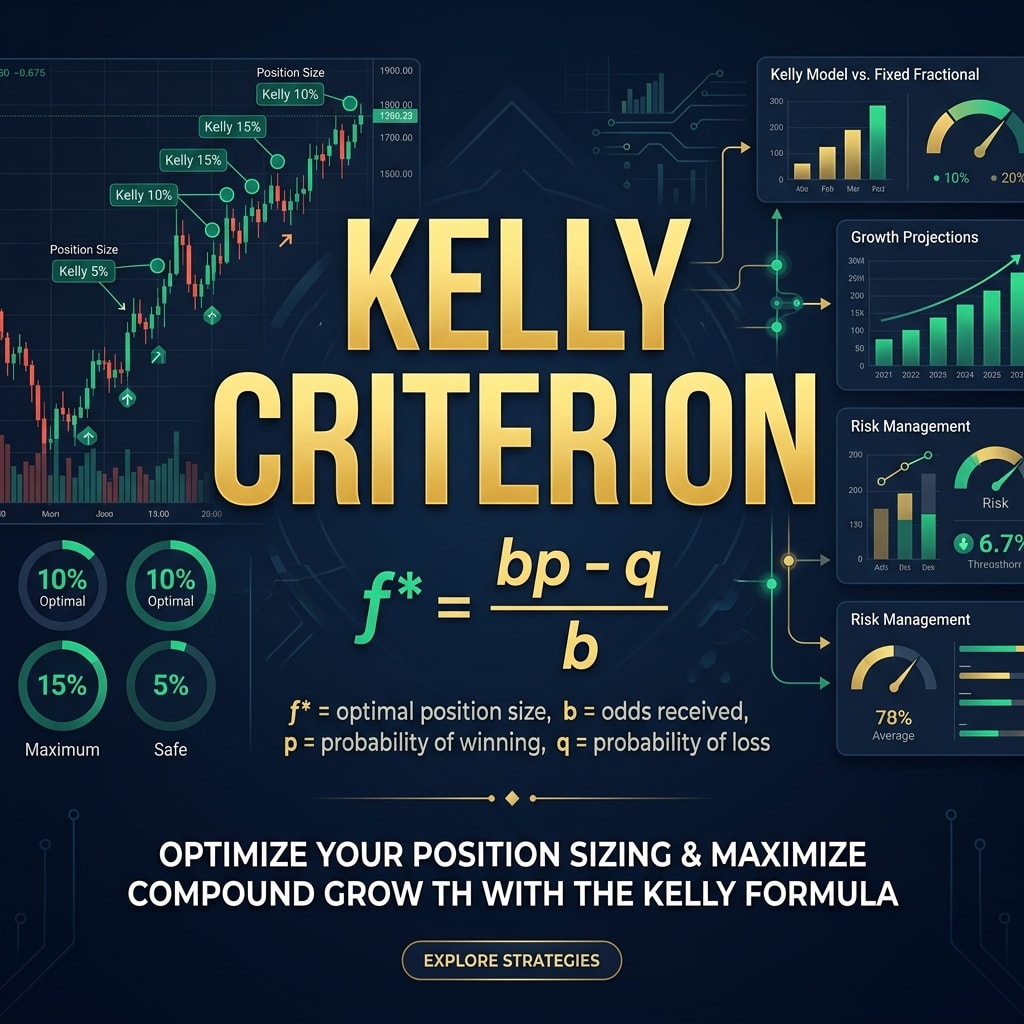
- The Kelly Criterion formula is f* = (bp - q) / b where b = win/loss ratio, p = win rate, q = loss rate
- Kelly tells you the optimal fraction of capital to risk per trade for maximum geometric growth
- Full Kelly is aggressive — most professional traders use Half-Kelly (50% of the result)
- A negative Kelly result means the trade has no edge — don't take it
- Use SM Developers' Position Size Calculator to apply Kelly-based sizing to your trades
What Is the Kelly Criterion?
The Kelly Criterion is a mathematical formula developed by physicist John L. Kelly Jr. in 1956 while working at Bell Labs. Originally designed for telephone signal transmission efficiency, it was quickly adopted by gamblers and later by professional traders to determine the optimal fraction of capital to bet on each trade or investment.
In trading, the Kelly Criterion answers one of the most practically important questions in risk management: given your win rate and average profit/loss ratio, what percentage of your capital should you risk on each trade to maximize long-term account growth?
The answer is not arbitrary. It is mathematically optimal.
The Kelly Criterion Formula Explained
The Kelly formula is:
f* = (bp - q) / bWhere:
- f* = the fraction of capital to risk (the Kelly percentage)
- b = the net odds received on the bet, or your average win/loss ratio (average winner ÷ average loser)
- p = the probability of winning (your win rate as a decimal, e.g. 55% = 0.55)
- q = the probability of losing (1 − p)
An equivalent and often more intuitive version of the formula is:
f* = (Win Rate / Loss Rate) - (Loss Rate / Win/Loss Ratio)Kelly Criterion Worked Example
Let's say you have a trading system with:
- Win rate: 55% (0.55)
- Average winning trade: $300
- Average losing trade: $150
- Win/loss ratio (b): $300 ÷ $150 = 2.0
Plugging into the formula:
f* = (2.0 × 0.55 - 0.45) / 2.0
f* = (1.10 - 0.45) / 2.0
f* = 0.65 / 2.0
f* = 0.325 or 32.5%
Kelly says you should risk 32.5% of your capital on each trade. That sounds aggressive — because it is. Full Kelly maximizes the geometric growth rate of your account, but it also produces significant drawdowns and extreme volatility along the way.
| Win Rate | Win/Loss Ratio | Full Kelly % | Half-Kelly % |
|---|---|---|---|
| 55% | 1.5:1 | 18.3% | 9.2% |
| 55% | 2.0:1 | 32.5% | 16.3% |
| 60% | 1.5:1 | 26.7% | 13.3% |
| 45% | 3.0:1 | 21.7% | 10.8% |
| 40% | 2.0:1 | 10.0% | 5.0% |
Why Professional Traders Use Half-Kelly
Full Kelly is mathematically optimal in theory. In practice, it produces drawdowns that most traders cannot psychologically or practically sustain. A 32.5% risk per trade will generate account swings of 40–60% during losing streaks that are completely normal within the statistical distribution of any trading system.
Professional traders — including legendary investors like Ed Thorp, who applied Kelly to blackjack and financial markets — consistently use Half-Kelly: risking exactly 50% of what the formula suggests.
Half-Kelly achieves approximately 75% of the maximum geometric growth rate while reducing drawdowns by roughly 50%. This is the pragmatic trade-off that makes the system survivable over a career.
What a Negative Kelly Result Means
If the Kelly formula produces a negative number, the message is unambiguous: this trade has no statistical edge. Do not take it.
Example: Win rate of 40%, win/loss ratio of 1.2:1
f* = (1.2 × 0.40 - 0.60) / 1.2 = (0.48 - 0.60) / 1.2 = -0.10Negative Kelly means the expected value of the trade is negative. Over a large sample of trades, this system loses money. No position sizing strategy — Kelly or otherwise — can turn a negative-expectancy system into a profitable one. The edge problem must be fixed first.
3 Critical Inputs: Getting Your Numbers Right
The Kelly Criterion is only as accurate as the data you feed it. Three inputs must be calculated from your actual trading history — not from wishful thinking.
- Win Rate: Calculate from your last 100+ trades minimum. Fewer than 50 trades produces statistically unreliable results.
Win Rate = Winning Trades / Total Trades - Average Winner: The mean profit across all winning trades. Include only closed, realized profits.
- Average Loser: The mean loss across all losing trades. Include slippage and commissions for accuracy.
Most traders overestimate their win rate and underestimate their average loss. Run the numbers on your actual history before applying Kelly.
Kelly Criterion vs Fixed Percentage Risk
| Method | What It Optimizes | Drawback | Best For |
|---|---|---|---|
| Fixed % (1–2% rule) | Capital preservation | Under-bets high-edge trades | Beginners, volatile markets |
| Full Kelly | Maximum growth rate | Extreme drawdowns, psychologically brutal | Theory only |
| Half-Kelly | Growth + drawdown balance | Requires accurate statistics | Experienced systematic traders |
| Quarter-Kelly | Capital preservation + growth | Slower compounding | Conservative traders, new strategies |
How to Apply the Kelly Criterion to Your Trades
- Track your last 100+ trades and calculate win rate, average winner, and average loser
- Plug into the formula:
f* = (b × p - q) / b - Multiply the result by 0.5 to get your Half-Kelly position size
- Apply that percentage to your current account balance to get the dollar risk amount per trade
- Use the Position Size Calculator to convert your dollar risk into the correct number of shares, lots, or contracts
- Recalculate Kelly every 3–6 months as your system statistics update
Kelly Criterion and the Break-Even Connection
Before applying Kelly sizing, always calculate your break-even price for the trade. Kelly tells you how much to risk. Break-even tells you where you must be right for the trade to not lose money. These two numbers define the full risk framework before you enter.
Common Kelly Criterion Mistakes
- Using too small a sample: 20 trades is not enough to establish win rate. Use 100+ trades minimum.
- Ignoring fees and slippage: Every dollar of friction reduces your win/loss ratio and therefore your Kelly percentage.
- Not recalculating: Your edge changes as markets change. Static Kelly numbers go stale.
- Applying Full Kelly: Very few real-world traders can sustain the drawdowns. Start with Quarter-Kelly and scale up.
- Applying Kelly to correlated positions: Kelly assumes independence between bets. Simultaneously holding correlated positions (e.g., two tech stocks) violates this assumption and overstates the safe bet size.
Key Takeaways
- Kelly Criterion formula: f* = (bp - q) / b — inputs are win rate and win/loss ratio
- A positive Kelly result gives the optimal risk fraction for maximum geometric account growth
- A negative Kelly result means the strategy has no edge — do not trade it
- Professional traders consistently use Half-Kelly to balance growth with survivable drawdowns
- Accurate trade statistics (100+ trade sample) are essential for reliable Kelly results
- Pair Kelly sizing with the Position Size Calculator and Risk-Reward Calculator for a complete pre-trade framework
What is the Kelly Criterion in simple terms?
The Kelly Criterion is a formula that tells you what percentage of your capital to risk on each trade to grow your account as fast as mathematically possible. It factors in your win rate and average profit-to-loss ratio. The result is the exact bet size that maximizes long-term wealth — risk less and you grow slower than optimal; risk more and you risk ruin.
How do you calculate the Kelly Criterion?
The formula is f* = (bp - q) / b, where b is your win/loss ratio (average winner divided by average loser), p is your win rate as a decimal, and q is your loss rate (1 - p). Example: 55% win rate, 2:1 win/loss ratio gives f* = (2 × 0.55 - 0.45) / 2 = 32.5%. Most traders use Half-Kelly, so they would risk 16.25% per trade.
What does a negative Kelly Criterion mean?
A negative Kelly result means your trading system has no statistical edge — the expected value per trade is negative. No position sizing technique can fix a negative-expectancy system. A negative Kelly is a clear signal to stop trading that strategy, fix the entry/exit rules, and recalculate once the underlying statistics improve.
Why do traders use Half-Kelly instead of Full-Kelly?
Full Kelly maximizes the mathematical growth rate but produces extreme drawdowns during normal losing streaks. Most traders cannot sustain 40-60% account drawdowns psychologically or practically. Half-Kelly achieves roughly 75% of the maximum growth rate with approximately half the drawdown — making it survivable as a long-term strategy.
How many trades do I need to calculate Kelly Criterion accurately?
A minimum of 100 completed trades is the practical standard for reliable Kelly calculations. Fewer than 50 trades produces statistically unreliable win rate and average win/loss ratios due to sample variance. The larger your trade sample, the more accurately your Kelly percentage reflects your true edge.