Key Takeaways
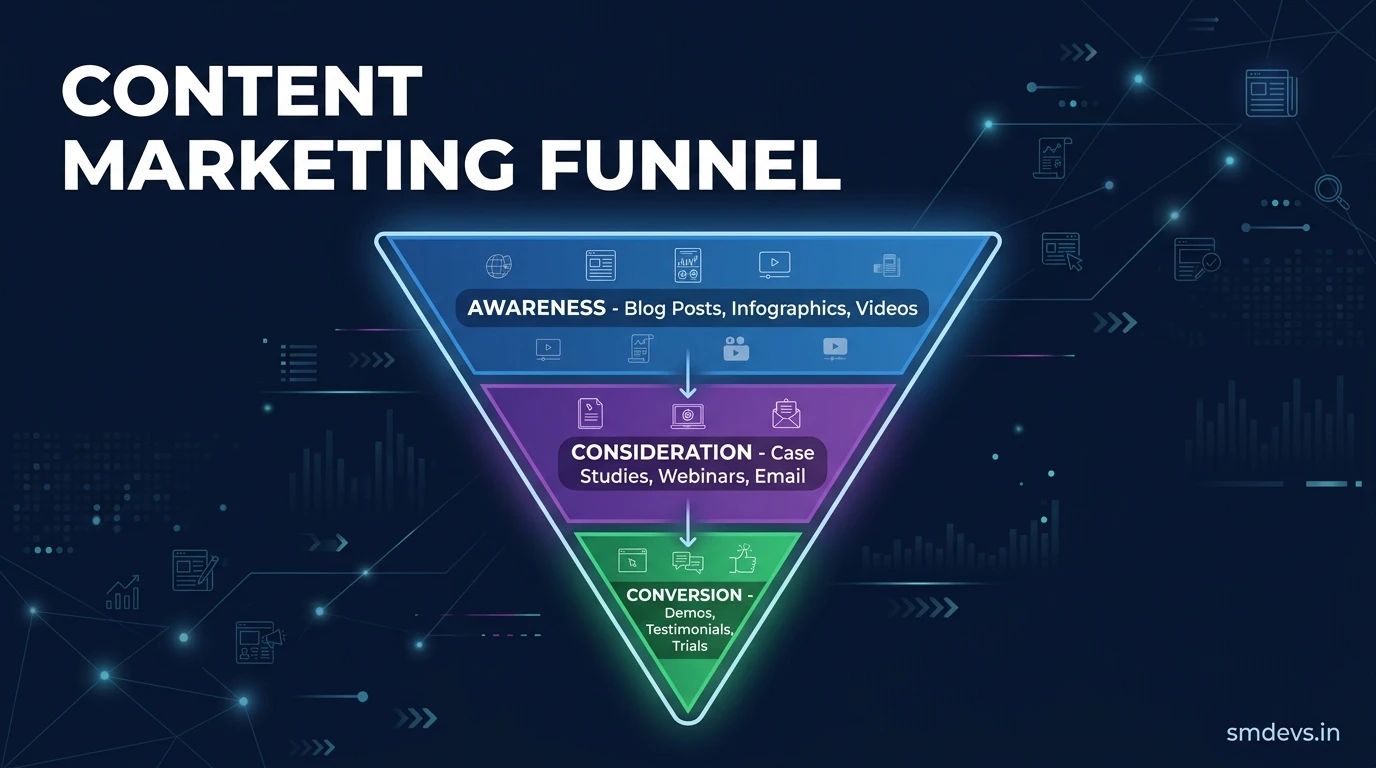
- TOFU (Awareness): blog posts, infographics, videos — attract and educate
- MOFU (Consideration): case studies, webinars, email sequences — build trust and capture leads
- BOFU (Conversion): demos, testimonials, free trials — remove objections and close
- Most businesses are 70–80% TOFU and massively underinvested in MOFU
- Measure each stage with different metrics: reach, leads, and conversions respectively
The single biggest reason content marketing fails is not poor writing quality, infrequent publishing, or lack of SEO optimization. It is content that targets the wrong stage of the buyer's journey. A brilliant, well-researched article on "how to choose the best CRM software" will not convert readers into buyers if those readers are just discovering what a CRM is. The content-to-funnel alignment problem is endemic across industries — and fixing it is one of the highest-ROI improvements you can make to your content strategy.
This guide maps every content format to the correct stage of the marketing funnel and gives you the framework to build a content library that moves people from discovery to decision.
What Is the Content Marketing Funnel?
The content marketing funnel is a model that maps the stages of a buyer's journey — from first awareness of a problem or need, through consideration of solutions, to a final purchase decision — and identifies which types of content are most effective at each stage.
The three stages are:
- TOFU — Top of Funnel (Awareness): The prospect has a problem or question but may not yet know a solution exists. Content at this stage educates and attracts.
- MOFU — Middle of Funnel (Consideration): The prospect is actively evaluating options. Content here compares, demonstrates, and nurtures trust.
- BOFU — Bottom of Funnel (Conversion): The prospect is ready to decide. Content here removes remaining objections and drives action.
Key Takeaways
- Most businesses only create TOFU content and then wonder why their blog traffic doesn't convert. Build all three stages.
- Mismatched content-to-funnel stage is the #1 content ROI killer. A product demo shown to someone at the awareness stage will be ignored.
- BOFU content has the highest direct conversion value but requires the smallest volume. A single well-crafted case study can close multiple deals.
- The goal of each stage is different: TOFU builds reach, MOFU builds trust, BOFU drives action.
- Content metrics differ by stage: TOFU → pageviews/reach; MOFU → time on page, email opens; BOFU → conversion rate, revenue.
Top of Funnel (TOFU) — Awareness Stage
At the top of the funnel, your prospect is experiencing a problem or asking a broad question. They may not know your brand exists. TOFU content must be discoverable, educational, and broadly valuable — it should solve a problem or answer a question without asking for anything in return.
TOFU content goals: Build brand awareness, attract organic traffic, position your brand as a helpful authority in the space.
Best TOFU content formats:
- Blog posts and long-form guides: Target informational keywords ("what is X," "how to do Y," "why does Z happen"). These attract top-of-funnel organic search traffic at high volume.
- Infographics: Visual, easily shareable, ideal for complex concepts. Strong for social media and backlink acquisition. See the SM Developers Infographics Hub for examples.
- Short-form social videos: YouTube Shorts, Instagram Reels, TikTok — educational snippets that reach new audiences through platform algorithms.
- Podcasts and video interviews: Build deeper brand awareness and authority through long-form audio/video content.
- Social media posts: Repurposed insights from longer content, delivered to your existing audience and their extended networks.
TOFU success metrics: Organic traffic, impressions, social reach, backlinks earned, brand search volume growth.
Middle of Funnel (MOFU) — Consideration Stage
At this stage, your prospect knows their problem and is actively researching solutions. They are comparing options, reading reviews, and trying to determine which solution — and which provider — is the best fit for their specific situation. MOFU content must demonstrate your superiority over alternatives and build enough trust that the prospect is willing to take the next step.
MOFU content goals: Educate prospects on your specific solution, differentiate from competitors, capture leads, and nurture relationships.
Best MOFU content formats:
- Case studies: Real stories from real customers showing specific, measurable outcomes. The most persuasive MOFU content for B2B. Include concrete numbers: "Increased organic traffic by 340% in 6 months."
- Comparison guides: "X vs. Y" content that honestly compares your solution with alternatives. Ranking for comparison keywords ("your product vs. competitor") captures prospects in active evaluation mode.
- Webinars and live demos: Real-time interaction builds trust faster than static content. Webinars also generate leads through registration.
- Email nurture sequences: Automated email campaigns that deliver progressive educational content to prospects who have joined your list. The goal is to move them from interested to confident.
- Free tools and templates: Tools that solve a real problem demonstrate your expertise in action while keeping prospects engaged with your brand. (Our own free SEO tools are a MOFU example.)
- In-depth guides and whitepapers: Downloadable comprehensive content that requires a small commitment (email address) in exchange — the most common lead generation mechanism at MOFU.
MOFU success metrics: Email subscribers, webinar registrations, content downloads, time on site, return visit rate.
Bottom of Funnel (BOFU) — Conversion Stage
At the bottom of the funnel, your prospect is ready to decide. They have done their research, compared their options, and are now weighing the final decision factors: price, trust, risk mitigation, and the confidence that your solution will work for them specifically. BOFU content removes the last objections and makes the decision easy.
BOFU content goals: Convert ready-to-buy prospects into customers. Remove friction. Build final confidence.
Best BOFU content formats:
- Free trials and freemium offers: "Try before you buy" dramatically reduces purchase risk. For SaaS and tool-based products, this is the most effective BOFU mechanism.
- Product demos and demo videos: Showing exactly how your product solves the prospect's specific problem in a live or recorded demo is the single highest-converting BOFU action for complex products.
- Testimonials and social proof: Verified reviews, video testimonials, and logos of recognizable clients address the "will this work for me?" objection that prevents final conversion.
- Detailed pricing pages: Transparent pricing with clear feature comparisons removes the "I don't know how much it costs" friction that causes prospects to leave without converting.
- FAQ pages and objection-handling content: Explicitly address the most common reasons people don't buy — pricing concerns, implementation complexity, competitor comparisons.
- Consultation booking: For high-ticket or complex products, a free initial consultation reduces risk and creates a personal connection that pushes prospects over the decision line.
BOFU success metrics: Trial signups, demo bookings, consultation calls booked, revenue attributed, conversion rate.
Content Format Matrix — What Works Across Multiple Stages
| Content Format | TOFU | MOFU | BOFU |
|---|---|---|---|
| Blog posts | ✅ Primary | ✅ Secondary | — |
| Case studies | — | ✅ Primary | ✅ Secondary |
| Infographics | ✅ Primary | ✅ Secondary | — |
| Video (educational) | ✅ Primary | ✅ Secondary | — |
| Video (product demo) | — | ✅ Secondary | ✅ Primary |
| Email sequences | — | ✅ Primary | ✅ Secondary |
| Free tools | ✅ Secondary | ✅ Primary | ✅ Secondary |
| Testimonials | — | ✅ Secondary | ✅ Primary |
| Webinars | ✅ Secondary | ✅ Primary | ✅ Secondary |
| Pricing pages | — | — | ✅ Primary |
How to Audit Your Current Content Against the Funnel
- Export all your existing content (blog posts, landing pages, guides) into a spreadsheet.
- Tag each piece with its funnel stage: TOFU, MOFU, or BOFU.
- Count the distribution: most audits reveal 70–80% TOFU, 15–20% MOFU, and 5–10% BOFU.
- Identify gaps: if you have almost no MOFU content, that is why your traffic-to-lead conversion rate is low.
- Create a content calendar that deliberately fills the gaps over the next 90 days.
Frequently Asked Questions
How much content do I need at each funnel stage?
A healthy content distribution for most businesses is approximately 50–60% TOFU (drives discovery and traffic), 30–40% MOFU (converts visitors into leads), and 10–15% BOFU (converts leads into customers). The exact ratio depends on your business model, sales cycle, and current content gaps. Run a content audit to establish your baseline before building your content calendar.
What is the most commonly missing funnel stage?
MOFU content is almost universally underrepresented. Most companies create TOFU blog posts to attract traffic and BOFU landing pages to sell — but they have almost no content that bridges the gap and nurtures prospects through the consideration phase. The result is a large email list that never converts. Investing in case studies, comparison guides, and nurture email sequences typically produces the fastest ROI improvement for companies with this gap.
Can one piece of content work across multiple funnel stages?
Yes. Certain content formats naturally bridge stages — a comprehensive guide can serve TOFU audiences through organic search while also providing enough depth to serve MOFU audiences evaluating your expertise. In-depth case studies can work at both MOFU (demonstrates capability) and BOFU (removes final objections). Design content for a primary funnel stage but acknowledge it may also serve adjacent stages.
How do I measure content marketing ROI?
Measure ROI by tracking progression through the funnel: TOFU content → organic traffic and brand awareness metrics; MOFU content → lead generation (email subscribers, content downloads, webinar registrations); BOFU content → conversion rate and revenue attributed. Use UTM parameters to track which content pieces are last-touch before conversion. Over time, build a content attribution model that shows which TOFU pieces feed the MOFU pipeline and which MOFU pieces feed BOFU conversions.
Your Next Step
Download the Content Marketing Funnel infographic for a visual guide to content formats at each stage. To build the foundational SEO that drives TOFU traffic, see the Keyword Research Process infographic. And to build the topical authority that powers long-term TOFU traffic growth, read the Topic Cluster Strategy guide.