Key Takeaways
- Bull market = prices rising 20%+ from lows — average duration 4–5 years in historical data
- Bear market = prices falling 20%+ from highs — average duration 9–14 months
- The biggest bull market mistake: abandoning risk management at peaks due to FOMO
- The biggest bear market mistake: panic selling at the lows — locks in permanent losses
- Long-term investors should welcome bear markets as discounted buying opportunities
Bull market and bear market are two of the most fundamental terms in investing and trading — describing the two dominant market conditions that every investor will experience repeatedly throughout their investing lifetime. Understanding the characteristics, duration, psychology, and optimal strategies for each market condition is essential for making rational investment decisions instead of reactive ones.
What Is a Bull Market?
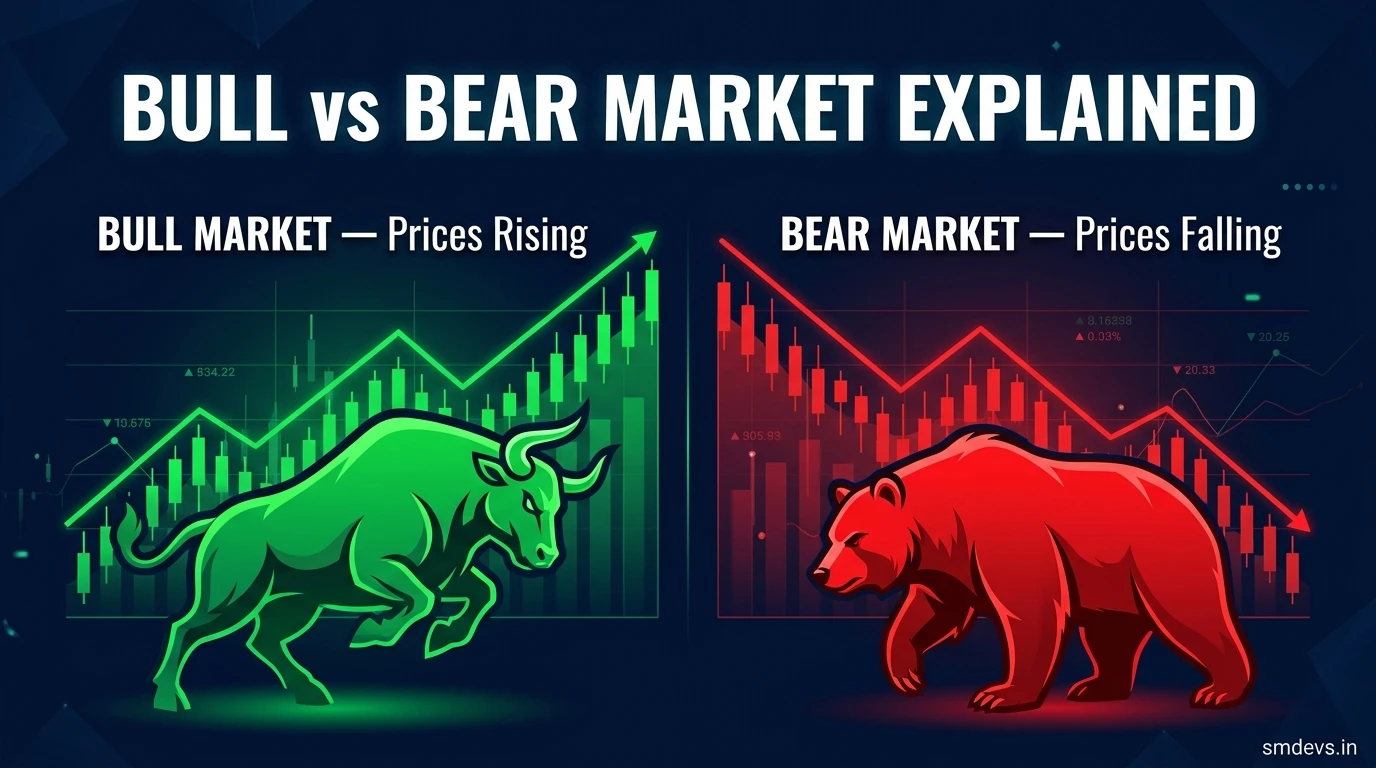
A bull market is a sustained period of rising asset prices, typically defined as a price increase of 20% or more from recent lows, accompanied by strong investor confidence, economic growth, and increasing corporate earnings. The term originates from the way a bull attacks — thrusting upward with its horns.
Characteristics of a bull market:
- Broad market indices (Nifty 50, Sensex, S&P 500) trending significantly higher over months to years
- Strong GDP growth and corporate earnings expansion
- Low unemployment and rising consumer confidence
- High investor optimism — FOMO (fear of missing out) is the dominant emotion
- Increasing IPO activity and elevated market valuations (high P/E ratios)
- Easy credit conditions — low interest rates encouraging borrowing and investment
- Rising volumes in equity markets as more retail investors participate
Historical bull markets in India (Nifty 50):
- 2003–2008: Nifty rose from ~1,000 to ~6,300 (+530%) — India's first major secular bull market
- 2009–2010: Post-global financial crisis recovery — Nifty doubled in 12 months
- 2014–2018: Modi government's first term, economic reform optimism
- 2020–2021: Post-COVID recovery — Nifty rose from ~7,500 to ~18,600 in 18 months
- 2023–2024: AI-driven global tech rally extending to Indian markets
What Is a Bear Market?
A bear market is a sustained period of declining asset prices, typically defined as a price decrease of 20% or more from recent highs, accompanied by widespread pessimism, economic contraction, and declining corporate earnings. The term comes from the way a bear attacks — swiping downward with its paws.
Characteristics of a bear market:
- Broad market indices falling 20%+ from their peaks over months
- Economic slowdown, recession fears, or actual recession
- Rising unemployment and declining consumer spending
- Fear and panic dominating investor sentiment — people selling at any price to "stop the losses"
- Compressed valuations as earnings expectations fall
- Tightening credit — rising interest rates or reduced lending
- Declining IPO activity; companies delaying or cancelling listings
Key Takeaways
- Bull markets last longer than bear markets on average. Historical analysis shows bull markets last 4–5 years on average; bear markets average 9–14 months.
- Bear markets are a normal, inevitable part of the market cycle. Every investor will experience multiple bear markets. Preparation, not avoidance, is the correct response.
- The biggest investing mistake in a bear market is panic selling. Selling at the lows locks in permanent losses and prevents participation in the eventual recovery.
- The biggest investing mistake in a bull market is abandoning risk management. "This time is different" thinking at market peaks has preceded every major crash.
- Long-term investors should welcome bear markets as opportunities to buy quality assets at discounted prices — Warren Buffett's "be greedy when others are fearful."
Bull Market vs. Bear Market — Key Comparisons
| Factor | Bull Market | Bear Market |
|---|---|---|
| Price direction | Rising 20%+ from lows | Falling 20%+ from highs |
| Average duration | 4–5 years | 9–14 months |
| Average magnitude (India) | +100–500% | −30–60% |
| Dominant emotion | Greed, FOMO, optimism | Fear, panic, despair |
| Economic context | GDP growth, low unemployment | Recession fears or actual recession |
| Interest rates | Often low (accommodative RBI/Fed) | Often rising (tightening cycle) |
| Investor behaviour | Buying dips, IPO enthusiasm | Selling rallies, holding cash |
Market Cycle Phases — Where Are We Now?
Markets don't move in simple straight lines — they cycle through four identifiable phases within the broader bull/bear framework:
- Accumulation (Early Bull): Smart money — institutions, value investors — begin buying as fear is at its peak and prices are at or near the bottom. Markets are quiet; mainstream media is still pessimistic. Best time to buy for long-term investors.
- Mark-up (Mid-to-Late Bull): Prices rise steadily as economic fundamentals improve. Retail investors begin participating. Momentum is strong, sentiment improves. The longest and most profitable phase for most investors.
- Distribution (Market Top): Smart money begins selling to late retail investors who are buying at the top out of FOMO. Valuations are stretched (high P/E ratios). Market shows narrowing breadth — only a few large-cap stocks continue rising while small and mid-caps peak first.
- Mark-down (Bear Market): Prices fall as institutional selling accelerates. Retail investors initially buy every dip ("it'll recover"), then panic-sell at the lows. Economic news turns negative, corporate earnings disappoint.
How to Invest in a Bull Market
- Stay invested — don't try to time the top. Staying invested through the entire bull market consistently produces better returns than trying to exit near the peak and re-enter after the correction.
- Maintain diversification. Bull markets tempt investors to concentrate in high-flying sectors. Diversification ensures you capture broad market gains without catastrophic concentration risk.
- Continue SIP contributions. Systematic Investment Plans working through a bull market accumulate units at rising prices — less advantageous than bear markets, but still building long-term wealth.
- Gradually increase equity allocation in early bull markets. The early accumulation phase — when pessimism is still high — offers the best risk/reward entry points for equity.
- Rebalance periodically. If equities have grown to 80% of your portfolio from a target of 60%, sell enough to rebalance — this naturally takes profit at higher prices.
How to Survive (and Profit From) a Bear Market
- Do not sell in panic. Bear market lows occur when fear peaks and selling is most intense. Selling at lows locks in maximum losses. Historical data shows that missing the 10 best market days in any decade due to panic-selling dramatically reduces long-term returns.
- Continue (or increase) SIP contributions. Bear markets are when SIP averaging works best — you accumulate more units at lower prices. These units generate outsized returns in the subsequent bull market recovery.
- Move to quality. In bear markets, lower-quality, high-debt companies fall much further than quality companies with strong balance sheets and free cash flow. Quality preservation is critical.
- Hold sufficient cash or liquid funds. Having 10–20% in liquid assets during a bear market lets you opportunistically buy extreme dips without being forced to sell other positions.
- Use the time to learn. Bear markets are the best time to deepen your investing and trading education — less FOMO, more time to research quality businesses at discounted prices.
Frequently Asked Questions
What is a market correction vs. a bear market?
A market correction is typically defined as a price decline of 10–19% from recent highs — smaller than the 20% threshold for a bear market. Corrections are normal occurrences, happening roughly every 12–18 months on average in most equity markets. They are shorter and shallower than bear markets. A correction becomes a bear market when the decline extends beyond 20% and economic fundamentals deteriorate to support a prolonged downtrend.
How long does it take for markets to recover from a bear market?
Recovery timelines vary significantly. The 2008 global financial crisis bear market took the Nifty 50 approximately 3–4 years to return to pre-crash levels. The COVID crash of 2020 recovered in under 18 months. The 2000 dot-com bust took Indian markets nearly 5 years to fully recover. On average, global equity markets have historically recovered from bear markets within 3–5 years — rewarding patient, invested long-term holders.
Can you profit from a bear market?
Yes — several strategies work in bear markets. Short selling (selling borrowed shares expecting to buy them back cheaper) profits from falling prices. Put options on indices or individual stocks rise in value as markets fall. Defensive sectors (FMCG, pharma, utilities) tend to outperform the broader market in downturns. Gold and gold ETFs historically rise during bear markets as a safe haven. And for long-term investors, investing consistently through a bear market generates the units that produce outsized bull market returns.
Is India in a bull or bear market in 2026?
We do not provide specific market condition assessments as this constitutes financial advice. To assess the current market cycle, examine: the Nifty 50's position relative to its 200-day moving average (above = generally bullish trend, below = bearish trend), the India VIX (fear gauge — spikes signal bear market conditions), trailing P/E ratio relative to historical averages, and RBI's interest rate posture (hiking cycle = tighter conditions). Always consult a registered financial advisor for personalized guidance.
Your Next Step
Use the Technical Analysis guide to identify market cycle phases on price charts. For trading within both market conditions, master the Trading Risk Management rules. And for long-term wealth building regardless of market phase, study SIP strategy and the SIP Calculator guide.