Key Takeaways
- Scalping requires a different risk-reward mindset than swing trading — most scalpers use a 1:1 to 1:1.5 risk-reward ratio.
- A lower RR works because scalpers compensate with a very high win rate — typically 65–75%+.
- With a 1:1 RR, you need to win more than 50% of trades just to break even after fees; at 1:1.5 you need ~40%.
- Brokerage and STT fees eat a much larger share of scalping profits — always calculate your break-even price before entry.
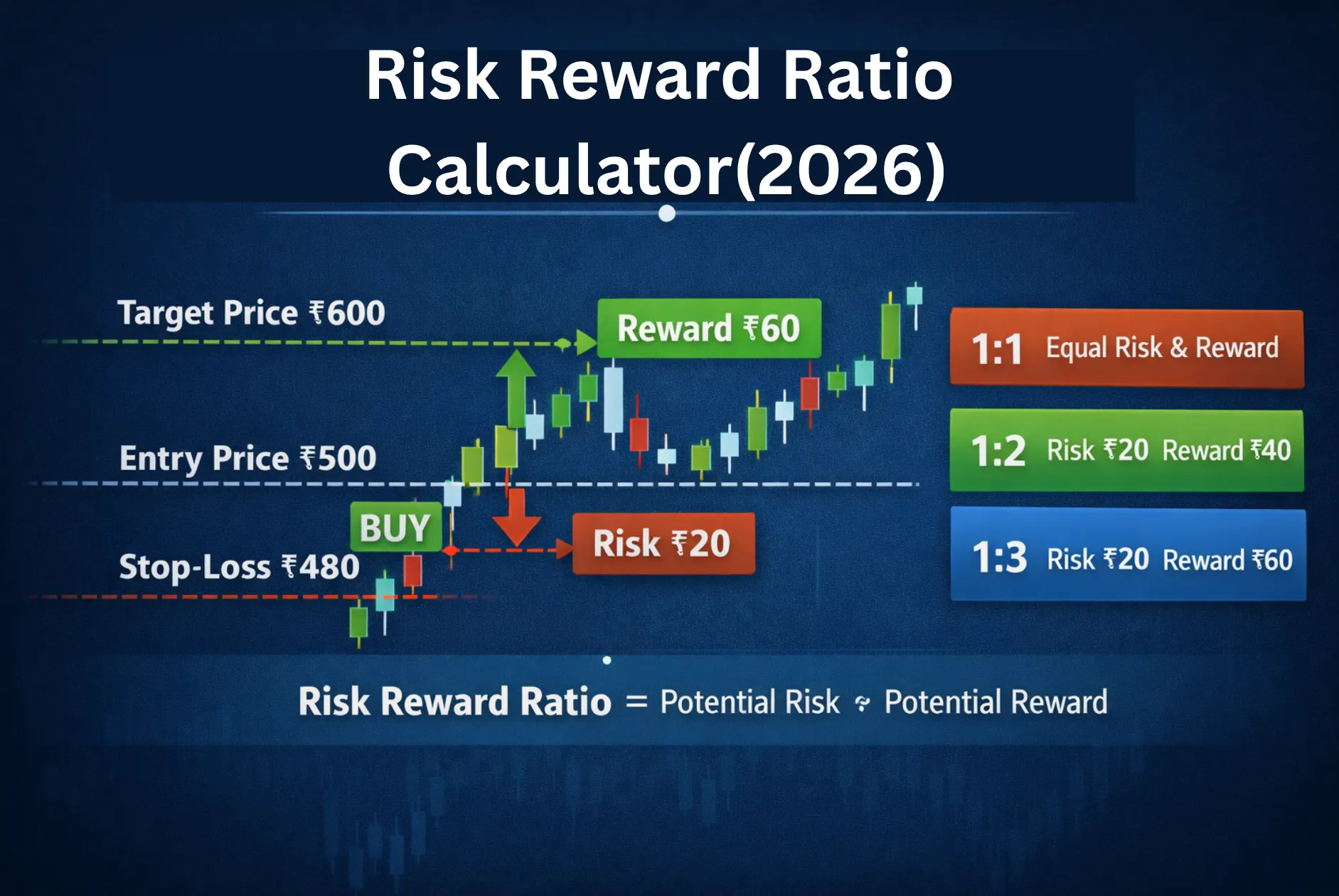
- Use our free Risk/Reward Calculator and Break-Even Calculator to plan every scalp before placing the order.
What Is the Best Risk-Reward Ratio for Scalping?
The best risk-reward ratio for scalping is typically 1:1 to 1:1.5 — meaning for every ₹1 you risk, you aim to make ₹1 to ₹1.50. This surprises traders who come from a swing trading background, where conventional wisdom demands a minimum 1:2 or 1:3 RR. Scalping is a fundamentally different style, and the rules that apply to position trading do not apply here.
Scalping involves taking many small trades across a session — often 10 to 30+ trades per day — with very tight stop-losses and small profit targets on 1-minute or 3-minute charts. The math of profitability works differently at this frequency and holding time.
Why Scalpers Use a Lower Risk-Reward Ratio
The confusion about scalping RR comes from applying swing trading logic to a different game. In swing trading, you might risk 1% to make 2–3% over days or weeks — a 1:2 or 1:3 ratio works because you hold the trade long enough for the full move to develop. Scalping does not give you that runway.
On a 1-minute chart, price rarely moves far before reversing. If you are entering near support with a 10-point stop, demanding a 20-point target (1:2 RR) means waiting for a move that may never come — or may come and reverse before you can exit. A 12–15 point target (1:1.2 to 1:1.5 RR) is far more achievable and keeps you in the trade long enough to let it work, without overstaying your welcome.
The Math: Why 1:1 RR Can Still Be Profitable for Scalpers
The profitability of any trading approach depends on two factors: win rate and risk-reward ratio. The formula for expected value per trade is:
Expected Value = (Win Rate x Avg Win) - (Loss Rate x Avg Loss)Let us compare three RR approaches for a scalper with a 68% win rate:
| RR Ratio | Win Rate Needed to Break Even | EV at 68% Win Rate |
|---|---|---|
| 1:1 | 50% | +36 per 100 risked |
| 1:1.5 | 40% | +62 per 100 risked |
| 1:2 | 33% | +68 per 100 risked (but win rate drops in practice) |
| 1:0.5 | 67% | +2 per 100 risked (dangerously thin margin) |
At a 68% win rate — achievable for a disciplined scalper on high-probability setups — a 1:1 RR produces a positive expected value. A 1:1.5 RR improves this significantly. The key insight: scalpers win with high frequency, not high RR. Swing traders win with high RR on fewer trades. Both can be profitable, but you cannot mix the two strategies.
Minimum Win Rate Required at Each RR Ratio
This table shows the minimum win rate needed to break even (before fees) at each RR level:
| Risk:Reward | Min Win Rate (Break Even) | Realistic for Scalping? |
|---|---|---|
| 1:0.5 | 67% | Extremely difficult to sustain |
| 1:1 | 50% | Achievable with good setup selection |
| 1:1.5 | 40% | The sweet spot for most scalpers |
| 1:2 | 33% | Achievable but targets often not reached |
| 1:3 | 25% | Rarely works on 1-minute charts |
The sweet spot for most scalpers is a 1:1.5 risk-reward ratio with a 55–70% win rate. This is achievable on high-probability setups — support/resistance bounces, pivot point reactions, first candle breakouts — and generates consistent positive expected value across a full trading session.
How to Set Scalping Targets Using Pivot Points
Pivot points are one of the most practical target-setting tools for scalpers because they define natural intraday support and resistance levels calculated from the previous session. When you enter a scalp near S1 (first support), your natural target is the central pivot point (PP). The distance from S1 to PP defines a mathematically sound reward — often 1.2x to 2x the distance from S1 to your stop below it.
Here is a common scalping setup using pivot levels:
- Price touches S1 and shows a bullish reversal candle (hammer, engulfing) on the 1-minute chart
- Entry: just above the bullish candle high
- Stop-loss: below S1 (typically 5–10 points below the candle low)
- Target: the central Pivot Point (PP) — this naturally creates a 1:1.3 to 1:1.8 RR in most market conditions
Use our free Pivot Point Calculator to calculate today's S1, S2, PP, R1, and R2 levels before the market opens, and pre-mark your scalping zones for the session.
The Fee Problem: Why Scalping RR Is Harder Than It Looks
This is the part most scalping guides ignore. On a 10-point stop scalp in Nifty futures (lot size 75), your absolute risk is ₹750. But your total round-trip fees — brokerage x2, STT, exchange charges, GST, SEBI fee — on a typical discount broker are approximately ₹80–120 per lot. Your actual break-even is not your entry price. It is your entry price plus 1–2 Nifty points just to cover fees.
On a 10-point scalp target, that fee drag represents 10–20% of your intended profit. On a 5-point scalp, it is 20–40%. This is why experienced scalpers avoid targets tighter than 10–15 points on Nifty, and why you must calculate your break-even price before entering any scalp.
Use our Break-Even Calculator to compute the exact price your scalp needs to reach just to cover fees — before thinking about profit targets.
Practical RR Settings by Scalping Timeframe
| Timeframe | Avg Stop Size | Recommended RR | Target Type |
|---|---|---|---|
| 1-minute chart | 5–10 points | 1:1 to 1:1.3 | Nearest pivot / VWAP |
| 3-minute chart | 10–20 points | 1:1.5 to 1:2 | Next pivot level |
| 5-minute chart | 15–30 points | 1:1.5 to 1:2 | Pivot or prior candle high/low |
| 15-minute chart | 25–50 points | 1:2 to 1:3 | Next R or S pivot |
As you move to higher timeframes, your stop size naturally expands, creating room for price to reach a larger target — making higher RR ratios practical. On 1-minute charts, price simply does not have enough time or range to deliver a clean 1:3 move before reversing.
How to Improve Your Scalping Win Rate Without Changing Your RR
Since scalping profitability depends heavily on win rate, here are the highest-impact ways to increase it without changing your RR targets:
- Trade only the first 90 minutes: 9:15–10:45 AM in Indian markets has the highest volume, tightest spreads, and most reliable pivot reactions. Scalping after 12:00 PM in low-volume midday sessions destroys win rates.
- Trade only high-probability setups: Wait for price to reach a confluence zone — a pivot level that also aligns with VWAP, a round number, or a prior day high/low. These setups have materially higher win rates than random entry scalps.
- Scale out at 1:1: Take half your position off at 1:1 RR to lock in profit. Let the remaining half run to 1:2. This reduces average RR but protects against sudden reversals and creates a free trade on the second half.
- Set a daily loss limit: Stop trading after 3 consecutive losses or a defined daily drawdown (2% of capital). Revenge scalping after losses is the fastest path from a bad day to a catastrophic one.
Using the Risk/Reward Calculator for Every Scalp
Before placing any scalp, use our free Risk/Reward Calculator to verify your entry, stop, and target produce at least a 1:1 net RR after fees. Combine it with the Position Size Calculator to size your lot count correctly based on your account capital and 1% risk rule.
Discipline in pre-trade planning is what separates scalpers who survive long-term from those who blow up within months. Use the calculators before you trade, every single time.
What is the best risk reward ratio for scalping?
The best risk-reward ratio for scalping is 1:1 to 1:1.5. Unlike swing trading where 1:2 or 1:3 RR is standard, scalpers use tighter targets because price on 1-minute and 3-minute charts rarely travels far before reversing. Scalpers compensate for the lower RR with a high win rate — typically 60–75%. A 1:1.5 RR with a 60% win rate produces a positive expected value, which compounds effectively across many daily trades.
Can scalping be profitable with a 1:1 risk-reward ratio?
Yes — scalping can be consistently profitable with a 1:1 RR, provided your win rate exceeds 55–60%. At 1:1 RR you need to win more than 50% of trades to break even before fees. Once you account for brokerage, STT, and exchange charges — which are proportionally larger on small scalping targets — you need a win rate of 55–60% to generate net profits. Many professional scalpers operate profitably at 1:1 RR by trading only the highest-probability setups and maintaining strict session time and daily loss limits.
Why don't scalpers use a 1:2 or 1:3 risk-reward ratio?
Scalpers avoid 1:2 or 1:3 RR because price on short timeframes — 1-min, 3-min charts — typically lacks the range to reach such large targets before reversing. Waiting for a 20-point target on a 10-point stop (1:2) on a 1-minute Nifty chart means holding through multiple candles and potential reversals, increasing the chance of being stopped out or giving profits back. Tighter, achievable targets (1:1 to 1:1.5) aligned with natural pivot levels work far better in the real market environment.
How do brokerage fees affect scalping profitability?
Brokerage fees significantly impact scalping because they represent a larger percentage of small scalping targets. On a 10-point Nifty scalp (approximately ₹750 profit per lot at lot size 75), round-trip fees of ₹100 represent 13% of intended profit. This shifts your effective break-even 1–2 points above your entry price, turning a theoretical 1:1 trade into approximately 0.85:1 net RR after fees. Always calculate your break-even price using a break-even calculator before setting your profit target.