Key Takeaways
- SIP (Systematic Investment Plan) is the most popular investment method in India — over 10 crore SIP accounts are active as of 2026. This complete guide explains what SIP is, how rupee cost averaging w
What is SIP (Systematic Investment Plan)?
A Systematic Investment Plan (SIP) is a method of investing a fixed amount in a mutual fund scheme at regular intervals — typically monthly. Instead of investing a large lump sum at once, you invest a set amount (say ₹5,000) automatically every month, regardless of whether the market is up or down.
SIP is not a product — it's a method of investing. You can SIP into equity funds, debt funds, gold funds, or hybrid funds. The mechanism simply automates disciplined, regular investing.
Why SIP is India's Most Popular Investment Method
As of June 2026, India's mutual fund SIP statistics are staggering:
- Active SIP accounts: Over 10.5 crore (105 million)
- Monthly SIP inflow: Over ₹26,000 crore/month
- Total SIP AUM: Over ₹14 lakh crore
- Average SIP amount: ~₹2,500/month per investor
Source: AMFI India — Monthly SIP Data
SIP's popularity stems from its simplicity, flexibility, and the power of compounding — it removes the burden of "timing the market" which even professional investors struggle with.
How SIP Works: Rupee Cost Averaging
The magic of SIP is Rupee Cost Averaging (RCA). When markets fall, your fixed SIP amount buys more units. When markets rise, it buys fewer. Over time, your average cost per unit tends to be lower than if you'd invested a lump sum at any random point.
| Month | SIP Amount | NAV | Units Bought |
|---|---|---|---|
| Jan | ₹5,000 | ₹100 | 50.00 |
| Feb | ₹5,000 | ₹80 (market dip) | 62.50 |
| Mar | ₹5,000 | ₹90 | 55.56 |
| Apr | ₹5,000 | ₹110 | 45.45 |
| May | ₹5,000 | ₹120 | 41.67 |
| Total | ₹25,000 | Avg: ₹100 | 255.18 units |
Average cost per unit = ₹25,000 / 255.18 = ₹97.97 — lower than the simple average NAV of ₹100. The February dip actually worked in your favour by buying more units cheaply.
The Power of SIP Compounding: Real Numbers
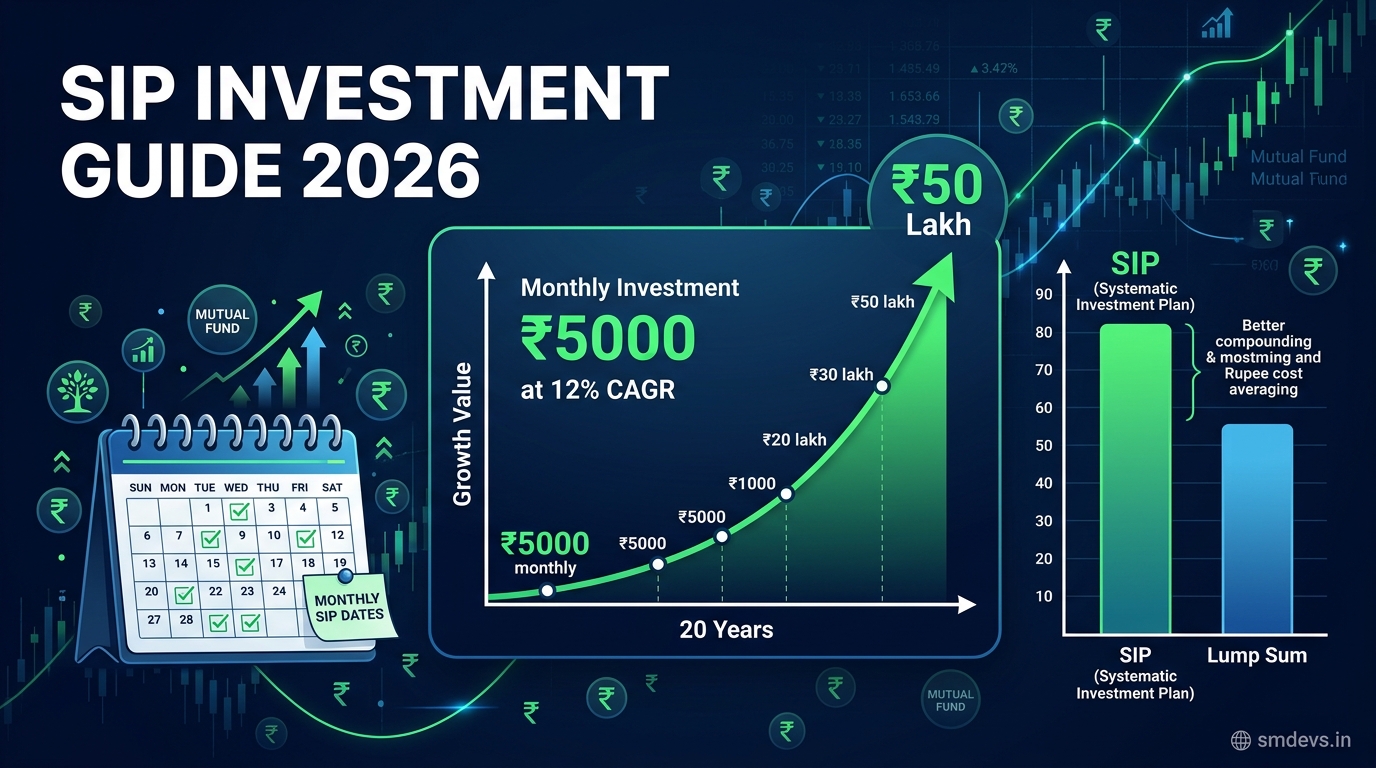
The single most powerful concept in SIP investing is compounding — earning returns on your returns, month after month, year after year:
| Monthly SIP | Duration | Total Invested | At 12% CAGR | Wealth Created |
|---|---|---|---|---|
| ₹5,000 | 10 years | ₹6,00,000 | ₹11,61,695 | +₹5,61,695 |
| ₹5,000 | 20 years | ₹12,00,000 | ₹49,95,740 | +₹37,95,740 |
| ₹5,000 | 30 years | ₹18,00,000 | ₹1,76,49,569 | +₹1,58,49,569 |
| ₹10,000 | 20 years | ₹24,00,000 | ₹99,91,479 | +₹75,91,479 |
| ₹25,000 | 20 years | ₹60,00,000 | ₹2,49,78,698 | +₹1,89,78,698 |
Key insight: A ₹5,000/month SIP in a good equity fund for 30 years creates over ₹1.76 crore — from just ₹18 lakh invested. The remaining ₹1.58 crore is pure compounding. This is why starting early is more important than starting with a large amount.
SIP vs Lump Sum: Which is Better?
| Factor | SIP | Lump Sum |
|---|---|---|
| Timing risk | Very low (averaged over periods) | High (depends entirely on entry point) |
| Returns in sustained bull market | Slightly lower (later investments buy at higher NAV) | Higher (full amount deployed early) |
| Returns in volatile market | Better (rupee cost averaging benefit) | Worse |
| Discipline | Automated, no emotional decisions | Requires willpower to hold |
| Accessibility | Start with ₹100/month | Need significant amount upfront |
| Best for | Salaried investors, volatile markets, beginners | Experienced investors with lump sum during market dips |
Recommendation: For most retail investors in India, SIP is the superior strategy because it removes market timing pressure and builds discipline. Those with large lump sums can combine both: start a SIP + invest a lump sum during significant market corrections (>15% fall).
Types of SIP
Regular SIP
Fixed amount invested on a fixed date every month. The most common type. Set it up once, forget it. Amount and date don't change.
Step-Up SIP (Top-Up SIP)
Automatically increases your SIP amount by a fixed % or ₹ amount each year. Example: ₹5,000/month SIP with 10% annual step-up → ₹5,500 in year 2 → ₹6,050 in year 3. Ideal to align with salary hikes. Step-up SIPs generate significantly more wealth over 20 years vs flat SIPs.
Flex SIP (Variable SIP)
You can vary the amount each month based on cash flow. Useful for business owners or freelancers with irregular income. The minimum amount is fixed, but you can invest more in good months.
Trigger SIP
SIP that activates based on market triggers (e.g., Nifty falls 10% from peak). Suitable only for experienced investors who actively track markets.
Best SIP Mutual Funds in India (2026)
Large Cap / Index Funds (Low Risk, Stable)
- UTI Nifty 50 Index Fund (Direct) — 0.18% expense ratio
- HDFC Nifty 50 Index Fund (Direct) — 0.20% expense ratio
- Nifty Next 50 Index Fund — slightly higher risk, higher potential
Flexi Cap Funds (Moderate Risk)
- Parag Parikh Flexi Cap Fund — known for global diversification
- Canara Robeco Flexi Cap Fund
Mid Cap Funds (Higher Risk, Higher Potential)
- Kotak Emerging Equity Fund
- Axis Midcap Fund
Note: Always verify current performance and choose direct plans. Past performance does not guarantee future results. Consult a SEBI-registered investment advisor for personalised advice.
How to Start a SIP in 3 Steps
- Complete KYC: Aadhaar + PAN based, takes 10 minutes online. One-time process.
- Choose a platform: Fund house website directly, or apps like Zerodha Coin (commission-free), Groww, Kuvera (free), MFCentral
- Set up SIP: Select fund → Choose Direct Plan → Set SIP date → Set amount (minimum ₹100–500) → Link bank account for auto-debit
SIP Taxation in India
Each SIP instalment is treated as a separate investment for tax purposes:
- Equity fund SIP units held 12+ months: LTCG at 12.5% (above ₹1.25 lakh annual exemption)
- Equity fund SIP units held less than 12 months: STCG at 20%
- ELSS SIP: 3-year lock-in per instalment; qualifies for ₹1.5 lakh deduction under Section 80C (old tax regime)
FAQs About SIP
What is the minimum SIP amount in India?
Most funds allow SIP with as little as ₹100–500 per month. SEBI has mandated that all mutual funds offer micro-SIP options to promote financial inclusion.
Can I stop my SIP anytime?
Yes — SIPs in most funds (except ELSS) can be paused or stopped anytime without any penalty. You retain all units already purchased.
Is SIP safe?
SIP is as safe as the underlying mutual fund. Equity fund SIPs carry market risk — NAV can fall in the short term. However, over 7+ year periods, well-chosen equity fund SIPs have historically delivered positive inflation-beating returns. Debt fund SIPs are lower risk.
What is XIRR in SIP?
XIRR (Extended Internal Rate of Return) is the correct way to calculate SIP returns — it accounts for the fact that each instalment is invested at different times. Simple percentage return is misleading for SIP calculations. XIRR is shown on platforms like Zerodha Coin and MF Central.