Key Takeaways
- Nifty 50 is India's most-watched stock market index. This complete guide explains what Nifty 50 is, how it is calculated, which companies are included, and how you can invest in it through index funds or ETFs.
What is Nifty 50?
Nifty 50 is the benchmark stock market index of the National Stock Exchange of India (NSE). It represents the weighted average of 50 of the largest, most liquid Indian companies listed on the NSE across 13 sectors.
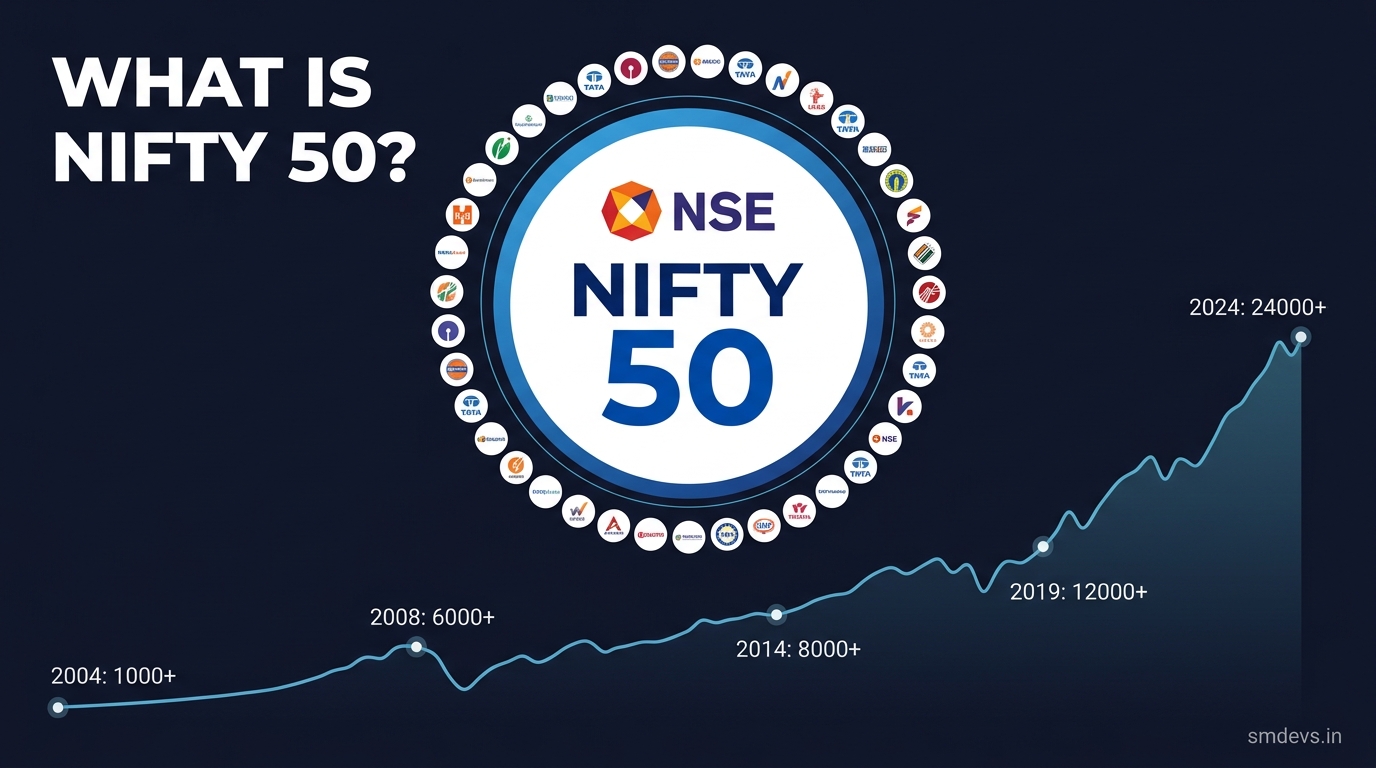
Nifty 50 was launched on April 22, 1996, with a base value of 1,000. As of 2026, it trades above 24,000 — reflecting India's extraordinary economic growth over three decades.
How is Nifty 50 Calculated?
Nifty 50 uses a free-float market capitalisation-weighted methodology. This means:
- Each company's weight = (Its free-float market cap / Total free-float market cap of all 50) × 100
- "Free-float" means only publicly tradeable shares — not promoter or government-held shares
- Larger companies like Reliance Industries have higher weight and more impact on the index
The index is reviewed and rebalanced every 6 months to ensure it remains representative.
Which Companies are in Nifty 50?
As of 2026, the top 10 Nifty 50 constituents by weight include:
- Reliance Industries (~10%)
- HDFC Bank (~8%)
- ICICI Bank (~7%)
- Infosys (~6%)
- TCS (~5%)
- Bharti Airtel (~4%)
- Kotak Mahindra Bank (~3.5%)
- Axis Bank (~3%)
- L&T (~3%)
- SBI (~2.5%)
The 13 sectors include Financial Services, IT, Energy, FMCG, Automobile, Metals, Pharma, and more.
Why Does Nifty 50 Matter?
Nifty 50 matters for several key reasons:
- Market barometer: It's the most watched indicator of Indian market health
- FII activity proxy: Foreign investor sentiment is measured via Nifty
- Derivatives benchmark: Nifty Futures and Options are the world's most traded index derivatives
- Index funds: Millions of SIP investors invest in Nifty 50 index funds
- Gift Nifty: Traded globally before Indian market opens as a pre-market indicator
Nifty 50 vs Sensex: What's the Difference?
| Feature | Nifty 50 | Sensex |
|---|---|---|
| Exchange | NSE | BSE |
| Companies | 50 | 30 |
| Base Year | 1995 (value 1000) | 1978-79 (value 100) |
| Sectors | 13 | 13 |
| Derivatives | Yes (very liquid) | Yes (less liquid) |
How to Invest in Nifty 50
There are three main ways to invest in Nifty 50:
1. Nifty 50 Index Funds
Mutual funds that passively track the Nifty 50 index. Very low expense ratio (0.1%–0.2%). You can invest via SIP with as little as ₹500/month. Examples: UTI Nifty 50 Index Fund, HDFC Index Fund Nifty 50 Plan.
2. Nifty 50 ETFs (Exchange Traded Funds)
ETFs trade on NSE like stocks during market hours. Slightly lower expense ratio than index funds. Examples: Nippon India ETF Nifty 50 BeES, ICICI Prudential Nifty 50 ETF.
3. Nifty Futures and Options (F&O)
For experienced traders who want to take leveraged positions on the Nifty 50 index. Requires significant knowledge of derivatives. Not recommended for beginners.
Nifty 50 Historical Performance
- 1996: 1,000 (base)
- 2008: ~6,357 (before financial crisis crash to ~2,500)
- 2014: ~8,000 (post-election rally)
- 2020: ~7,500 (COVID crash), recovered to ~13,000 by year end
- 2024: ~24,000+
- CAGR since inception: ~13% per year
What Affects Nifty 50 Movement?
- RBI monetary policy: Rate cuts are bullish; hikes are bearish
- FII flows: Foreign buying pushes Nifty up; selling pulls it down
- Global cues: US market direction, crude oil prices, USD/INR
- Corporate earnings: Quarterly results of Nifty heavyweights
- Macroeconomic data: GDP growth, inflation (CPI/WPI), IIP data
- Government policy: Budget announcements, infrastructure spending
FAQs About Nifty 50
Is Nifty 50 safe to invest in?
Nifty 50 index funds are one of the safest long-term equity investments in India. While short-term volatility exists, the index has never failed to recover from any crash over a 5–7 year horizon historically.
Can I buy Nifty 50 directly?
You cannot buy the index directly, but you can buy Nifty 50 index funds or ETFs which replicate the index performance.
What time does Nifty open?
Nifty 50 trading hours: 9:15 AM to 3:30 PM IST, Monday to Friday (excluding NSE holidays).