Key Takeaways
- A mutual fund is an investment vehicle that pools money from many investors and invests it in a diversified portfolio of stocks, bonds, or other securities — managed by a professional fund manager. In
What is a Mutual Fund?
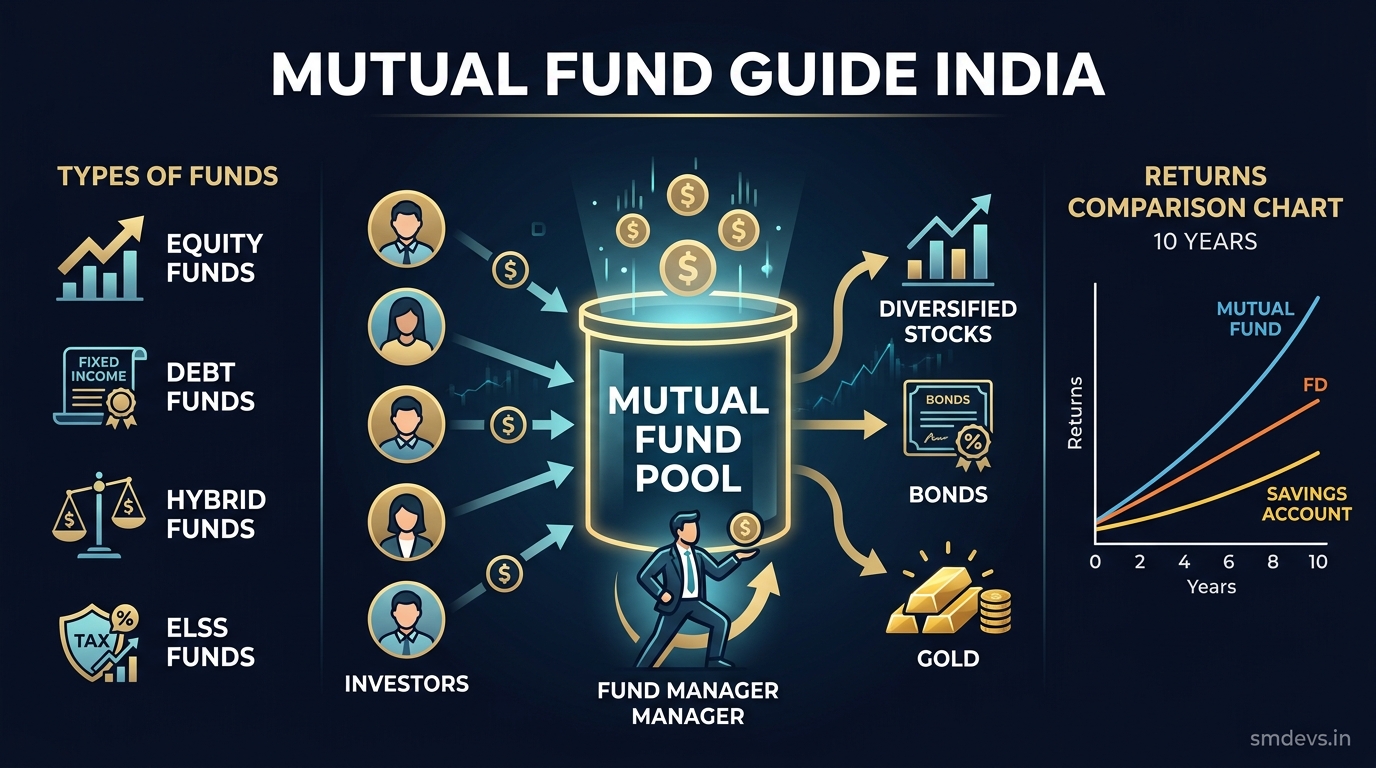
A mutual fund is a professionally managed investment vehicle that pools money from many investors and invests it collectively in a diversified portfolio of securities — which could include stocks, bonds, government securities, gold, or a mix of these.
Think of it as a shared investment pot: instead of buying individual stocks with ₹5,000 (which might only buy a few shares of one company), your ₹5,000 goes into a fund alongside thousands of other investors' money, giving you a proportionate slice of a diversified portfolio of potentially hundreds of securities.
The fund is managed by a professional Fund Manager — a SEBI-registered expert whose sole job is to analyse markets and make investment decisions on behalf of all investors in the fund.
India's Mutual Fund Industry in 2026
- Total AUM (Assets Under Management): ₹65+ lakh crore (as of June 2026)
- Number of AMCs (Asset Management Companies): 44 SEBI-registered AMCs
- Unique investors: 5+ crore folios
- Active SIP accounts: 10.5 crore
- Monthly SIP inflows: ₹26,000+ crore/month
- Regulator: SEBI (Securities and Exchange Board of India)
Source: Association of Mutual Funds in India (AMFI)
How a Mutual Fund Works
- You invest: You put ₹5,000 into an equity mutual fund
- Pooling: Thousands of investors simultaneously invest varying amounts
- Fund manager invests: The pooled corpus (say ₹5,000 crore) is invested in a diversified portfolio of stocks as per the fund's objective
- NAV is calculated: The fund's total value divided by total units = Net Asset Value (NAV) per unit. NAV is updated daily after market hours.
- You receive units: Your investment buys units at the current NAV. If NAV = ₹50, ₹5,000 buys you 100 units.
- Returns flow to you: As the portfolio grows, NAV rises. Your 100 units × higher NAV = higher value
Key Mutual Fund Terms Explained
| Term | Meaning |
|---|---|
| NAV (Net Asset Value) | Price per unit of the fund. Calculated daily: (Total Assets − Liabilities) / Total Units |
| AUM (Assets Under Management) | Total value of all assets the fund manages |
| Expense Ratio | Annual fee charged by AMC for managing the fund, as % of AUM. Deducted from returns automatically. |
| Exit Load | Penalty fee for redeeming units before a specified period (typically 1 year for equity funds) |
| Direct Plan | Bought directly from AMC without distributor. Lower expense ratio (typically 0.5–1% less than Regular) |
| Regular Plan | Bought through a distributor/agent. Higher expense ratio (commission goes to distributor) |
| Growth Option | Profits reinvested; no dividend paid out. NAV grows over time. Best for long-term wealth creation. |
| IDCW Option | Income Distribution cum Capital Withdrawal — fund distributes periodic dividends. Not ideal for long-term growth. |
| Folio Number | Your unique investor ID with an AMC — like an account number |
| KYC | Know Your Customer verification (PAN + Aadhaar). One-time process; required before investing |
Types of Mutual Funds in India
1. Equity Funds (High Risk, High Potential)
Primarily invest in stocks. Best for long-term wealth creation (5+ year horizon). Subcategories:
- Large Cap Funds: Invest in top 100 companies by market cap. Stable, lower volatility. E.g., Axis Bluechip Fund
- Mid Cap Funds: Companies ranked 101–250. Higher growth potential, more volatile. E.g., Kotak Emerging Equity
- Small Cap Funds: Companies ranked 251+. Highest potential returns AND highest risk. Not for beginners.
- Flexi Cap Funds: Can invest across large, mid, small caps at fund manager's discretion. E.g., Parag Parikh Flexi Cap
- Index Funds: Passively track an index (Nifty 50, Sensex). Very low cost. Best choice for most retail investors.
- ELSS (Equity Linked Saving Scheme): 3-year lock-in; eligible for ₹1.5 lakh tax deduction under Section 80C
- Sectoral/Thematic Funds: Invest in specific sectors (IT, Pharma, Infrastructure). High concentration risk — for experts only
2. Debt Funds (Lower Risk, Stable Returns)
Invest in bonds, government securities, money market instruments. Lower risk than equity; better returns than FDs in most environments. Best for short to medium term (1–5 years) or as the debt component of a diversified portfolio.
- Liquid Funds: Very short duration (up to 91 days). Best emergency fund alternative to savings account
- Short Duration Funds: 1–3 year instruments. Better than FD for 1–2 year goals
- Dynamic Bond Funds: Fund manager adjusts duration based on interest rate outlook
- Gilt Funds: Only government securities. Zero credit risk; sensitive to interest rates
3. Hybrid Funds (Balanced Risk)
Mix of equity and debt in varying proportions. Good for moderate-risk investors or those new to equity.
- Aggressive Hybrid: 65–80% equity, rest debt. Suitable for long-term investors wanting some stability
- Balanced Advantage (Dynamic Asset Allocation): Dynamically shifts between equity and debt based on market valuation. E.g., HDFC Balanced Advantage Fund
- Arbitrage Funds: Low-risk; taxed like equity. Good for 6–12 month parking
4. Gold and International Funds
- Gold ETF / Gold Fund of Funds: Invest in gold without holding physical gold. Most cost-effective gold investment
- International Funds: Invest in overseas stocks (US, global). Provides geographical diversification and currency hedge
Direct vs Regular Plan: Why This Matters
| Direct Plan | Regular Plan | |
|---|---|---|
| Expense Ratio | 0.1–1% (lower) | 0.6–2.5% (higher) |
| Returns | Higher (saves on commission) | Lower |
| Where to buy | AMC website, Kuvera, Zerodha Coin, MF Central | Banks, HDFC Securities, agents |
| Guidance | Self-directed; you choose the funds | Advisor/agent recommends |
Impact of 1% extra expense ratio over 20 years: On ₹10,000/month SIP, at 12% (Direct) vs 11% (Regular): ₹99.9 lakh vs ₹85.9 lakh — a difference of ₹14 lakh. Always choose Direct Plans if you can do basic research yourself.
How to Start Investing in Mutual Funds in India
- Complete KYC: One-time Aadhaar + PAN based verification at any KYC-compliant platform. Free and takes ~10 minutes online.
- Choose a platform:
- Zerodha Coin: Zero commission, direct plans, excellent UI
- Kuvera: Free platform, goal-based investing, direct plans
- MF Central: Government's official MF portal, consolidates all holdings
- AMC websites directly: Go to HDFC AMC, SBI MF, etc. directly
- Choose your fund: For beginners: start with a Nifty 50 Index Fund (UTI, HDFC, or Nippon)
- Set up SIP: Minimum ₹100–500/month. Link bank for auto-debit.
- Stay invested: The most important step. Don't check NAV daily. Review annually.
Mutual Fund Taxation in India (2026)
| Fund Type | Holding Period | Tax Rate |
|---|---|---|
| Equity Funds (65%+ in equity) | Less than 12 months | STCG: 20% |
| Equity Funds | 12 months or more | LTCG: 12.5% (above ₹1.25 lakh exemption) |
| Debt Funds | Any duration | Added to income; taxed at slab rate |
| ELSS | Minimum 3 years (lock-in) | LTCG: 12.5% (above ₹1.25 lakh) |
FAQs: Mutual Funds India
Is mutual fund safe in India?
Mutual funds are regulated by SEBI and your money is held in a segregated trust — the AMC cannot use it for its own purposes. Equity funds carry market risk (NAV fluctuates), but the regulatory framework protects against fraud. Debt funds carry credit risk (if the bonds they hold default). Overall, mutual funds from SEBI-registered AMCs are safe from a regulatory standpoint.
What is the minimum investment in a mutual fund?
Most equity funds allow lump sum investments from ₹500–5,000 and SIPs from ₹100–500 per month. Index funds often have the lowest minimums.
Can I withdraw my mutual fund money anytime?
For open-ended funds (most equity and debt funds): yes, you can redeem anytime. The redemption amount is credited to your bank account in 1–3 business days (T+1 for equity, T+2 for debt). Exception: ELSS funds have a mandatory 3-year lock-in per investment.
Which mutual fund is best for beginners in India?
For beginners: (1) Nifty 50 Index Fund (lowest cost, broadly diversified), or (2) a Balanced Advantage Fund (manages equity-debt allocation automatically). Avoid small cap, sectoral, and international funds as your first investment.