Key Takeaways
- Inflation silently erodes your wealth — ₹1 lakh today will have the purchasing power of just ₹61,000 in 10 years at 5% inflation. This guide explains what inflation is, how RBI measures it, and which
What is Inflation?
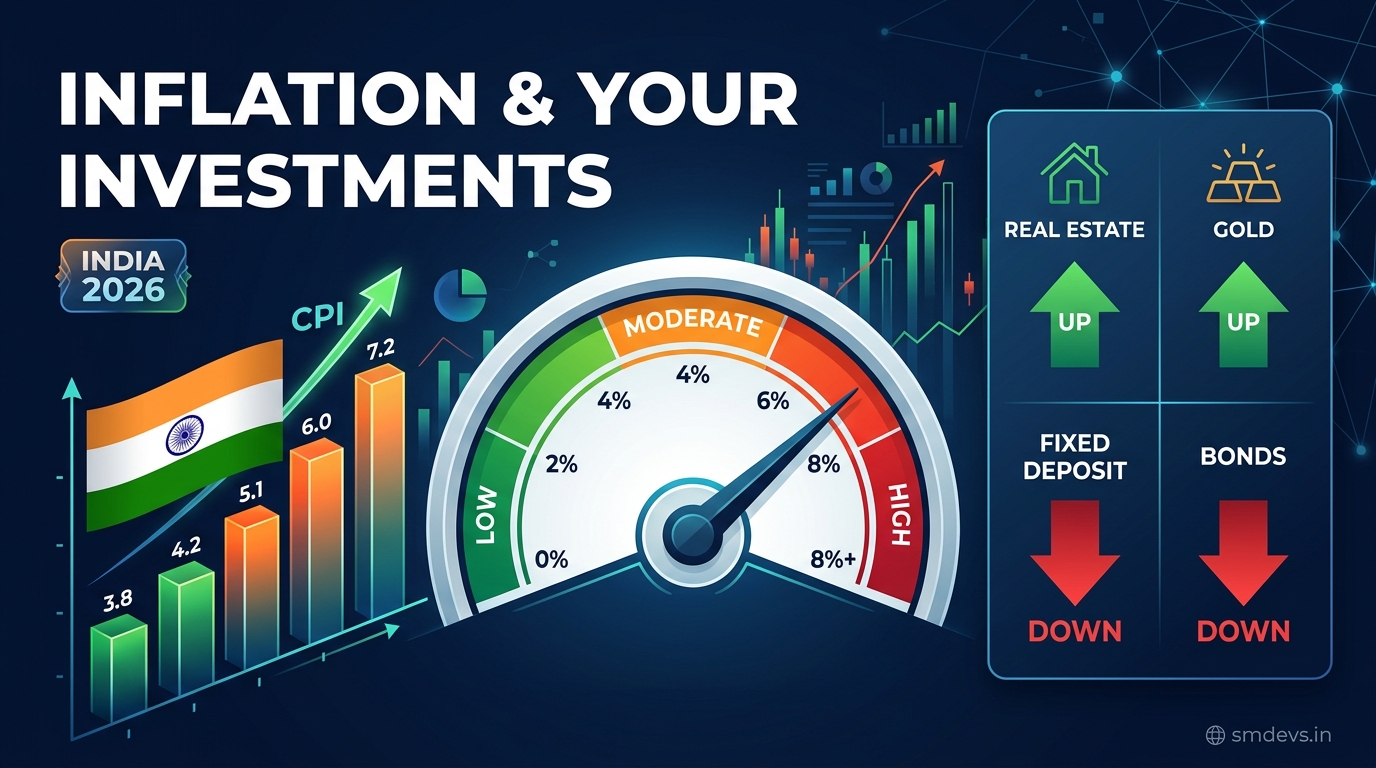
Inflation is the rate at which the general price level of goods and services rises over time, reducing the purchasing power of money. When inflation is 5%, a basket of goods costing ₹100 today will cost ₹105 next year. Over time, this compounding effect significantly erodes wealth held in low-return instruments like savings accounts or Fixed Deposits.
Simple rule: If your investment returns less than the inflation rate, you are losing real wealth — even if your nominal balance is growing.
How India Measures Inflation
CPI — Consumer Price Index (Headline Inflation)
CPI measures the average change in prices paid by urban and rural consumers for a representative basket of goods. The RBI uses CPI as its primary inflation target: 4% (±2% tolerance band).
CPI basket composition (approximate):
- Food and Beverages: 45.86% (largest component — major volatility driver)
- Housing: 10.07%
- Fuel and Light: 6.84%
- Clothing and Footwear: 6.53%
- Miscellaneous: 28.32%
Source: MOSPI — Ministry of Statistics and Programme Implementation
WPI — Wholesale Price Index
WPI measures price changes at the producer/wholesale level — before goods reach consumers. It's a leading indicator: WPI inflation often flows into CPI inflation 1–3 months later. High WPI = rising input costs for manufacturers = eventual price hikes for consumers.
Core Inflation
CPI excluding food and fuel. It represents underlying, structural inflation that is less volatile and harder for RBI to directly control. Core inflation above 5% for multiple months triggers concern at the RBI regardless of headline CPI.
India's Inflation History (2020–2026)
| Year | Avg CPI Inflation | Key Driver |
|---|---|---|
| 2020 | 6.2% | Food prices spike; supply disruption from COVID |
| 2021 | 5.1% | Base effect moderates; fuel prices rising |
| 2022 | 6.7% | Russia-Ukraine war; global commodity surge; fuel hikes |
| 2023 | 5.4% | Vegetable prices volatile; core softening |
| 2024 | 4.8% | Easing commodity prices; good monsoon |
| 2025 | 4.3% | Rate cuts began; food inflation moderate |
| 2026 (proj.) | 5.0% | RBI's revised projection (Aug 2026 MPC) |
Source: RBI Annual Reports and MPC Statements
The Real Cost of Inflation: Wealth Erosion
At 5% annual inflation, the purchasing power of money falls significantly over time:
| Amount Today | Real Value in 10 Years | Real Value in 20 Years | Real Value in 30 Years |
|---|---|---|---|
| ₹1,00,000 | ₹61,391 | ₹37,689 | ₹23,138 |
| ₹10,00,000 | ₹6,13,913 | ₹3,76,889 | ₹2,31,377 |
| ₹1,00,00,000 | ₹61,39,133 | ₹37,68,895 | ₹23,13,774 |
Key takeaway: A Fixed Deposit giving 6% returns at 5% inflation only earns you a real return of ~0.95% (after tax, possibly negative real returns for those in the 30% slab).
How Different Assets Perform Against Inflation
1. Equity (Stocks/Mutual Funds) — Best Inflation Hedge Long-Term
Historically, Indian equities (Nifty 50) have delivered ~13–15% CAGR vs average inflation of ~5–6% — a real return of 7–9% per annum. Companies can raise prices during inflation, protecting and growing real earnings.
- Best sectors during high inflation: Commodities, Energy, FMCG (pricing power), Infrastructure
- Worst sectors during high inflation: Utilities (regulated prices), High-debt companies, Consumer discretionary
2. Gold — Reliable Inflation Hedge
Gold has historically maintained purchasing power during inflationary periods. In India, gold is also a currency hedge — when the rupee weakens (often during high inflation), gold in INR terms appreciates. The 2020–2026 period saw gold rise from ~₹38,000/10g to ~₹92,000+/10g.
Best held via Gold ETFs (lowest cost, highest liquidity) rather than physical jewellery (which has making charges of 10–25%).
3. Real Estate — Moderate Inflation Hedge
Real estate prices generally rise with inflation over long periods, and rental income can be revised upward. However, real estate is illiquid and the actual return depends heavily on location and entry price. In high-inflation/high-interest environments, real estate can underperform due to rising mortgage costs.
4. Fixed Deposits — Inflation Killer for Real Wealth
FD rates (currently ~5.75–6.25% for major banks post rate cuts) barely exceed inflation, especially after tax:
- FD at 6% → After 30% tax → 4.2% post-tax return
- Inflation at 5% → Real return = −0.8% (you're losing real wealth)
FDs work for capital preservation (short-term parking), not wealth creation.
5. Bonds / Debt Mutual Funds
Government bonds (G-Secs) and debt funds offer returns slightly above inflation. During falling rate environments (like 2025–2026), long-duration bond funds deliver capital gains in addition to coupon income. In rising rate periods, bond prices fall.
6. TIPS (Inflation-Indexed Bonds) — India
The RBI issues Inflation-Indexed Bonds (IIBs) and Inflation-Indexed National Savings Securities (IINSS-C) where the principal adjusts with CPI. These guarantee a real return above inflation. Available to retail investors through RBI Retail Direct.
Inflation's Impact on Different Investor Types
Salaried Employees
If salary hikes don't keep pace with inflation, real purchasing power declines. Invest at least 15% of salary in equity instruments to counteract inflation erosion of savings.
Retirees
Inflation is most dangerous for retirees living on fixed income. ₹50,000/month today has the purchasing power of ₹30,697/month in 10 years at 5% inflation. Retirees need equity exposure (20–30% minimum) to maintain real income levels.
Business Owners
Inflation typically compresses margins unless businesses have pricing power. Companies with strong brands, essential products, and low debt navigate inflation best.
RBI's Fight Against Inflation: The Repo Rate Tool
When inflation exceeds the 6% upper tolerance band, RBI raises the repo rate. Higher rates:
- Make borrowing expensive → less spending → demand falls
- Strengthen the rupee → cheaper imports → reduces imported inflation
- Increase return on savings → people save more, spend less → demand cools
The 2022 rate hike cycle (4% → 6.5%) successfully brought CPI from 7.79% (April 2022) down to ~4.3% by 2025.
Investment Strategy: Beating Inflation in 2026
- 30-40% Equity (Nifty 50/Next 50 Index Funds): Best long-term inflation beater
- 10-15% Gold (Gold ETF): Portfolio stabiliser and inflation/currency hedge
- 30-40% Debt (Combination of FD for liquidity + debt mutual funds for returns)
- 10-15% Real Estate (REITs for those wanting real estate exposure without liquidity lock-in)
With RBI projecting 5% inflation for FY27, your overall portfolio must target at least 10-12% gross returns (7-8% real returns after inflation) to build meaningful wealth over time.
FAQs About Inflation in India
What is the current inflation rate in India (2026)?
The RBI's revised inflation projection for FY2026-27 is 5.0%, as announced in the August 2026 MPC meeting. Actual monthly CPI data is released by MOSPI around the 12th of each month.
Which investment beats inflation best in India?
Equity (stocks and equity mutual funds) historically deliver the highest inflation-adjusted returns in India — approximately 7-9% real return per year over 10+ year periods based on Nifty 50 historical data.
Is 6% FD rate good against 5% inflation?
For investors in the 30% tax bracket, a 6% FD yields only ~4.2% post-tax, which is below 5% inflation — meaning your real wealth is declining. FDs are better suited for liquidity management and short-term goals, not long-term wealth creation.
How does inflation affect stock markets?
Moderate inflation (3-5%) is generally positive for equities as it reflects economic activity. High inflation (above 6%) can be negative as it forces rate hikes, increases business costs, and compresses margins. The RBI's ability to keep inflation near 5% in 2026 is a supportive environment for equity markets.