Key Takeaways
- E-E-A-T stands for Experience, Expertise, Authoritativeness, and Trustworthiness — Google's framework for evaluating whether a webpage deserves to rank highly. It's not a direct ranking algorithm, but
What is E-E-A-T?
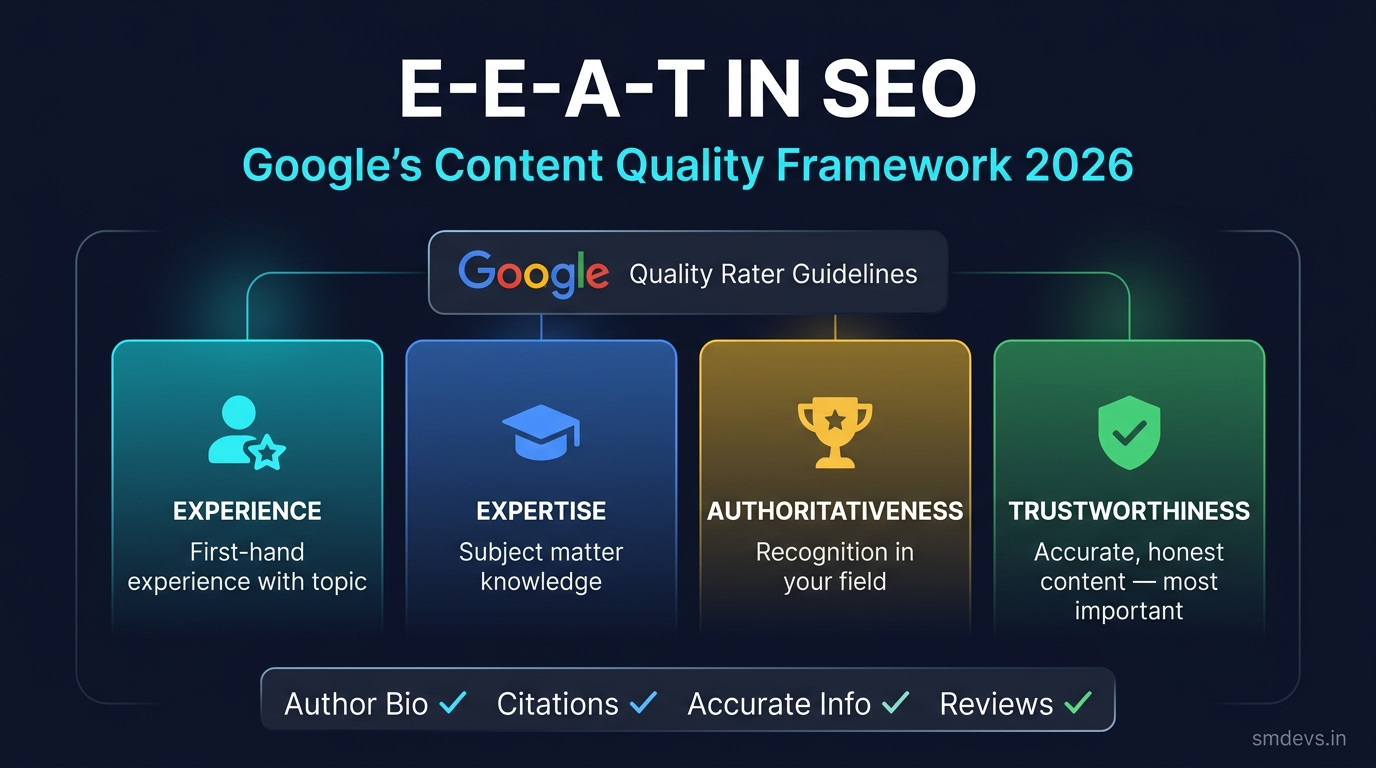
E-E-A-T stands for Experience, Expertise, Authoritativeness, and Trustworthiness. It is a framework from Google's Search Quality Rater Guidelines — a 168-page document Google uses to train human quality raters who evaluate search results.
E-E-A-T was originally E-A-T (without the first E) until December 2022, when Google added Experience — recognising that first-hand, lived experience with a topic is a distinct quality signal from pure academic expertise.
Important: E-E-A-T is NOT a direct Google ranking algorithm — there is no "E-E-A-T score" in Google's systems. However, the signals that indicate E-E-A-T (author credentials, citations, backlinks from authoritative sites, accurate information, user trust signals) ARE measured by Google's algorithms, making E-E-A-T effectively a ranking factor in practice.
The 4 Pillars of E-E-A-T Explained
1. Experience (The Newest Addition)
What it means: Does the content creator have first-hand, personal experience with the topic? Someone who has actually used a product, visited a location, or traded in the stock market brings something a researcher who just read about the topic cannot.
Examples of Experience signals:
- A product review that includes original photos taken by the reviewer
- A trading strategy guide written by someone who has actually traded it live
- A travel guide that includes personal anecdotes and real photos from the visit
- A recipe blog where the author writes about how the dish turned out for their family
How to show Experience: Include original photos, personal case studies, real examples from your own work, and first-person language that demonstrates you've personally done what you're writing about.
2. Expertise
What it means: Does the creator have the knowledge and skill to write authoritatively on the subject? Expertise can be formal (qualifications, certifications) or informal (demonstrated through years of practical experience).
Examples of Expertise signals:
- Author bio listing relevant qualifications (CA, CFA, SEBI-registered advisor for finance topics)
- Depth and accuracy of content — does it cover the topic comprehensively and correctly?
- Use of precise terminology without errors
- Bylined content from named, verifiable experts
How to demonstrate Expertise: Write detailed, accurate content. Include author bios with credentials on every article. Have subject matter experts review content before publishing — especially on YMYL topics.
3. Authoritativeness
What it means: Is the creator or website recognised as an authority in its field — by other experts and authoritative sources? This is largely about reputation and recognition, not just what you say about yourself.
Examples of Authoritativeness signals:
- Backlinks from authoritative, relevant websites (The Hindu, Economic Times, NSE India linking to your finance content)
- Brand mentions in industry publications without a link (unlinked citations)
- Being cited, quoted, or referenced by other experts
- Wikipedia mentions or being listed as a source by credible organisations
- Social proof: following count, verified social profiles, industry awards
How to build Authoritativeness: Earn backlinks from relevant, reputable sites through high-quality content. Build a brand — social media presence, author profiles on reputable platforms, and participation in industry communities.
4. Trustworthiness (The Most Important)
What it means: Google explicitly states that Trustworthiness is the most important of the four E-E-A-T pillars. A site can have experienced, expert, authoritative content — but if it's not trustworthy (accurate, honest, safe, transparent), the other three don't matter.
Trustworthiness signals:
- Accurate, factually correct information — especially critical for YMYL topics
- Clear disclosure of who is responsible for the content (About Us, Contact page)
- Transparency about business model, affiliates, ads
- HTTPS (SSL certificate — basic but required)
- Privacy Policy and Terms of Service pages
- No deceptive practices, misleading claims, or clickbait
- Positive user reviews and ratings (for e-commerce and service sites)
- Clear correction policy — admitting and fixing errors
Why E-E-A-T Matters More in 2026
Google's 2023–2026 "Helpful Content" algorithm updates significantly amplified E-E-A-T signals:
- AI content flood: As AI-generated content exploded, Google strengthened signals that distinguish genuine human expertise from automated, low-quality content
- Helpful Content System: Google's classifier now downgrades content that exists purely to rank rather than to help users — E-E-A-T is the antidote
- YMYL harder to rank: Finance, trading, health, and legal content now requires demonstrably stronger E-E-A-T signals than before to rank on page 1
For a site like smdevs.in covering trading and SEO tools — both YMYL-adjacent topics — E-E-A-T is not optional. Every piece of advice about trading, investments, or SEO strategy can affect users' financial decisions.
12 Concrete Ways to Improve E-E-A-T on Your Website
Experience
- Add original photos and screenshots: Replace stock images with real screenshots from tools you actually use. Show real results, real data, real usage.
- Write personal case studies: "We tested this SEO tactic on our own site and here's what happened" outperforms generic advice in E-E-A-T evaluation.
- Include real examples from your niche: For a trading site, show actual trade examples with entry/exit logic — not hypothetical ones.
Expertise
- Add author bios to every article: Include the author's name, photo, credentials, and a link to their author page. Google needs to be able to identify who wrote the content.
- Create an Author page: A dedicated page per author listing their qualifications, experience, and all articles they've written — this gives Google a comprehensive expertise signal.
- Cite authoritative sources: Link out to SEBI, NSE, RBI, academic papers, and trusted news sources. Citing sources signals you've done thorough research and aren't just making things up.
- Keep content updated: Outdated information signals poor expertise. Add "Last updated" dates and refresh articles annually — especially for rapidly changing topics like tax rules, trading regulations, and SEO algorithm changes.
Authoritativeness
- Build backlinks from relevant sites: One backlink from Economic Times or Moneycontrol for your finance content is worth more than 100 random directory links. Create content worth linking to — original data, unique guides, free tools.
- Get mentioned in your niche: Contribute guest posts to industry blogs. Be a source for journalists (sign up for HARO — Help A Reporter Out). Participate in industry forums and Q&A sites.
- Build a strong social presence: Verified social profiles, active engagement, and follower counts on LinkedIn and Twitter are indirect authority signals.
Trustworthiness
- Complete your About Us and Contact pages: Google needs to know who is behind the site. Include the founding story, the team, physical address or region, and multiple contact methods.
- Add clear disclosure and disclaimer pages: For trading/finance content, include a clear investment disclaimer. For affiliate content, disclose partnerships. Transparency = trust.
E-E-A-T for YMYL Content (Finance & Trading)
YMYL (Your Money or Your Life) content — finance, investing, health, legal — is held to the highest E-E-A-T standards. Google's reasoning: bad advice in these topics can cause real-world harm to users' finances or health.
For a trading and SEO tools website:
- All trading content should include an investment disclaimer
- Authors writing about specific trading strategies should have demonstrable trading experience
- All statistics and data should be cited to official sources (NSE, BSE, SEBI, RBI)
- Avoid guaranteeing returns or making specific investment recommendations without qualification
FAQs: E-E-A-T SEO
What is E-E-A-T in SEO?
E-E-A-T stands for Experience, Expertise, Authoritativeness, and Trustworthiness. It's Google's framework from its Search Quality Rater Guidelines for evaluating content quality. While not a direct algorithmic ranking factor, the signals that demonstrate E-E-A-T (author credentials, accurate content, authoritative backlinks, transparency) are measured by Google's ranking systems and directly impact search rankings.
How do I improve E-E-A-T for my website?
The most impactful E-E-A-T improvements: (1) Add detailed author bios with credentials to every article, (2) Create thorough About Us and Contact pages, (3) Cite authoritative sources in your content, (4) Earn backlinks from relevant, authoritative sites, (5) Keep content accurate and up-to-date, (6) Include original photos/screenshots showing first-hand experience, (7) Add relevant disclosures and disclaimers for YMYL topics.
Is E-E-A-T a ranking factor?
E-E-A-T itself is not a single algorithmic ranking factor with a direct score. However, the signals associated with strong E-E-A-T — authoritative backlinks, accurate content, author expertise signals, user trust indicators — are measured by Google's algorithms and do affect rankings. Sites with weak E-E-A-T signals, especially on YMYL topics, are demonstrably disadvantaged in search rankings after Google's Helpful Content updates.
What is the difference between E-A-T and E-E-A-T?
Google introduced E-A-T (Expertise, Authoritativeness, Trustworthiness) in 2014. In December 2022, Google added a second "E" for Experience, creating E-E-A-T. The addition of Experience recognises that first-hand, lived experience with a topic — using a product, visiting a place, actually trading a strategy — is a distinct quality signal from purely academic expertise. Someone with real experience brings authenticity that purely researched content lacks.