Key Takeaways
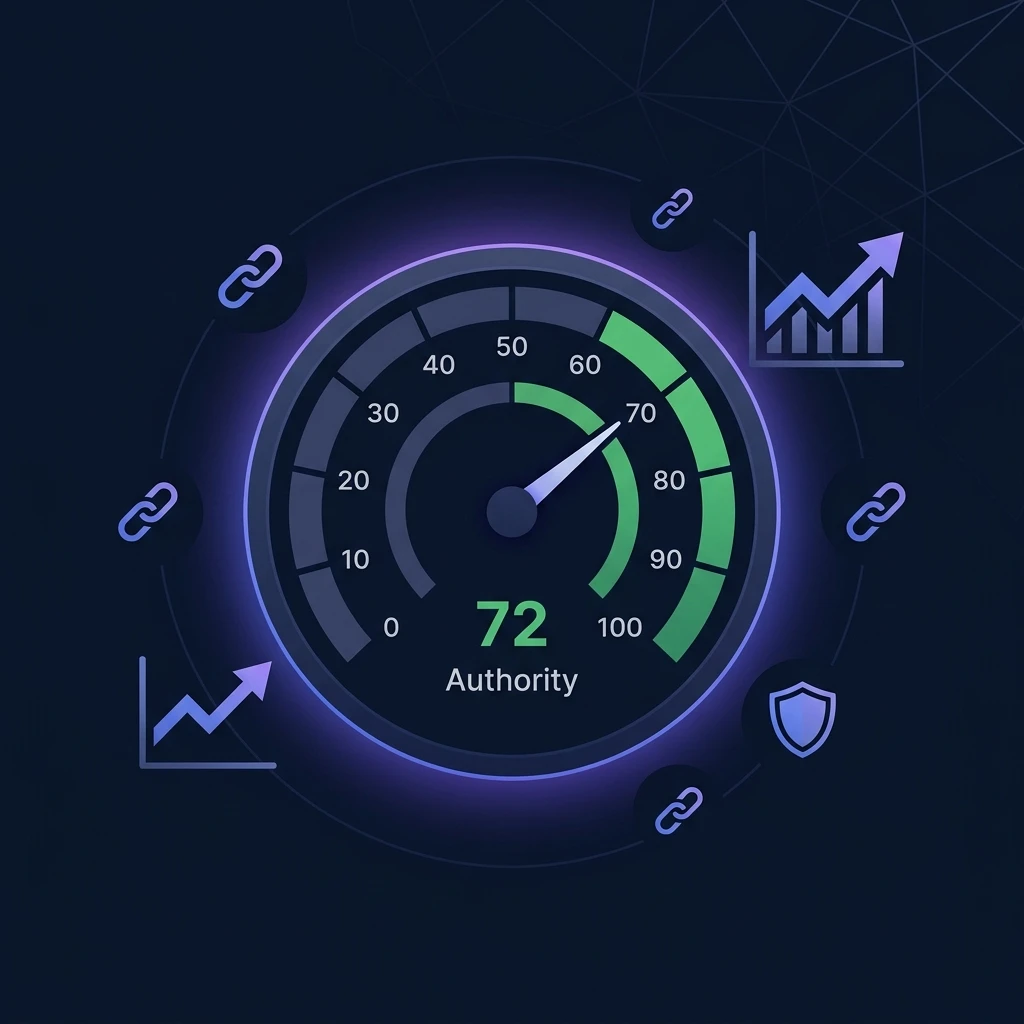
- Domain Authority (DA) is a metric created by Moz that scores a website's ranking potential on a 1–100 scale based primarily on its backlink profile.
- DA is NOT a Google ranking factor — Google confirmed it does not use DA in its algorithm. But it is a useful benchmark for comparing site strength against competitors.
- Similar metrics exist: Domain Rating (DR) by Ahrefs and Authority Score by Semrush — all measure slightly different things but correlate with overall site strength.
- The fastest way to increase DA is to earn high-quality backlinks from authoritative, relevant websites in your niche.
- Check your site's authority score for free with our Authority Score Checker — no account required.
What Is Domain Authority?
Domain Authority (DA) is a metric created by Moz that predicts how likely a website is to rank on search engine results pages (SERPs). It scores websites on a scale from 1 to 100 — higher scores indicate a stronger backlink profile and greater ranking potential. New websites typically start at DA 1; established sites like Wikipedia score 90+.
The score is calculated primarily by evaluating the quality and quantity of a site's inbound links (backlinks) — how many other websites link to it, and how authoritative those linking sites are. A backlink from The New York Times carries far more weight than one from a random blog with no followers.
DA was created to give SEO professionals a comparative benchmark — a quick way to ask "is Site A stronger than Site B?" for any given niche or SERP competition analysis.
Does Domain Authority Affect Google Rankings?
No — and this is the most important thing to understand about DA. Google does not use Moz's Domain Authority metric in its ranking algorithm. Google has its own internal PageRank system (now called "link equity") that evaluates link quality, but this is entirely separate from Moz's DA calculation and not publicly available.
This does not mean DA is useless. It means DA is a proxy metric — a third-party approximation of link strength that correlates with Google's own assessment but is not identical to it. Sites with high DA tend to rank well because they have strong backlink profiles that also influence Google's algorithm. But DA is a symptom of a strong site, not the cause of ranking success.
Practical implication: focus on building the things that actually cause rankings (quality content, genuine backlinks, technical SEO, E-E-A-T signals). Your DA will increase as a natural byproduct — not the other way around.
Domain Authority vs Domain Rating vs Authority Score
Three major SEO platforms each have their own version of a "domain strength" metric. They measure slightly different things and produce different scores for the same site:
| Metric | Creator | Scale | Primary Signal | Free to Check? |
|---|---|---|---|---|
| Domain Authority (DA) | Moz | 1–100 | Linking root domains + link quality | Yes (limited) |
| Domain Rating (DR) | Ahrefs | 0–100 | Quality of linking domains (logarithmic) | Yes (limited) |
| Authority Score | Semrush | 0–100 | Backlinks + organic traffic + spam signals | Yes (limited) |
The key difference: Moz's DA focuses heavily on the number of unique linking domains. Ahrefs' DR is more sensitive to the quality (not just quantity) of those domains, using a logarithmic scale that makes the jump from 70 to 80 much harder than from 10 to 20. Semrush's Authority Score also factors in estimated organic search traffic — a more holistic measure.
None of these metrics is definitively "correct" — they all correlate with site strength but have different sensitivities. When analyzing competitor domains, it is worth checking all three for a full picture.
Use our free Authority Score Checker to check any website's authority score in seconds — no signup required.
What Is a Good Domain Authority Score?
There is no universal "good" DA score — it depends entirely on your competitive context. What matters is your DA relative to the pages ranking for your target keywords:
| DA Range | Site Type | What It Means |
|---|---|---|
| 1–20 | New or very small site | Just starting to build backlinks. Focus on content quality first. |
| 20–40 | Growing site | Established enough to rank for long-tail and low-competition keywords. |
| 40–60 | Mid-authority site | Can compete for medium-difficulty keywords in most niches. |
| 60–80 | High-authority site | Ranks for competitive head terms. Strong brand presence online. |
| 80–100 | Major platform or brand | Wikipedia, BBC, Amazon-level authority. Extremely difficult to outrank directly. |
For a new site with DA 15, a keyword where page-one results are all DA 60+ sites is not a reasonable target. The same keyword becomes viable after 12–18 months of consistent backlink building and quality content production. Check competitor DA before targeting any keyword — it is the most practical use of the metric.
How to Check Domain Authority for Free
You can check domain authority scores without a paid subscription using several methods:
- SM Developers Authority Score Checker: Use our free Authority Score Checker to check any domain instantly. Enter a URL and get the authority score, backlink overview, and ranking potential assessment — completely free, no account required.
- Moz Link Explorer: The original DA metric. Moz offers limited free lookups at moz.com/domain-analysis.
- Ahrefs Website Authority Checker: Free DR checks at ahrefs.com/website-authority-checker — no login required for basic checks.
- MozBar: A free Chrome extension that shows DA scores for every website you visit directly in your browser bar. Invaluable for quick competitor research while browsing search results.
7 Proven Ways to Increase Domain Authority in 2025
1. Earn High-Quality Backlinks from Authoritative Sites
Backlinks remain the primary driver of DA improvement. A single backlink from a DA 70+ site in your niche is worth more than 50 links from DA 5 blogs. Focus on quality over quantity. The most reliable tactics for earning quality backlinks: publish original research or data studies, create free tools that other sites want to reference, write detailed guides that become reference material in your industry.
2. Guest Post on Relevant, High-DA Sites
Guest posting on established websites in your niche earns you backlinks while exposing your brand to an existing audience. Focus on relevance — a guest post on a finance site is worth 10x more for a trading tools website than a guest post on a general technology blog. Avoid guest posting networks and paid link placement services — Google has become very effective at identifying and discounting artificial link schemes.
3. Create Linkable Assets (Content Worth Citing)
The most scalable backlink strategy is creating content other sites naturally want to link to. This includes: original research with unique data, free tools and calculators, comprehensive reference guides, infographics that visualize complex data, and industry statistics pages that journalists and bloggers cite in their articles.
4. Fix Broken Link Opportunities
Find pages in your niche that link to dead resources (404 errors). Reach out to the page owner, point out the broken link, and offer your own relevant content as a replacement. Use our free Broken Link Checker to identify broken links on competitor sites and find outreach opportunities.
5. Build Strong Internal Linking
Internal links distribute link equity (ranking power) across your site. A page that receives 50 external backlinks but has no internal links pointing to your other pages wastes most of its ranking potential. Implement a systematic internal linking strategy — every new blog post should link to 3–5 related pages, and high-value pages should receive internal links from your most-linked content.
6. Remove or Disavow Toxic Backlinks
Low-quality, spammy backlinks from link farms, PBNs (private blog networks), or irrelevant directories actively harm your DA. Conduct a quarterly backlink audit. For links you cannot have removed, use Google's Disavow tool to tell Google's algorithm to ignore them. Cleaning toxic links can produce a noticeable DA improvement within 2–3 months.
7. Increase Organic Traffic Through Content Quality
Authority Score (Semrush's version of DA) explicitly factors in organic search traffic — a site that ranks well and receives genuine organic traffic is rated more authoritative. Creating content that ranks for long-tail keywords drives traffic that both signals quality to platforms calculating authority scores and attracts natural backlinks from users who discover and cite your content.
Realistic Timeline for DA Improvement
| Starting DA | Target DA | Time Estimate | Requirements |
|---|---|---|---|
| 1–10 | 20–30 | 6–12 months | 5–10 quality backlinks/month + consistent content |
| 20–30 | 40–50 | 12–18 months | 10–20 quality backlinks/month + linkable assets |
| 40–50 | 60+ | 18–36 months | Consistent high-authority backlinks + PR coverage |
DA improvement is non-linear — early gains come faster, but each additional point becomes harder as you climb the scale. Consistent effort over 12–24 months is the only reliable path to meaningful DA growth.
What is Domain Authority in SEO?
Domain Authority (DA) is a metric created by the SEO company Moz that predicts how likely a website is to rank in search engine results. It scores websites on a scale from 1 to 100, with higher scores indicating greater ranking potential. DA is calculated based primarily on the quality and quantity of backlinks pointing to a domain. It is not a Google ranking factor — Google does not use Moz's DA in its algorithm — but it serves as a useful benchmark for comparing the relative strength of different websites in a competitive analysis.
What is the difference between Domain Authority and Domain Rating?
Domain Authority (DA) is Moz's metric for predicting ranking potential, calculated using linking root domains and overall link profile quality. Domain Rating (DR) is Ahrefs' equivalent metric, using a logarithmic scale that weights the quality of linking domains more heavily than their quantity. Both are third-party approximations of site strength, neither is used by Google directly. A site can have a DA of 45 and a DR of 38 — different tools produce different numbers. For practical competitor analysis, check both and look for relative differences rather than treating either number as absolute.
How long does it take to increase Domain Authority?
Increasing Domain Authority is a slow, long-term process. A new site going from DA 5 to DA 25 typically takes 6–12 months of consistent backlink building and content production. Going from DA 30 to DA 50 often takes 12–24 months. The logarithmic nature of the scale means each additional point becomes progressively harder to earn. The fastest path is creating genuinely linkable content (free tools, original research, comprehensive guides) that earns backlinks naturally rather than through outreach alone.
Does Domain Authority directly affect Google rankings?
No — Domain Authority does not directly affect Google rankings because Google does not use Moz's DA metric in its algorithm. However, the factors that make DA go up — quality backlinks, topical authority, strong content — are the same factors that improve Google rankings. High-DA sites tend to rank well not because of their DA score, but because they have the underlying qualities that both Moz's algorithm and Google's algorithm reward. Think of DA as a useful proxy, not a direct ranking lever.