Key Takeaways
- Beta measures a stock's volatility relative to the broader market. This guide explains what beta means, how to interpret different beta values, the difference between beta and alpha, and how to use beta when building your investment portfolio.
What is Beta in Stocks?
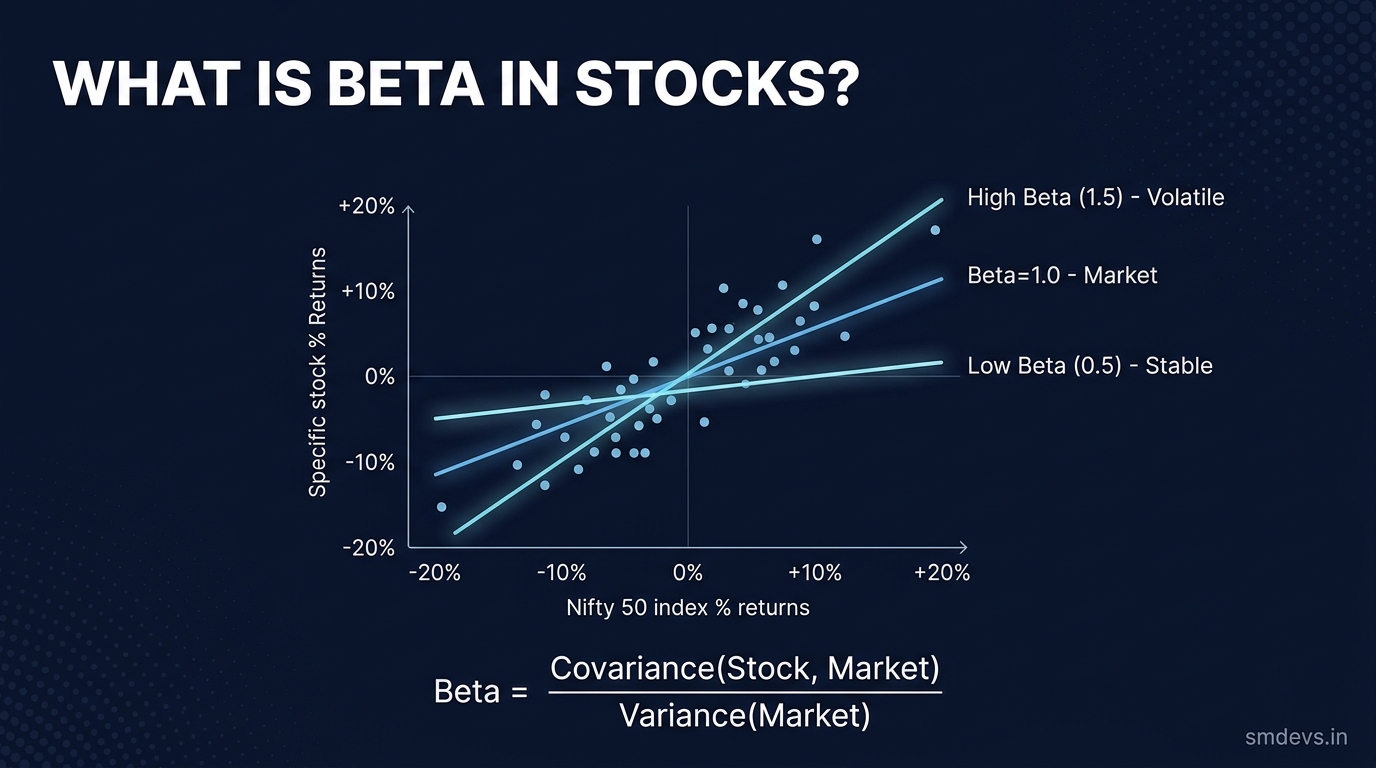
Beta is a measure of a stock's volatility (price swings) relative to the overall market (typically the Nifty 50 in India or S&P 500 in the US). It tells you how much a stock tends to move when the market moves 1%.
Formula: Beta = Covariance(Stock Returns, Market Returns) / Variance(Market Returns)
How to Interpret Beta Values
| Beta Value | Meaning | Example |
|---|---|---|
| Beta > 1 (e.g., 1.5) | More volatile than market. If Nifty rises 10%, stock rises ~15% | Small-cap tech, high-growth stocks |
| Beta = 1 | Moves in line with market | Nifty 50 index ETF |
| Beta 0 to 1 (e.g., 0.5) | Less volatile. If Nifty falls 10%, stock falls only ~5% | FMCG, utilities, pharma |
| Beta = 0 | No correlation to market | Cash, gold (approximately) |
| Negative beta | Moves opposite to market | Inverse ETFs, some gold stocks |
High Beta vs Low Beta Stocks
High Beta Stocks (Beta > 1)
More upside in bull markets, more downside in bear markets. Examples in India: most small-caps, IT stocks during growth phases, auto stocks. Suitable for aggressive investors with long time horizons who can stomach volatility.
Low Beta Stocks (Beta < 1)
More defensive — they fall less in market downturns. Examples: ITC, HUL, HDFC Bank, power sector stocks. Suitable for conservative investors, retirees, or bearish market phases.
Beta vs Alpha
Beta and alpha are both from the Capital Asset Pricing Model (CAPM):
- Beta: Measures market-related risk (systematic risk). Cannot be diversified away.
- Alpha: Measures the return in excess of what beta predicts (the fund manager's skill). Positive alpha = outperforming expectations. Negative alpha = underperforming.
A fund with Beta 0.8 and Alpha 2% took less risk than the market but still outperformed expectations by 2% — a good outcome.
Limitations of Beta
- Beta is calculated from historical data — past volatility doesn't guarantee future volatility
- A company's fundamentals can change, making its historical beta irrelevant
- Beta doesn't capture company-specific risk (earnings miss, management scandal)
- Different time periods give different beta values — 1-year beta vs 5-year beta can differ significantly
Using Beta in Portfolio Construction
- Bull market: Increase high-beta exposure to maximise gains
- Bear market: Shift to low-beta defensive stocks to preserve capital
- Balanced portfolio: Mix of high and low beta stocks for stability with growth potential
- Portfolio beta: Average of all individual stock betas weighted by portfolio allocation
Example: 50% in beta 1.5 stocks + 50% in beta 0.5 stocks = portfolio beta of 1.0 (market-like risk).