Key Takeaways
- One of the most common fears among Indian investors is: "What if Zerodha or Upstox shuts down? Will I lose all my stocks?" This is a completely valid question — and the answer will likely surprise you
First: The Most Important Thing to Understand
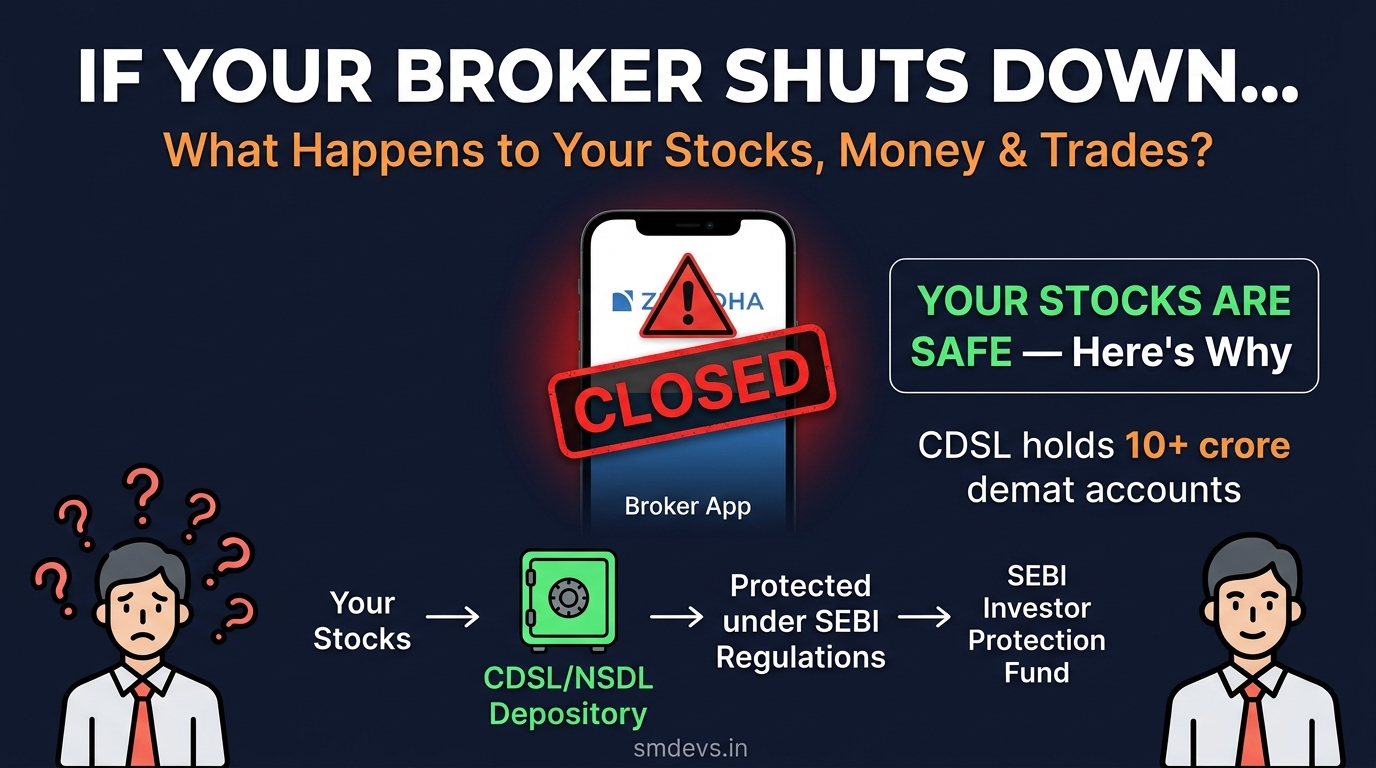
Your stocks are NOT held by your broker. They are held by the depository.
In India, all equity shares in demat form are held in one of two central depositories regulated by SEBI:
- CDSL — Central Depository Services (India) Limited — promoted by BSE, with 10+ crore active demat accounts
- NSDL — National Securities Depository Limited — promoted by NSE, with 3+ crore active demat accounts
Your broker is a Depository Participant (DP) — an intermediary that gives you access to the depository. The broker does NOT own your stocks. The stocks sit in your demat account at CDSL or NSDL — the broker is just the interface through which you view and trade them.
If your broker shuts down tomorrow, your stocks remain exactly where they are — in your demat account at CDSL or NSDL. The broker cannot take them.
What Exactly Is the Demat Account?
A demat account (short for dematerialised account) is an electronic account maintained by CDSL or NSDL that holds your shares, bonds, mutual fund units (in statement of account form), and ETFs in digital form. It works like a bank account — except instead of money, it holds securities.
Just as your money in SBI is safe even if your bank branch closes (because it's backed by RBI regulations and DICGC insurance), your shares at CDSL/NSDL are safe even if your broker closes (because the depository holds them independently).
What Happens Step by Step If Your Broker Shuts Down
Day 1–7: Broker Shutdown Announced
If a SEBI-registered broker shuts down (voluntarily or involuntarily due to insolvency), SEBI immediately:
- Places the broker's operations under SEBI surveillance
- Appoints a settlement agent or administrator to protect client assets
- Freezes the broker's own proprietary assets to prevent misuse of client funds
- Issues a public notice to affected clients
Your Demat Holdings: Safe Immediately
Since your stocks are at CDSL/NSDL — NOT at the broker — they are immediately safe. No transfer is needed. You can:
- Open an account with any other SEBI-registered broker
- Submit a DIS (Delivery Instruction Slip) or online transfer request to move your demat account from the old DP to your new broker
- CDSL/NSDL will process this transfer regardless of the old broker's status
Your Idle Cash (Funds in Trading Account): The Complicated Part
Here's where it gets more complex. Cash sitting in your broker's trading account (not invested in stocks or mutual funds) is more at risk than your stocks. SEBI regulations require:
- Brokers to keep client funds in a segregated client account — separate from the broker's own operational funds
- Funds must be deposited in a designated bank account in the name of the client pool
- Brokers cannot use client funds for their own operations
In practice, if a broker fails with proper compliance, your idle cash should be recoverable. However, if the broker was misusing client funds (which has happened in some cases — Karvy Stock Broking in 2019, for instance), recovery may be partial and take time.
NSE/BSE Investor Protection Fund
Both NSE and BSE maintain an Investor Protection Fund (IPF) to compensate investors in case a broker defaults. Compensation limits:
- NSE IPF: Up to ₹25 lakh per investor per default
- BSE IPF: Up to ₹15 lakh per investor per default
This covers losses from a broker default — not market losses (normal investment risk). The IPF claim process requires filing with the exchange within the specified time window after a broker default is declared.
Real Case: What Happened When Karvy Shut Down (2019)
Karvy Stock Broking, one of India's oldest broking firms, was suspended by SEBI in November 2019 for pledging client securities without consent (using client stocks as collateral for the company's own loans). This affected approximately 2.4 lakh clients.
What happened to clients:
- Stocks NOT pledged (the majority of clients): Transferred to clients' own demat accounts or new brokers within 3–6 months after SEBI/NSDL intervention
- Stocks pledged without consent (approximately 95,000 clients): Required legal resolution — some received compensation via SEBI's investor protection fund; legal proceedings continued for years
- Funds in trading accounts: Mostly recovered through SEBI-supervised settlement; some clients faced extended delays
Lesson: The depository system protected most investors. The violation was the broker illegally pledging client assets — which SEBI now has stricter rules to prevent (margin pledge reform of 2021 requires explicit client consent for pledging).
How to Protect Yourself: 5 Practical Steps
1. Know Your DP ID and Client ID
Your demat account has a DP ID (identifies your broker as a depository participant) and a Client ID (identifies you specifically). You need these to transfer holdings. Find them in your broker app under "Profile" or "Demat Account Details," or in your annual demat account statement from CDSL/NSDL.
2. Keep Minimal Idle Cash in the Trading Account
Transfer only the money you plan to use for upcoming trades to your broker's trading account. Keep the rest in your bank account and move funds only when needed. Idle cash in a trading account is the most vulnerable part of your relationship with a broker.
3. Check Your CDSL/NSDL Statement Directly
You can view your actual demat holdings directly on CDSL's website (www.cdslindia.com) or NSDL's website (www.nsdl.co.in) using your DP ID and Client ID — without going through your broker. Do this quarterly to verify that your holdings match what your broker's app shows.
4. Don't Pledge Shares Without Understanding the Terms
Many brokers offer "margin against shares" — they pledge your existing holdings to give you additional margin for trading. Understand exactly what you're authorising. After SEBI's 2021 margin pledge reform, this requires explicit client consent via OTP. Never authorise pledging shares unless you fully understand the terms and risks.
5. Choose SEBI-Registered, SEBI-Compliant Brokers
Zerodha, Upstox, Angel One, Groww, ICICI Direct, HDFC Securities — all are SEBI-registered brokers with strong compliance records. Zerodha, India's largest broker, is employee-owned with no external investors and transparent financials — it regularly publishes its financial health. For additional peace of mind, check your broker's net worth and compliance status on SEBI's website.
FAQs: Broker Shutdown and Investment Safety
Is my money safe if Zerodha shuts down?
Your stocks: Yes — they're held at CDSL/NSDL, not by Zerodha. If Zerodha shuts down, you transfer your demat account to another broker within weeks. Your idle cash in the trading account: protected by SEBI regulations requiring segregated client accounts, but not 100% immune to risk in an extreme fraud scenario. For maximum safety, keep minimal idle cash in your trading account at all times.
What is CDSL and why does it matter for my investments?
CDSL (Central Depository Services India Limited) is one of India's two central depositories, regulated by SEBI, where your demat shares are actually held. It's like the "bank" of your shares — your broker is just an interface. If your broker shuts down, your shares at CDSL are unaffected. You simply link your CDSL demat account to a new broker and continue trading.
What is the Investor Protection Fund?
NSE and BSE each maintain an Investor Protection Fund (IPF) that compensates investors who lose money due to a SEBI-registered broker's default (insolvency or fraud). NSE's IPF covers up to ₹25 lakh per investor per default. This is separate from normal market losses — IPF protects only against broker failure, not losses from bad investment decisions.