Key Takeaways
- Domain Authority (DA) is a third-party Moz metric — Google has explicitly confirmed it is not a ranking signal
- Topical authority measures how comprehensively a website covers a subject area — Google uses this to determine ranking eligibility
- Low-DA sites regularly outrank high-DA sites when they have deeper topical coverage
- Building topical authority requires content clusters — pillar pages + supporting articles covering every sub-topic
- Internal linking between related pages is how you signal topical relationships to Google
Domain Authority vs Topical Authority: The Core Difference
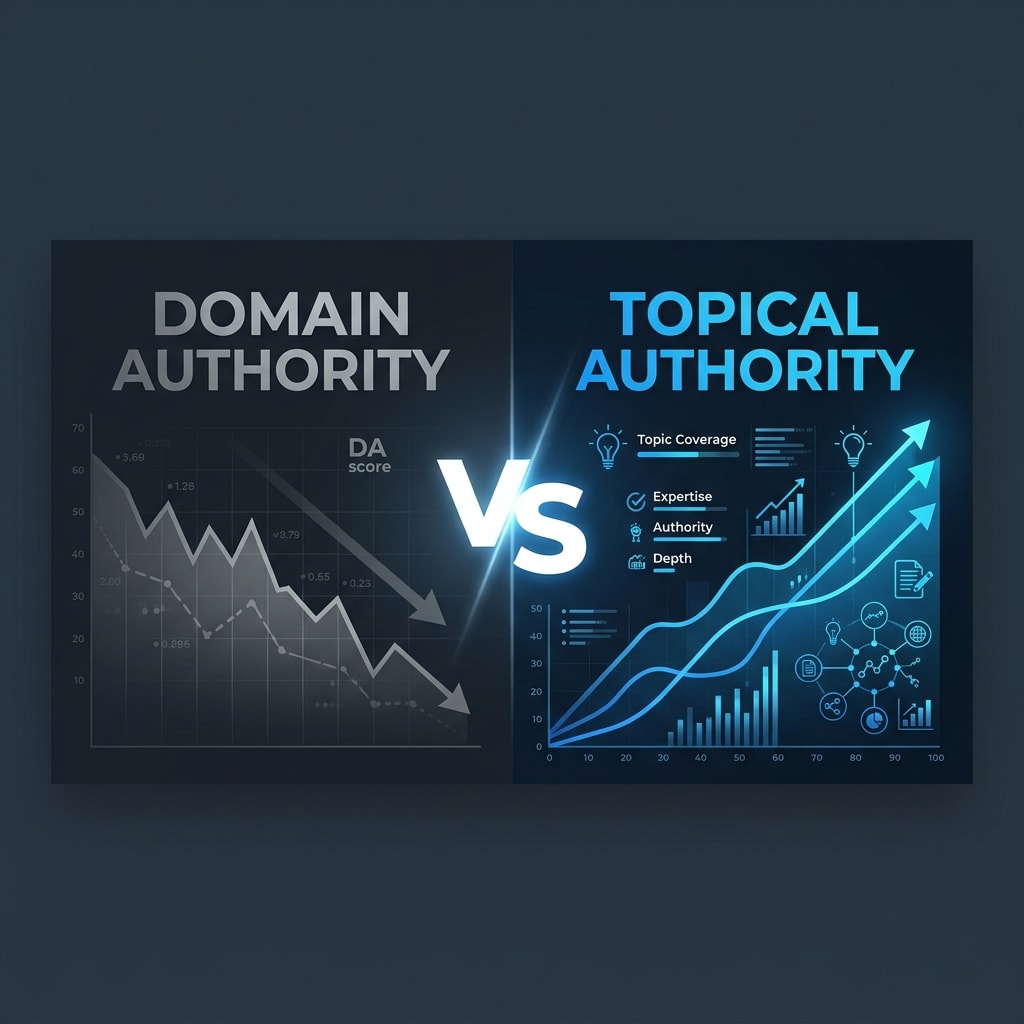
Domain Authority (DA) is a proprietary score created by Moz that attempts to predict how well a website will rank in search engines. It runs from 0 to 100 and is calculated based primarily on the quantity and quality of backlinks pointing to your domain. Google has never used Domain Authority as a ranking signal. It was never designed by Google, measured by Google, or integrated into Google's algorithm in any form.
Topical authority is the degree to which Google considers a website an authoritative source on a specific subject. It is not a single number — it is a judgment Google's algorithm makes based on the breadth and depth of your content coverage within a topic area, your content's semantic relationships, and user signals that confirm your content satisfies queries on that topic better than competitors.
One is a third-party approximation. The other is a real ranking factor.
Why the SEO Industry Got Addicted to DA
Domain Authority filled a practical gap. Before tools like Moz, Ahrefs, and SEMrush, SEOs had no consistent metric to compare websites. Google's own PageRank was retired from public display in 2016. DA became the de facto replacement — partly because it's visible, partly because it's easy to communicate to clients, and partly because it does correlate loosely with ranking ability in some contexts.
The problem is correlation without causation. High-DA sites often have high topical authority too — but only because they've been publishing content in their niche for a long time. DA is a lagging indicator. Topical authority is the actual driver.
The practical consequence: countless SEO campaigns have been optimized around building DA (chasing backlinks from high-DA domains) while neglecting the content coverage gaps that prevent ranking regardless of how many backlinks the site has.
Real Evidence: Low-DA Sites Outranking High-DA Sites
The clearest evidence that topical authority outweighs DA comes from looking at actual SERPs in niche categories. A site with DA 25 that has published 40 deeply researched articles on a specific topic (say, "day trading risk management") will consistently rank above a DA 60 general finance website that has published 3 generic articles on the same topic.
Google's John Mueller has directly addressed this multiple times. In 2022 he stated: "Domain Authority is not something we use." In 2023, Google's Search Central documentation was updated to emphasize "topical relevance" and "content depth" as quality signals — with no mention of domain-level link metrics as a direct ranking input.
What Google Actually Uses: The Topical Authority Signals
Based on Google's documentation, confirmed algorithm updates, and consistent SERP behavior, topical authority is built from:
- Content breadth: Do you cover all the major sub-topics within your niche? A site about SEO that covers keywords, technical SEO, link building, analytics, and content strategy has broader topical authority than one that only covers keyword research.
- Content depth: Does each piece of content fully satisfy the search intent? Thin, surface-level articles that don't answer all the questions a searcher has reduce topical authority signals.
- Semantic entity relationships: Does your content consistently mention the entities (concepts, tools, people, brands) that are semantically expected in your niche? Google's Knowledge Graph recognizes entity associations — content that consistently uses industry-standard terminology signals expertise.
- Internal linking architecture: Are related articles linked to each other? Internal links are how you communicate topical relationships to Google. A pillar page linked to 10 supporting articles signals that the pillar is the authoritative hub of that topic cluster.
- User engagement signals: Do users who find your content via search stay, read, and not immediately return to Google for more results? Low bounce rates and high dwell time on specific topics signal that your content satisfies that topic's queries better than competitors.
The Topical Authority Content Cluster Model
The practical framework for building topical authority is the content cluster model:
- Pillar page: A comprehensive, long-form guide on a broad topic (e.g., "The Complete Guide to SEO"). This is the hub of the cluster.
- Cluster pages: Focused articles on specific sub-topics within the pillar topic (e.g., "How to Do Keyword Research," "Technical SEO Audit Guide," "Link Building Strategies"). Each links back to the pillar.
- Supporting pages: Tool pages, case studies, or resource pages that support specific cluster topics and link into the cluster structure.
| Level | Content Type | Example | Links To |
|---|---|---|---|
| Pillar | Broad guide (3,000–5,000 words) | Complete SEO Guide | All cluster pages |
| Cluster | Focused article (1,500–2,500 words) | Keyword Research Guide | Pillar + related clusters |
| Supporting | Tool / resource page | Keyword Density Checker | Relevant cluster pages |
How to Measure Topical Authority (Since There's No Score)
Because topical authority has no single public metric, you measure it indirectly through:
- Topic coverage gap analysis: List all the questions users ask about your topic (use Google's People Also Ask, Answer the Public, or your keyword research tool). Map each question to existing content. Gaps = authority missing.
- Rankings across the topic cluster: If you publish 20 articles on SEO and 17 of them rank on page 1–2, your topical authority in SEO is strong. If only 3 rank, it's weak regardless of your DA score.
- Keyword difficulty at which you rank: Sites with strong topical authority can rank for medium-to-high difficulty keywords without heavy backlink profiles. If you're consistently ranking for difficult keywords with few links, your topical authority is doing the heavy lifting.
A Practical Topical Authority Building Plan
- Choose one core topic to dominate (not five — one)
- Map every sub-topic, question, and intent variation within that topic
- Audit existing content: what's covered, what's thin, what's missing
- Publish supporting cluster articles for each uncovered sub-topic
- Build internal links between all related pages using descriptive anchor text
- Update existing thin content to meet the depth standard of top-ranking competitors
- Use the Keyword Intent Analyzer to confirm intent alignment for each piece
- Use the SEO Structure Analyzer to audit internal linking gaps
Should You Still Care About Backlinks?
Yes — but as a supporting signal, not the primary strategy. Backlinks remain one of Google's confirmed ranking signals. The effective framework is: build topical authority first (content coverage + internal linking), then build links to your pillar and high-value cluster pages.
Links to topically irrelevant pages or random blog posts don't move the needle the way they did in 2015. Links to pages that are already topically authoritative — and that have strong internal link support — compound significantly.
Key Takeaways
- Domain Authority is a Moz metric — Google has confirmed it plays no role in their ranking algorithm
- Topical authority — content breadth, depth, semantic richness, and internal linking — is what Google actually measures
- Low-DA sites with deep topical coverage consistently outrank high-DA generalist sites
- Build topical authority through content clusters: one pillar page + multiple cluster articles + tool/supporting pages
- Internal linking is the mechanism that communicates topical relationships to Google
What is topical authority in SEO?
Topical authority is Google's assessment of how comprehensively and authoritatively a website covers a specific subject area. It is built through broad content coverage of all sub-topics within a niche, deep content that fully satisfies search intent, semantic entity richness, and strategic internal linking that communicates topical relationships between pages. Websites with strong topical authority rank more easily and for more competitive keywords within their topic cluster.
Is Domain Authority a Google ranking factor?
No. Domain Authority (DA) is a proprietary metric created by Moz. Google has explicitly confirmed multiple times — including directly from John Mueller, Google's Search Relations Lead — that DA is not used in Google's ranking algorithm in any form. Google's own systems use internal signals related to content quality, link authority at the page level, topical relevance, and user experience signals.
How do you build topical authority?
Build topical authority by: (1) Choosing one core topic to focus on deeply rather than covering many topics superficially. (2) Mapping all sub-topics, questions, and search intents within that topic. (3) Creating a content cluster with a pillar page and supporting cluster articles. (4) Building internal links between all related content using descriptive anchor text. (5) Updating existing thin content to meet depth standards. (6) Tracking rankings across your entire topic cluster as the primary authority signal.
Can a low-DA site outrank a high-DA site?
Yes — consistently. Sites with low Domain Authority but high topical authority (deep content coverage of a specific niche) regularly outrank high-DA generalist websites in competitive searches. This happens because Google's algorithm rewards content relevance, depth, and user satisfaction signals more than domain-level link metrics for most non-competitive queries. The more specialized your topic focus, the greater your advantage over high-DA generalists.