Key Takeaways
- Day trading: all positions closed same day — requires full-time focus during market hours
- Swing trading: positions held 2 days to 6 weeks — compatible with a full-time job
- Day trading has higher transaction costs that significantly eat into profits
- Swing trading captures larger per-trade moves (5–25%) vs. intraday (0.5–2%)
- For beginners, swing trading is the strongly recommended starting point
One of the most common questions new traders face is choosing between swing trading and day trading. Both involve active trading — buying and selling financial instruments based on market analysis — but they differ fundamentally in time horizon, lifestyle requirements, capital efficiency, risk profile, and the psychological demands they place on the trader.
This guide provides a complete, honest comparison of both styles so you can make an informed decision about which approach is actually right for you — not based on which sounds more exciting, but based on your circumstances, personality, and realistic goals.
What Is Day Trading?
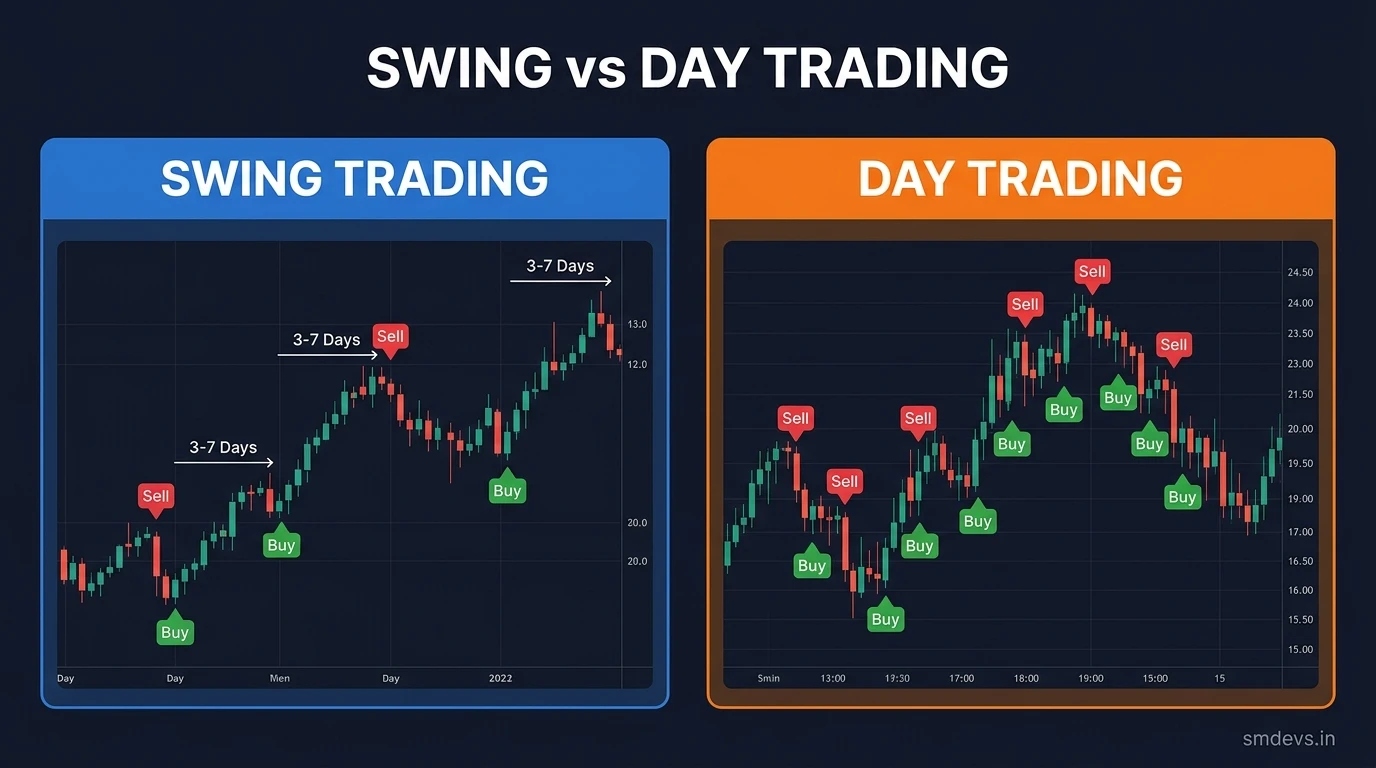
Day trading involves opening and closing all positions within the same trading session — no positions held overnight. In India, this means all trades are squared off before the NSE/BSE market closes at 3:30 PM (typically by 3:20 PM for intraday MIS orders). Day traders profit from short-term price movements that occur within a single day.
Day trading characteristics:
- Positions held for minutes to hours
- Requires active monitoring during market hours (9:15 AM – 3:30 PM in India)
- Higher leverage available (3–5× for equity intraday in India)
- No overnight risk
- Full-time time commitment during market hours
- Profits taxed as speculative business income in India
What Is Swing Trading?
Swing trading involves holding positions for multiple days to several weeks — capturing "swings" in price as assets move from one support/resistance level to the next within a broader trend. Swing traders aim to capture a meaningful portion of a trend move, not every tick within a single day.
Swing trading characteristics:
- Positions held for 2 days to 4–6 weeks
- Requires analysis once or twice daily (end of day or morning)
- Lower leverage than intraday (margin depends on broker and product)
- Overnight risk (price can gap up or down between sessions)
- Compatible with a full-time job or other commitments
- Profits taxed as Short-Term Capital Gains (STCG) in India — 20% flat rate
Key Takeaways
- Day trading requires your full attention during market hours. It is incompatible with a full-time job and demands professional-grade focus, speed, and discipline.
- Swing trading is more compatible with a primary career because analysis can be done outside market hours.
- Day trading produces higher frequency of trades — and higher frequency of losses. Transaction costs compound rapidly.
- Swing trading captures larger per-trade moves — individual trades often deliver 5–20% returns, vs. 0.5–2% for most intraday trades.
- Neither style is inherently better. The best style is the one that matches your personality, schedule, capital, and emotional resilience.
Head-to-Head Comparison
| Factor | Day Trading | Swing Trading |
|---|---|---|
| Hold duration | Minutes to hours | 2 days to 4–6 weeks |
| Number of trades | 5–30 per day | 5–15 per month |
| Time required | Full-time (6+ hours/day) | 30–90 minutes/day |
| Capital required | Lower (leverage amplifies) | Moderate to higher (full position value overnight) |
| Transaction costs | High (many trades/day) | Low (few trades/month) |
| Overnight gap risk | None | Yes — news and global markets can gap your position |
| Profit per trade | Small (0.5–2%) | Larger (5–25%) |
| Stress level | Very high | Moderate |
| Skill level required | Very high | Moderate to high |
| Tax rate (India) | Income tax slab (up to 30%) | STCG — 20% flat |
| Computer/setup required | Yes — multi-monitor preferred | Smartphone is sufficient for analysis |
The Psychology Difference
This is the factor most traders underestimate. Day trading and swing trading demand fundamentally different psychological profiles.
Day trading psychology requirements:
- Ability to make rapid decisions under pressure with real money at stake
- Capacity to instantly cut losses without hesitation (stops will be hit frequently)
- Emotional flatness — the ability to remain unaffected by both wins and losses in quick succession
- Resistance to FOMO (Fear of Missing Out) — not chasing setups that have already moved
- Ability to stop after a daily loss limit is reached, even when "the market looks good"
Swing trading psychology requirements:
- Patience to wait for setups — sometimes waiting multiple days for the right entry
- Ability to hold a position through normal pullbacks without panicking out
- Comfort with overnight uncertainty — knowing that news events can gap the market against you
- Discipline to stick to the plan when a position moves against you before your stop is hit
Most people find swing trading's psychological demands easier to manage — the slower pace allows more rational decision-making. Day trading requires a near-professional level of emotional control that takes years to develop.
Capital and Transaction Cost Comparison
Day Trading costs (example: ₹5 lakh account, 10 trades/day):
- Brokerage: ₹20 per order × 20 orders (10 entries + 10 exits) = ₹400/day
- STT (equity sell side intraday): 0.025% on sell turnover
- Exchange fees, SEBI charges, GST: approximately 0.04–0.06% total on turnover
- Monthly costs (22 trading days): ₹8,000–12,000+ in transaction costs alone
Transaction costs are the hidden destroyer of many day traders' P&L. You must generate enough gross profit just to break even on costs — before making any net profit.
Swing Trading costs (example: 10 trades/month):
- Brokerage: ₹20 per order × 20 orders = ₹400/month
- STT and other charges on delivery: approximately 0.1% total on buy side
- Monthly costs: ₹1,000–2,000 typically
Swing trading's lower trade frequency dramatically reduces the transaction cost burden — giving each trade more room to be profitable on a net basis.
Which Is Better for Beginners?
For most beginners, swing trading is significantly more appropriate as an entry point into active trading. Here's why:
- More time to analyze: Swing traders can analyze charts in the evening without the real-time pressure of the market. Beginners need this time to learn and think clearly.
- Lower transaction costs: Fewer trades mean less money lost to friction while you are still developing your edge.
- Better risk management: Stop losses placed on end-of-day charts are less likely to be triggered by normal intraday noise.
- Compatible with employment: Most beginners have day jobs. Swing trading allows you to develop skills without quitting your primary income.
- Lower psychological pressure: Slower decision-making pace is more forgiving during the learning phase.
Day trading should be considered only after you have been profitably swing trading for at least 1–2 years, you have sufficient capital to absorb the higher transaction costs, and you are prepared to commit full-time during market hours.
The Hybrid Approach — Position Trading
Many experienced traders adopt a hybrid approach: swing trading as their primary strategy for most positions (2–6 week holds capturing 10–25% moves), with selective intraday trading on high-conviction setups where the market is showing strong directional momentum. This maximizes capital efficiency while keeping transaction costs manageable and lifestyle requirements flexible.
Frequently Asked Questions
Can I do both swing trading and day trading?
Yes, many traders do. The most common approach is maintaining a separate "swing trading account" (for positions held overnight) and a "day trading account" (for intraday-only positions). This segregation prevents confusion about your intention for each position and keeps accounting clean. Psychologically, it also prevents the temptation to convert a losing intraday position into a "swing trade" — a very common and costly mistake.
How much money can I make from swing trading?
Realistic returns for consistently profitable swing traders are 15–40% annually on the trading capital — significantly higher than index funds in good years, but this requires real skill, discipline, and risk management. The wide variation depends on market conditions, strategy quality, and capital deployed. Be extremely skeptical of claims of 100%+ annual returns from swing trading — these are possible in exceptional bull markets but are not sustainable expectations.
What is the best timeframe for swing trading?
The daily chart is the primary timeframe for swing trading — it provides the clearest picture of multi-day trends and support/resistance levels. Use the weekly chart to identify the larger trend and major levels. Use the 4-hour chart to refine entry timing and identify precise entry points with tighter stop losses. The daily chart should always be your primary decision-making reference; shorter timeframes are for entry timing only.
Do swing traders need to watch the market all day?
No — this is one of swing trading's primary advantages over day trading. Most swing traders spend 20–60 minutes per day on market analysis: reviewing their positions in the morning, scanning for new setups in the evening, and placing their trades with pre-set stop losses and targets. Once you have your stop loss and target orders in, you do not need to watch the market. This makes swing trading the most compatible active trading style with a regular career or other commitments.
What is the biggest risk in swing trading?
Overnight gap risk is the primary risk specific to swing trading. News events (earnings, regulatory decisions, global market crashes) can cause prices to "gap" — opening significantly higher or lower than where they closed. A stop loss set at ₹500 on a stock that gaps down to ₹470 at open will execute at ₹470, not ₹500 — creating a larger loss than expected. Managing this risk requires: avoiding holding positions through earnings announcements, position sizing conservatively (never risking more than 1–2% even accounting for potential gaps), and avoiding illiquid stocks where gaps are larger.
Your Next Step
Whether you choose swing trading or day trading, the foundation is identical: master Technical Analysis, apply strict Risk Management rules, and always calculate your position size before entering any trade. For the specific chart setups that work best for swing trading, explore the full chart pattern infographic library.