Key Takeaways
- Stock market myths spread faster than stock tips in India. From believing that SIP is risk-free to thinking that penny stocks are the shortcut to riches, these misconceptions cost Indian investors tho
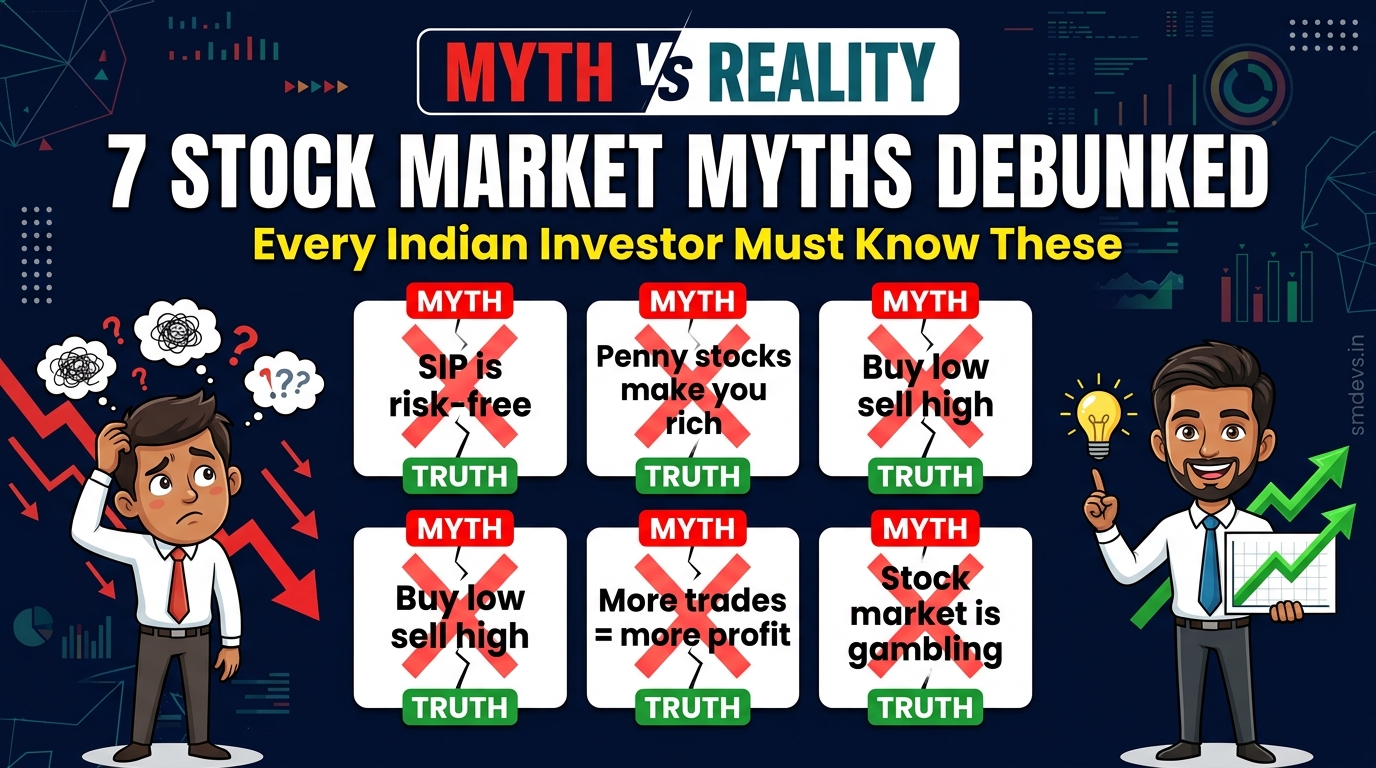
Myth 1: "SIP is Risk-Free"
❌ The Myth: "I invest via SIP so I don't lose money. SIP eliminates risk."
✅ The Truth: SIP (Systematic Investment Plan) reduces the risk of timing the market wrong — through rupee cost averaging. It does NOT eliminate market risk. If the market falls for an extended period, your SIP portfolio will also fall. SIP in equity mutual funds still carries full equity market risk.
What the data shows: During the 2020 COVID crash, even SIP investors who had invested for 1–3 years saw portfolio values drop 35–40%. SIP investors in 2007–2010 who started right before the financial crisis were in negative territory for 3–5 years.
The correct framing: SIP is an excellent strategy for building wealth over long periods (10+ years) because it removes timing risk and builds discipline. But it is NOT a capital protection tool for short or medium time horizons. Keep your SIP investment time horizon minimum 7 years for equity, and only invest money you don't need in that timeframe.
Myth 2: "Penny Stocks Can Make You Rich Quickly"
❌ The Myth: "This stock is only ₹2 — if it goes to ₹20, I'll 10x my money! Low-priced stocks have more room to grow."
✅ The Truth: A stock's absolute price tells you nothing about its upside potential. A ₹2 stock is not "cheaper" or has more growth potential than a ₹2,000 stock — what matters is the company's valuation relative to its earnings and growth.
Penny stocks (typically priced below ₹10–₹50) in India are disproportionately represented among: BSE SME / illiquid companies, companies with weak financials, and pump-and-dump schemes. The promoters buy cheaply, drive up the price through social media hype, and sell to retail investors who are then left with worthless shares.
What the data shows: NSE data shows that stocks priced below ₹10 on NSE have an average 3-year return of approximately -45% — they destroy wealth at roughly 3x the rate of large-cap indices over the same period.
The correct framing: Judge stocks by fundamentals (P/E ratio, earnings growth, debt levels, management quality), not by absolute share price. Read our guide on valuing stocks using intrinsic value.
Myth 3: "The Stock Market is Just Gambling"
❌ The Myth: "The stock market is just like a casino. It's all luck. You can't predict what will happen."
✅ The Truth: Gambling is a negative-sum game where the house always wins. The stock market is fundamentally different — it's a positive-sum game where the total wealth of all participants has historically grown over long periods, because companies generate real profits, create real products, and provide real employment.
What the data shows: The Nifty 50 index has delivered approximately 13–15% CAGR over the last 25 years (1999–2024), despite multiple crashes. ₹1 lakh invested in Nifty 50 in 1999 would be worth approximately ₹25–30 lakh by 2024. A casino has a fixed, negative expected return for every bet.
The nuance: Short-term trading in derivatives without a strategy does resemble gambling. Long-term investing in quality businesses is categorically different — you're a part-owner of companies creating value for society.
Myth 4: "Buy Low, Sell High — It's That Simple"
❌ The Myth: "Just buy when prices are low and sell when they're high. What's so hard about that?"
✅ The Truth: This is circular advice — it's definitionally true but operationally useless. The question is: how do you know what's "low" and what's "high"? A stock at ₹100 can always go to ₹50. A stock at ₹1,000 can always go to ₹5,000. "Low" and "high" are only visible in hindsight.
The psychological reality is the exact opposite of buy-low-sell-high: stocks feel most attractive when they're rising (and therefore expensive) and most scary when they're falling (and therefore cheap). This is why the average retail investor buys at tops and sells at bottoms.
The correct framing: Rather than trying to predict price direction, focus on valuation (buying when price is below intrinsic value) and time horizon (holding long enough that company fundamentals drive returns). For traders, a systematic rules-based approach (like using RSI divergence or pivot level setups) is more reliable than gut-feel timing.
Myth 5: "More Trading = More Profit"
❌ The Myth: "I need to be in the market all day. More trades = more opportunities = more profit."
✅ The Truth: SEBI data shows that traders who execute 10+ trades per day lose money at a higher rate than those who execute 2–3 trades per day. Overtrading is a profit killer for two reasons: (1) transaction costs accumulate rapidly — a trader doing 20 options trades a day might pay ₹2,000–₹4,000 in charges regardless of P&L, and (2) lower-quality setups are taken to fill the need to be "doing something."
What the data shows: The most consistently profitable traders across styles (Warren Buffett for value investing; Paul Tudor Jones for macro trading) are notable for how few trades they make, not how many. Quality over quantity.
The correct framing: Trade only when your specific setup criteria are met. If no valid setup exists today, don't trade. The money you don't lose on forced bad setups is money in your account tomorrow.
Myth 6: "I Need a Lot of Money to Start Investing"
❌ The Myth: "I'll start investing when I have ₹1 lakh saved up. Right now, my savings are too small to matter."
✅ The Truth: Time in the market is more powerful than the amount you start with. This is the compounding effect — and waiting destroys it.
Example: Person A invests ₹500/month from age 22 (₹6,000/year). Person B waits and invests ₹5,000/month from age 32 (₹60,000/year). Assuming 12% CAGR, at age 60:
- Person A (₹500/month for 38 years): ~₹2.8 crore
- Person B (₹5,000/month for 28 years): ~₹2.3 crore
Person A invested 1/10th the monthly amount but ended up with more money because of time. Most mutual funds now allow SIP with just ₹100/month through platforms like Groww and Zerodha Coin.
Myth 7: "IPOs Always Make Money — Apply for Every IPO"
❌ The Myth: "IPOs always give listing gains. Just apply for every IPO and sell on listing day."
✅ The Truth: IPO listing day performance is highly variable. Data from 2020–2024 shows that approximately 40% of NSE/BSE IPOs gave negative or zero listing day returns for retail investors. High-profile IPOs like LIC (2022) listed below issue price and stayed there for over a year.
The subscription hype creates a selection bias — you hear about the IPOs that listed at 50–100% premium (Paytm excluded — that was a disaster), and not the dozens that quietly listed flat or below issue price.
The correct framing: Evaluate IPOs on fundamentals — valuation relative to listed peers, promoter quality, use of IPO proceeds, and growth potential. Don't blindly apply for every IPO expecting guaranteed listing gains.
FAQs: Stock Market Myths
Is SIP really risk-free?
No — SIP is not risk-free. SIP reduces timing risk through rupee cost averaging but does not eliminate market risk. Equity SIP investments can and do show negative returns over 1–5 year periods if markets are in a bear phase. SIP is best suited for long-term wealth creation (7+ year horizon) where short-term volatility is acceptable.
Are penny stocks good investments?
Generally no. Penny stocks carry disproportionate risks: low liquidity (hard to sell when you want to), high manipulation risk, poor corporate governance, and weak underlying business fundamentals. NSE data shows penny stocks (below ₹10) have significantly underperformed large-cap stocks over 3–5 year periods. Exceptions exist but are rare and require deep research to identify.
Is the stock market the same as gambling?
No — long-term equity investing is fundamentally different from gambling. In gambling, the house has a mathematical edge and the expected return for players is negative. In equity markets, the long-term expected return is positive because you're investing in businesses that create real value. Short-term speculation in derivatives without a tested strategy does share characteristics with gambling — negative expected return after costs.