Key Takeaways
- The RBI Monetary Policy Committee kept the repo rate unchanged at 5.25% on August 5, 2026. Repo rate is the rate at which RBI lends money to commercial banks — and its every change sends ripples acros
RBI Repo Rate Decision: August 5, 2026
The Reserve Bank of India's Monetary Policy Committee (MPC), in its meeting held from August 3–5, 2026, voted unanimously to keep the policy repo rate unchanged at 5.25%. The MPC also maintained its neutral policy stance, citing global uncertainties including West Asia conflict, supply-chain disruptions, and El Niño risks.
- Repo Rate: 5.25% (unchanged)
- Standing Deposit Facility (SDF): 5.00%
- Marginal Standing Facility (MSF) / Bank Rate: 5.50%
- GDP Forecast FY27: Revised up to 6.7% from 6.6%
- CPI Inflation Projection FY27: Lowered to 5.0%
Source: Reserve Bank of India — Official MPC Press Release
What is the Repo Rate?
The Repo Rate (Repurchase Rate) is the interest rate at which the Reserve Bank of India (RBI) lends short-term money to commercial banks against government securities as collateral. It is the RBI's primary monetary policy tool — used to control inflation, liquidity, and economic growth.
Think of it as the "wholesale cost of money" for banks. When RBI raises the repo rate, borrowing becomes more expensive for banks, which pass this cost on to consumers and businesses through higher loan interest rates. When RBI cuts the rate, borrowing becomes cheaper, stimulating spending and investment.
Formula relationship: Repo Rate ↑ → Borrowing Cost ↑ → Economic Activity ↓ → Inflation ↓
Repo Rate ↓ → Borrowing Cost ↓ → Economic Activity ↑ → Inflation ↑
Repo Rate vs Reverse Repo Rate vs SDF
| Term | Definition | Current Rate |
|---|---|---|
| Repo Rate | Rate at which RBI lends to banks | 5.25% |
| SDF (Standing Deposit Facility) | Rate at which banks park excess funds with RBI overnight (replaced reverse repo) | 5.00% |
| MSF / Bank Rate | Rate at which banks borrow emergency overnight funds from RBI | 5.50% |
| CRR (Cash Reserve Ratio) | % of deposits banks must hold with RBI (not a rate, but affects liquidity) | 4.00% |
Source: RBI Monetary Policy Dashboard
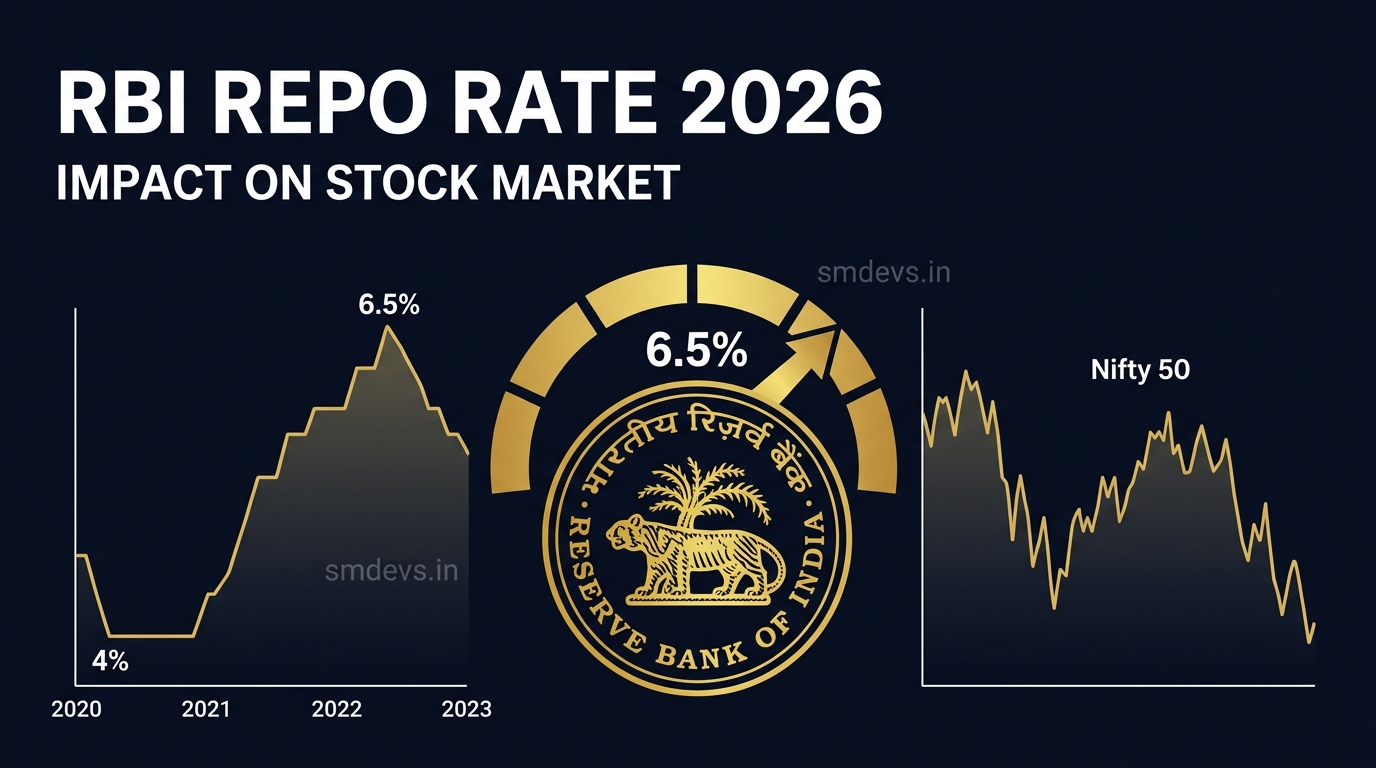
RBI Repo Rate History: 2020–2026 (Complete Timeline)
Understanding the historical context is critical to understanding where rates are headed and what it means for markets.
2020: Historic Low During COVID-19 Pandemic
| Date | Decision | Repo Rate | Change |
|---|---|---|---|
| Feb 6, 2020 | Pre-pandemic baseline | 5.15% | — |
| Mar 27, 2020 | Emergency cut — COVID lockdown | 4.40% | −75 bps |
| May 22, 2020 | Off-cycle cut — economic support | 4.00% | −40 bps |
The RBI slashed rates by a cumulative 115 basis points in 2020 alone — the steepest rate cuts in modern Indian history — to counter the economic collapse caused by COVID-19 lockdowns. GDP contracted by 7.3% in FY21.
2021–Early 2022: Rates at Historic Lows
Repo rate held at 4.00% throughout 2021 and into early 2022. This ultra-loose monetary policy fuelled one of India's strongest-ever equity bull markets. Nifty 50 rose from 7,511 in March 2020 to 18,477 by October 2021 — a 145% rally in 19 months.
Key stat: At 4% repo rate, home loan rates hit a 15-year low of ~6.5–7%, triggering a massive real estate and consumer lending boom.
2022: Aggressive Tightening Cycle
| Date | Decision | Repo Rate | Change |
|---|---|---|---|
| May 4, 2022 | Surprise emergency hike — inflation crisis | 4.40% | +40 bps |
| Jun 8, 2022 | Rate hike — inflation at 7.79% | 4.90% | +50 bps |
| Aug 5, 2022 | Rate hike | 5.40% | +50 bps |
| Sep 30, 2022 | Rate hike | 5.90% | +50 bps |
| Dec 7, 2022 | Rate hike | 6.25% | +35 bps |
Russia's invasion of Ukraine (February 2022) triggered a global commodity price surge. India's CPI inflation peaked at 7.79% in April 2022, far above the RBI's 4% target (±2% band). The RBI raised rates by 225 basis points in 2022 alone — the fastest tightening in 14 years. Nifty corrected ~17% from its peak during this cycle.
Source: MOSPI Consumer Price Index Data
2023–2024: Extended Pause at 6.50%
| Date | Decision | Repo Rate |
|---|---|---|
| Feb 8, 2023 | Final hike of cycle | 6.50% |
| Apr 2023 – Oct 2024 | Pause — 9 consecutive holds | 6.50% |
The 6.50% rate was held for an unprecedented 20+ months. India's GDP held up strongly at 7–8% growth even at this rate, giving RBI room to hold. The Nifty 50 made new all-time highs during this period, rising from ~17,000 to 26,000+ — demonstrating that stable rates, not just low rates, support equity markets.
2025–2026: Cutting Cycle Begins
| Date | Decision | Repo Rate | Change |
|---|---|---|---|
| Feb 7, 2025 | First cut in 5 years | 6.25% | −25 bps |
| Apr 9, 2025 | Second cut | 6.00% | −25 bps |
| Jun 6, 2025 | Third cut | 5.75% | −25 bps |
| Aug 8, 2025 | Fourth cut | 5.50% | −25 bps |
| Oct 2025 | Fifth cut | 5.25% | −25 bps |
| Aug 5, 2026 | Hold — neutral stance | 5.25% | 0 bps |
A total of 125 basis points of rate cuts since February 2025, driven by falling inflation, slowing global growth, and the need to boost domestic consumption. The cutting cycle has supported a broad rally across rate-sensitive sectors.
How Repo Rate Changes Affect the Stock Market
The repo rate is one of the most powerful macroeconomic forces on Indian equity markets. Here's the complete transmission mechanism:
Direct Mechanism: Cost of Capital
When the repo rate changes, it ripples through the entire financial system within weeks:
- RBI changes repo rate
- Banks adjust MCLR (Marginal Cost of Fund-based Lending Rate) and EBLR
- Home loans, car loans, business loans all reprice
- Consumer spending and corporate borrowing costs change
- Company revenues, profits, and valuations are affected
- Stock prices reflect these new earnings expectations
Sector-by-Sector Impact
Banking and Financial Services (Largest Weight in Nifty: ~35%)
- Rate cut impact: Initially NIM (Net Interest Margin) compression, but improved loan growth. Bank stocks often underperform slightly at the start of cutting cycles as NIMs compress, then recover as loan volumes grow.
- Rate hike impact: NIMs expand as lending rates rise faster than deposit rates. Banks are initially bullish on rate hikes — but excessive hikes increase NPA risk.
- Today's impact (hold at 5.25%): Neutral for banks. Loan growth continues at current pace; NIMs stable.
Real Estate and Housing Finance
- Most sensitive sector to rate changes. Each 25 bps cut saves ~₹700/month on a ₹50 lakh, 20-year home loan.
- The 125 bps cut cycle (2025–2026) has been a major tailwind for housing demand.
- Stocks: DLF, Macrotech, Godrej Properties, Sobha, LIC Housing Finance benefit from rate cuts.
Auto Sector
- 70%+ of cars are purchased on finance. Lower rates → higher affordability → more vehicle purchases.
- Rate cut cycle has boosted auto sector volumes significantly in 2025–2026.
- Stocks: Maruti Suzuki, Tata Motors, M&M, Bajaj Auto benefit from rate cuts.
Infrastructure and Capital Goods
- Government infrastructure projects are financed by borrowings. Lower rates reduce debt servicing costs.
- Lower bond yields during rate cuts attract FII flows into India → rupee strengthens → import cost reduces.
- Stocks: L&T, Larsen, NTPC, Power Grid benefit from rate cuts.
IT and Technology (Export-Oriented)
- Less directly impacted by repo rate. IT stocks are more correlated with US Federal Reserve decisions.
- Indirectly: Lower Indian rates attract FII flows → broader market rally includes IT.
- A stronger rupee (from FII inflows) can marginally hurt IT earnings (USD revenues worth less in INR).
FMCG (Consumer Goods)
- Rate cuts boost consumer spending power (lower EMIs = more disposable income).
- Rural consumption often improves when agriculture credit costs fall.
- Stocks: HUL, ITC, Nestle, Britannia benefit from improved rural and urban demand.
Utilities and Dividend Stocks
- Lower rates reduce opportunity cost of holding dividend-paying stocks vs bonds.
- Dividend yields become more attractive relative to falling Fixed Deposit rates.
- Stocks: ONGC, Coal India, Power Grid, NTPC — high dividend payers get re-rated upward.
Historical Data: Nifty 50 Performance vs Repo Rate Cycles
| Period | Rate Direction | Rate Change | Nifty 50 Performance |
|---|---|---|---|
| Mar 2020 – Oct 2021 | Cuts (4.00%) | −115 bps | +145% (7,511 → 18,477) |
| May 2022 – Feb 2023 | Hikes (4% → 6.5%) | +250 bps | −5% to −17% (volatile, but resilient) |
| Feb 2023 – Oct 2024 | Hold (6.5%) | 0 bps | +55% (17,000 → 26,277) |
| Feb 2025 – Aug 2026 | Cuts (6.5% → 5.25%) | −125 bps | Positive (ongoing) |
Key insight: Indian markets have shown remarkable resilience. The strongest rally (2023–2024) actually happened during a hold period — because stability and strong earnings growth matter more than low rates alone.
Source: NSE India Historical Data | SEBI Statistical Reports
Repo Rate vs Nifty: The Correlation Explained
The common belief is that "rate cuts = markets rally" and "rate hikes = markets fall." The truth is more nuanced:
Why Rate Cuts Don't Always Rally Markets
Rate cuts are sometimes done during economic crises (like 2020) — the initial reaction can be panic. Markets rally when cuts are accompanied by improving economic fundamentals, not just when cuts happen in isolation.
Why Rate Hikes Don't Always Crash Markets
If rates rise because the economy is growing strongly and inflation is above target, earnings growth can offset the negative effect of higher discount rates. India's market held up well in 2022–2023 because corporate earnings were strong despite the hiking cycle.
The Valuation Link (DCF)
Stocks are theoretically valued by discounting future earnings. The discount rate includes the risk-free rate (typically linked to government bond yields, which track repo rate). When repo rate falls:
- Bond yields fall → risk-free rate falls → future earnings worth more today → stock valuations expand (P/E multiples rise)
- This is why a rate cut cycle typically leads to P/E multiple expansion even without earnings growth
What Today's Hold Means for Markets (August 5, 2026)
The unchanged rate decision today was widely expected by the markets. Key implications:
Short-term (next 1–3 months)
- Market reaction: Neutral to slightly positive — status quo maintains a liquidity-supportive environment
- RBI's higher GDP forecast (6.7%) is bullish for corporate earnings growth expectations
- Lower inflation forecast (5%) gives room for future cuts if growth needs support
Medium-term (3–12 months)
- If global uncertainties stabilise, another 25–50 bps of cuts remain possible before end-FY27
- Further rate cuts would especially benefit: Real Estate, NBFCs, Autos, Rate-sensitive mid-caps
- Banking sector: Watch for MCLR resets and NIM trends in Q2FY27 results
What Could Change RBI's Course
- Upside risk to rates: Monsoon failure → food inflation spike above 6%, crude oil above $100/bbl, rupee depreciation below ₹90/$
- Downside risk to rates: US Federal Reserve cuts aggressively → capital inflows to India → RBI can cut more
How Fixed Deposits and Home Loans are Affected
The repo rate directly impacts the rates banks offer on Fixed Deposits and charge on loans:
| Product | At 6.5% Repo (2024) | At 5.25% Repo (2026) | Change |
|---|---|---|---|
| 1-year FD (major bank) | ~7.0–7.5% | ~5.75–6.25% | ~−125 bps |
| Home Loan Rate (floating) | ~8.5–9.0% | ~7.25–7.75% | ~−125 bps |
| Car Loan Rate | ~8.5–9.5% | ~7.5–8.5% | ~−100 bps |
| Personal Loan Rate | ~11–13% | ~10–12% | ~−100 bps |
Note: Individual rates vary by bank and borrower credit profile.
How to Invest Around Repo Rate Cycles
During Rate Cut Cycles (Like 2025–2026)
- Overweight: Real Estate, Housing Finance, Auto, Consumer Discretionary, Small/Midcaps (higher beta benefits from liquidity)
- Consider: Long-duration debt funds (bond prices rise as yields fall)
- Reduce: Fixed Deposits (FD rates will fall — lock in long-term FDs early in cutting cycle)
During Rate Hike Cycles (Like 2022)
- Overweight: Banking (NIM expansion), FMCG (defensive), IT (USD earnings)
- Consider: Short-duration debt funds (less sensitive to rising yields)
- Reduce: High-debt companies, Real Estate, Rate-sensitive NBFCs
During Hold Periods (Like 2023–2024 and Current)
- Focus on earnings quality over interest rate plays
- Broad market participation — less sector-specific rate trade
- Look for next policy signal (cuts or hikes) and position ahead
Tracking RBI Repo Rate: Official Sources
- RBI Official Monetary Policy Page — primary source for all rate decisions
- RBI MPC Meeting Schedule — upcoming meeting dates
- NSE India — market reaction data
- SEBI — regulatory and market statistics
- MOSPI — CPI inflation data (key input for RBI decisions)
FAQs About RBI Repo Rate
What is the current repo rate in India?
The current repo rate in India is 5.25% as of August 5, 2026. The RBI's Monetary Policy Committee decided to hold rates unchanged at its August 3–5, 2026 meeting.
When does RBI announce the repo rate?
The RBI MPC meets 6 times per year (approximately every 2 months). The rate decision is announced on the last day of the 3-day meeting, usually around 10 AM IST. Upcoming MPC meetings in FY27: October 2026, December 2026, February 2027, April 2027, June 2027.
Does repo rate affect stock market directly?
Not directly — the repo rate affects the stock market indirectly through the cost of borrowing, corporate earnings, consumer spending, FII flows, and bond yields. Rate-sensitive sectors (banking, real estate, auto) react most immediately. The full market impact typically plays out over 3–6 months.
What happens to gold when RBI cuts rates?
Rate cuts typically weaken the rupee modestly, which makes gold (priced in USD) more expensive in INR terms, pushing gold prices higher. Additionally, lower real interest rates (nominal rate minus inflation) reduce the opportunity cost of holding gold, making it more attractive relative to FDs.
How many times has RBI cut rates in 2025–2026?
The RBI has cut the repo rate 5 times in the current cycle — each by 25 basis points — for a total reduction of 125 basis points: February 2025 (6.25%), April 2025 (6.00%), June 2025 (5.75%), August 2025 (5.50%), and October 2025 (5.25%). The rate has been held at 5.25% since then.
What is the repo rate effect on home loan EMI?
The cumulative 125 bps reduction in repo rate since February 2025 has reduced floating home loan rates by approximately 100–125 bps. On a ₹50 lakh loan with 20-year tenure, this saves approximately ₹3,500–4,000 per month in EMI compared to the peak rate environment of 2023–2024.