Key Takeaways
- Position sizing determines how many shares or lots to buy on any trade — it's one of the most important risk management decisions you make.
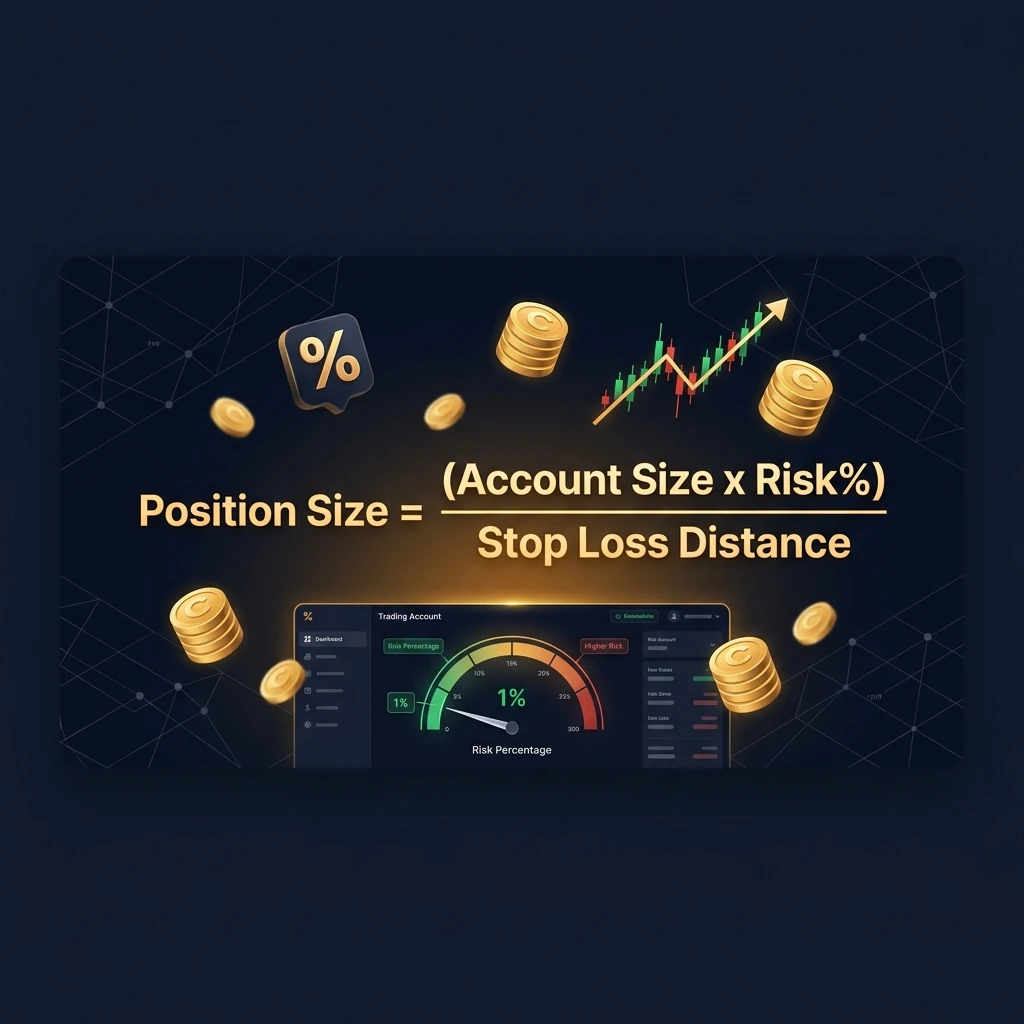
- The core formula: Position Size = (Account Size × Risk%) ÷ (Entry Price − Stop-Loss Price).
- The 1% Rule means risking no more than 1–2% of total account capital on any single trade.
- Wider stop-losses require proportionally smaller position sizes to keep risk constant.
- Use our free Position Size Calculator to compute your exact lot size before placing any order.
What Is Position Sizing in Trading?
Position sizing is the process of determining how many shares, units, or lots to buy or sell on a single trade, based on your account size, risk tolerance, and stop-loss distance. It is arguably the most important risk management decision a trader makes — more important than entry strategy, indicator selection, or market timing.
Even a strategy with a 40% win rate can be highly profitable with correct position sizing. The same strategy can blow up an account with poor position sizing. Professional traders don't just ask "what to buy" — they ask "how much to buy and why."
The Core Position Sizing Formula
The standard position sizing formula used by professional traders worldwide is:
Position Size = (Account Size × Risk Per Trade %) ÷ (Entry Price − Stop-Loss Price)This formula has three inputs:
- Account Size: Your total trading capital (the amount in your trading account)
- Risk Per Trade %: The maximum percentage of your account you're willing to lose if the trade hits your stop-loss (typically 1–2%)
- Entry Price − Stop-Loss Price: The distance from your entry to your stop-loss (also called "risk per share" or "stop distance")
Worked Example: Position Sizing for a Stock Trade
Scenario: You have a ₹5,00,000 trading account. You've identified a trade in Infosys at ₹1,800. Based on technical analysis, your stop-loss is at ₹1,760. You risk 1% of your capital per trade.
Step 1: Calculate maximum risk amount
Risk Amount = ₹5,00,000 × 1% = ₹5,000Step 2: Calculate risk per share
Risk Per Share = Entry − Stop = ₹1,800 − ₹1,760 = ₹40Step 3: Calculate position size
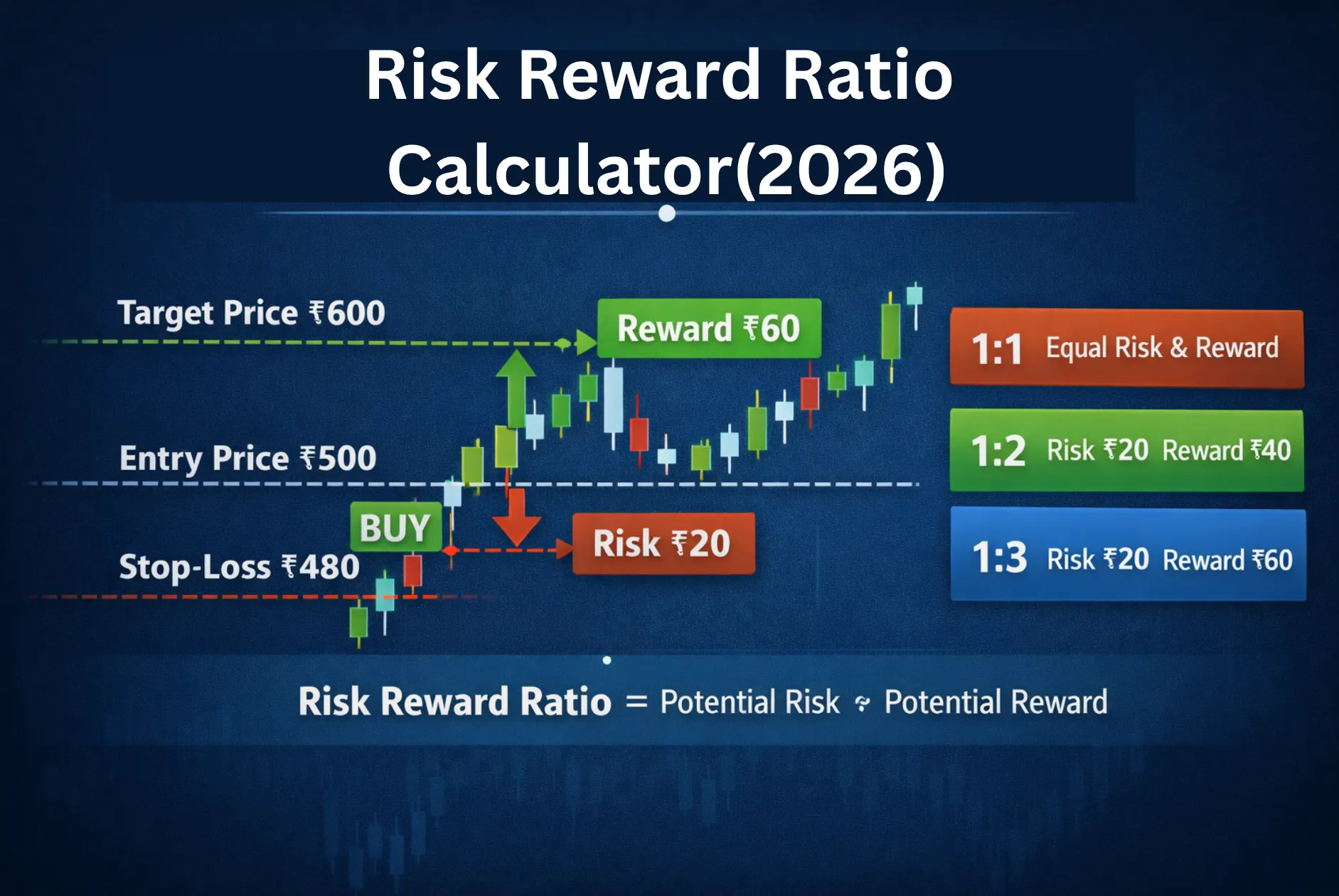
Position Size = ₹5,000 ÷ ₹40 = 125 sharesResult: Buy 125 shares of Infosys. If price drops to your ₹1,760 stop-loss, you lose exactly ₹5,000 (1% of account). If price rises to your target of ₹1,880, you profit ₹10,000 (2% of account) — a 1:2 risk/reward ratio.
The 1% Rule: Why Professional Traders Risk Only 1–2% Per Trade
The 1% rule states that you should never risk more than 1% of your total account on a single trade. Some traders use 2%, and very experienced traders sometimes go to 3% — but rarely more.
Why? Because of drawdown math. If you risk 10% per trade and have a losing streak of 5 trades in a row (which happens to even the best traders), you've lost 41% of your account. Recovery from a 41% drawdown requires a 69% gain — increasingly difficult. But with 1% risk, 5 consecutive losses cost you only 4.9% of your account — a manageable setback you can recover from quickly.
| Risk Per Trade | Account After 5 Losses | Required to Recover |
|---|---|---|
| 1% | 95.1% remaining | 5.1% gain |
| 2% | 90.4% remaining | 10.6% gain |
| 5% | 77.4% remaining | 29.2% gain |
| 10% | 59.0% remaining | 69.5% gain |
| 20% | 32.8% remaining | 205% gain |
The 1% rule keeps your account alive through inevitable losing streaks so you can continue trading when market conditions improve.
Position Sizing for Futures and Options Trades
Futures Position Sizing
For futures contracts, position sizing is calculated in lots, not shares. Each futures lot has a specific lot size defined by the exchange. The formula adjusts to:
Number of Lots = (Account Size × Risk%) ÷ (Stop Distance × Lot Size)Example: Nifty 50 Futures, lot size = 75 units. Entry = 23,500, Stop = 23,200, Stop distance = 300 points. Account = ₹10,00,000, Risk = 1% = ₹10,000.
Number of Lots = ₹10,000 ÷ (300 × 75) = ₹10,000 ÷ ₹22,500 = 0.44 lotsSince you can't trade fractional lots, round down to 0 lots — the trade is too large for your risk parameters. Either widen your stop (reduces precision), lower your risk %, or skip this trade. This is important discipline: if the math says don't take the trade, don't take the trade.
Options Position Sizing
For options, "position size" typically refers to the number of lots (contracts). Risk per lot = Premium Paid × Lot Size. If you're buying a Nifty Call at ₹150 premium (lot size 75), your risk per lot is ₹150 × 75 = ₹11,250. With a ₹5,000 max risk, you cannot buy even 1 lot — you'd need to either reduce premium (find a cheaper strike) or allocate a higher risk amount.
Number of Option Lots = Risk Amount ÷ (Premium × Lot Size)How Stop-Loss Distance Affects Position Size
The key insight of position sizing is the inverse relationship between stop-loss distance and position size. A wider stop-loss forces a smaller position to keep risk constant. Beginners often use a wide stop to "give the trade room" without reducing their position size — this is the most common way traders blow up accounts without realizing why.
| Account | Risk (1%) | Stop Distance | Position Size |
|---|---|---|---|
| ₹5,00,000 | ₹5,000 | ₹20 (tight) | 250 shares |
| ₹5,00,000 | ₹5,000 | ₹40 (moderate) | 125 shares |
| ₹5,00,000 | ₹5,000 | ₹100 (wide) | 50 shares |
| ₹5,00,000 | ₹5,000 | ₹250 (very wide) | 20 shares |
Adjusting Position Size for Brokerage Fees
For accurate position sizing, especially on smaller accounts or high-frequency strategies, factor in transaction costs. Add total fees to your risk amount before calculating:
Adjusted Position Size = (Risk Amount − Total Fees) ÷ Stop DistanceIf your 1% risk = ₹5,000 but total round-trip fees = ₹400, your effective risk budget for price movement is only ₹4,600.
Adjusted Size = ₹4,600 ÷ ₹40 = 115 shares (not 125)This level of precision matters most for intraday traders where fees represent a larger fraction of position P&L. Use our Break-Even Calculator to compute the exact fee impact on any trade.
Position Sizing Strategies Beyond the 1% Rule
Fixed Fractional (Standard)
Risk a fixed percentage of current account value per trade. As your account grows, position sizes grow proportionally. This is the standard approach described above and used by most professional traders.
Fixed Ratio
Increase your position size by one unit for every fixed profit amount gained. Conservative during drawdowns, more aggressive as profits accumulate. Popularized by Ryan Jones in trading literature.
Kelly Criterion (Advanced)
A mathematical formula that calculates optimal position size based on your historical win rate and average win/loss ratio: Kelly % = Win Rate − [(1 − Win Rate) / (Avg Win / Avg Loss)]. Most professional traders use half-Kelly or quarter-Kelly to reduce volatility. Full Kelly is theoretically optimal but psychologically brutal during drawdown periods.
Use the Position Size Calculator
Instead of calculating manually, use our free Position Size Calculator. Enter your account size, risk percentage, entry price, and stop-loss — and get your exact share/lot size instantly. You can also combine it with our Risk/Reward Calculator to ensure each trade meets your minimum reward-to-risk threshold before you place the order.
What is the position sizing formula in trading?
The standard position sizing formula is: Position Size = (Account Size × Risk Per Trade %) ÷ (Entry Price − Stop-Loss Price). For example, with a ₹5,00,000 account, 1% risk (₹5,000), entry at ₹1,800 and stop-loss at ₹1,760 (₹40 risk per share), position size = ₹5,000 ÷ ₹40 = 125 shares. This formula ensures that a single losing trade never destroys more than your pre-defined maximum risk percentage.
What is the 1% rule in trading?
The 1% rule states that you should never risk more than 1% of your total trading capital on a single trade. If your account is ₹5,00,000, your maximum loss on any trade should be ₹5,000. This rule exists to protect your account from catastrophic drawdowns during losing streaks — which happen to every trader regardless of skill level. With 1% risk, even 10 consecutive losses (a rare but possible scenario) reduces your account by only 9.6%, from which recovery is straightforward.
How do I calculate position size for futures in India?
For Indian index futures, the formula is: Number of Lots = (Account Size × Risk%) ÷ (Stop Distance in Points × Lot Size). For Nifty 50 (lot size 75) with a ₹10,00,000 account, 1% risk (₹10,000), and a 200-point stop: Lots = ₹10,000 ÷ (200 × 75) = ₹10,000 ÷ ₹15,000 = 0.67 lots. Round down to 0 or 1 lot (1 lot = ₹15,000 risk, which exceeds 1%). In this case, either widen your account size, reduce stop distance to 133 points, or increase your risk % to 1.5%.
Why does stop-loss distance affect position size?
Stop-loss distance and position size have an inverse relationship: the wider your stop-loss, the smaller your position must be to keep total dollar risk constant. If you risk ₹5,000 with a ₹20 stop, you can buy 250 shares. With a ₹100 stop (5× wider), you can only buy 50 shares (5× smaller) to maintain the same ₹5,000 maximum loss. This is why traders who use wide stops without reducing their share count dramatically overstake their trades — often the hidden reason for account blowups.