Key Takeaways
- Search intent determines content format — wrong format means no ranking
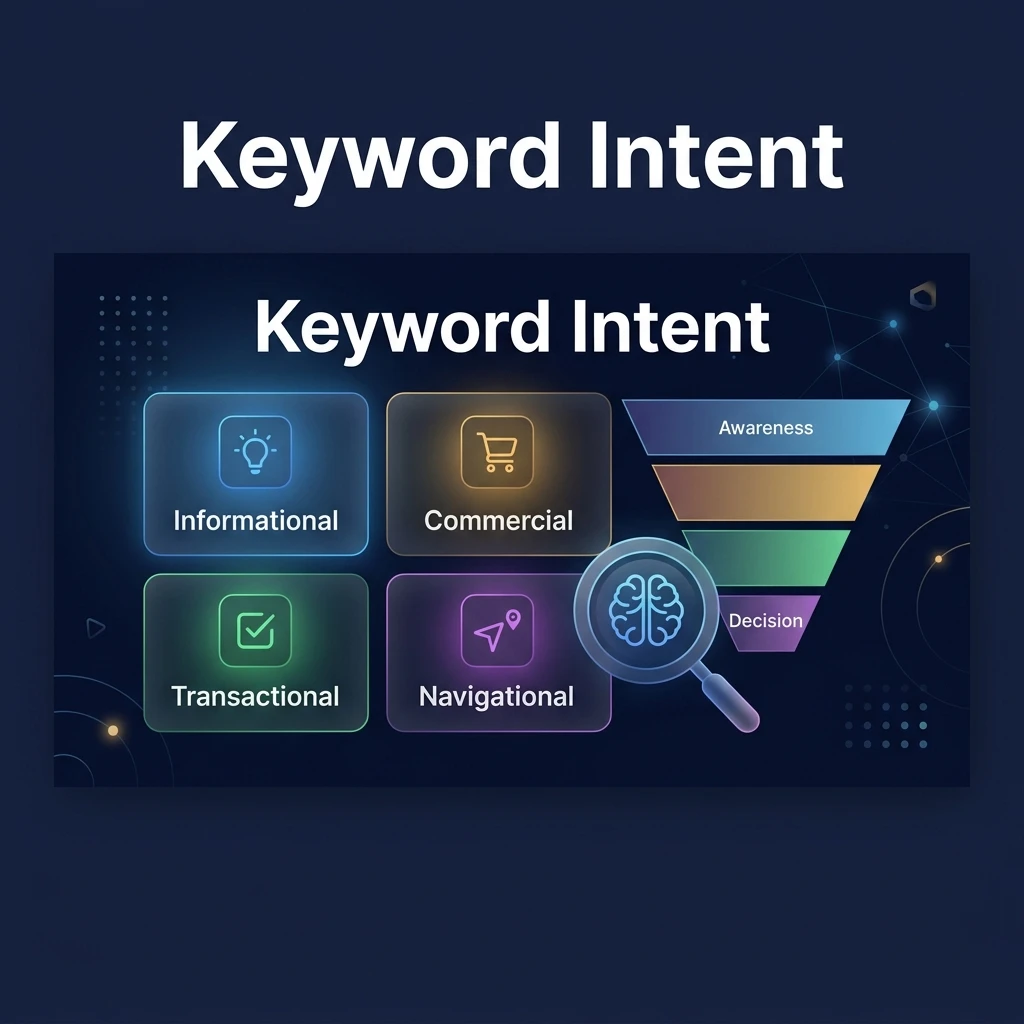
- Four intent types: Informational, Commercial, Transactional, Navigational
- Check intent before you write, not after publishing
- Mixed-intent keywords require separate pages for each intent type
- Use SM Developers Keyword Intent Analyzer to classify any keyword instantly
You can spend three months writing the most comprehensive article on the internet and still not rank—if your content format mismatches what searchers actually want. This is the most common and most expensive mistake in content marketing, and it is entirely preventable.
The solution is keyword intent analysis: understanding the why behind every search query before you write a single word. This guide explains the four intent types, how to identify them accurately, how to match content format to intent, and how to use the Keyword Intent Analyzer to automate the classification process.
Key Takeaways
- Search intent is the single most important factor in determining whether a piece of content ranks—more important than word count, keyword density, or backlinks.
- The four intent types (Informational, Commercial, Transactional, Navigational) each require a fundamentally different content format.
- Publishing the wrong format for a keyword's intent is an unrecoverable ranking error—rewriting from scratch is required.
- Mixed-intent keywords require separate pages targeting each intent, not a single page attempting to serve both.
- The Keyword Intent Analyzer classifies any keyword instantly with a confidence score and content angle recommendations.
What Is Keyword Intent?
Keyword intent (also called search intent or user intent) is the underlying purpose or goal a user has when typing a query into a search engine. It answers the question: what does this person actually want to accomplish?
Google's core ranking mission is to return the result that best satisfies the searcher's intent. This means Google has already done intent analysis on every query—its ranking results are a published answer to what format works best. When your content format aligns with that intent, ranking becomes dramatically easier. When it misaligns, ranking becomes nearly impossible regardless of other optimization factors.
The Four Types of Search Intent—Defined Precisely
1. Informational Intent
The searcher wants to learn something. They are asking a question, seeking an explanation, or trying to understand a concept. They are not ready to buy, subscribe, or take commercial action.
Signal words: how, what, why, when, who, guide, tutorial, tips, explained, definition, examples
Best content format: Long-form blog posts, how-to guides, educational articles, explainers, listicles with detailed explanations
SERP indicators: Featured snippets, People Also Ask boxes, knowledge panels, informational blog posts dominating top 10
Example: "how to do keyword research" → The user wants a guide, not a keyword research tool product page
2. Commercial Investigation Intent
The searcher is actively researching before making a purchase or commitment decision. They know what category of solution they need—they are comparing specific options, reading reviews, or looking for the best version of something.
Signal words: best, top, review, vs, comparison, alternatives, recommended, worth it, pros cons
Best content format: Comparison articles, review posts, "best X for Y" listicles, alternative pages, pros/cons breakdowns
SERP indicators: Review sites (G2, Capterra, Trustpilot), comparison blogs, affiliate content dominating top 10
Example: "best free SEO tools 2026" → The user wants a curated comparison, not a generic guide about what SEO is
3. Transactional Intent
The searcher is ready to take action—purchase, download, sign up, or use something right now. They have already made their decision or are at the final evaluation stage before committing.
Signal words: buy, price, cheap, discount, free download, sign up, get started, trial, coupon, order
Best content format: Product pages, pricing pages, free tool landing pages, sign-up flows, app download pages
SERP indicators: Google Shopping ads, product pages, pricing pages, tool landing pages in top 10
Example: "free schema validator tool" → The user wants a tool they can use right now, not an article about schema
4. Navigational Intent
The searcher is trying to reach a specific website, page, or brand. They already know the destination—the search engine is their navigation mechanism.
Signal words: Brand names, product names, "login," "official," "website," "app"
Best content format: The specific page the user is looking for (homepage, login page, specific product page)
SERP indicators: Sitelinks for the target brand, direct homepage result, branded pages dominating
Example: "SM Developers SEO tools" → The user wants smdevs.in, not an article about SEO tools
Why Intent Misalignment Is an Unrecoverable Ranking Error
Consider this scenario: You research the keyword "best meta tag generators" and notice it gets substantial search volume. You write a comprehensive 4,000-word educational guide explaining what meta tags are, the history of meta tags, and how meta tags work technically. You publish it with perfect on-page SEO.
It will not rank. Here is why.
Google has already determined that "best meta tag generators" has Commercial intent. The top 10 results are comparison articles, review posts, and tool roundups—not educational guides. When your educational guide appears as a candidate, Google's algorithm compares it against what users have consistently engaged with for this query. Users bounce from educational guides when they expect comparison content. That high bounce rate signals to Google that your page is a poor match, and it depresses your ranking over time.
The only fix is to rewrite the page as a comparison article. There is no amount of on-page optimization that overrides a fundamental intent misalignment.
How to Identify Keyword Intent Accurately
Method 1: Use the Keyword Intent Analyzer
The Keyword Intent Analyzer on SM Developers classifies any keyword with a confidence score in seconds. Enter your target keyword, and the tool returns:
- The dominant intent type (Informational, Commercial, Transactional, Navigational)
- A confidence percentage indicating how strongly the keyword signals that intent
- The corresponding funnel stage (Awareness, Consideration, Decision)
- Three blog angle suggestions matched to the detected intent
Low confidence scores (under 60%) indicate mixed intent—keywords where the search population has significantly split goals. These require special handling.
Method 2: Manual SERP Analysis
Google's own results pages are the most accurate intent classifier available. Search your target keyword and analyze the top 5 results:
- What format are they? (Guide, list, product page, comparison, review, homepage)
- What length are they? (Short answer vs. long-form)
- What is in the URL structure? (/blog/ vs /products/ vs /tools/)
- Are there ads? (Shopping ads and text ads strongly signal Transactional intent)
- Is there a featured snippet? (Usually signals Informational intent with a clear answer)
Intent Matching: Content Format Decision Table
| Intent Type | Funnel Stage | Correct Content Format | Wrong Format (Will Not Rank) |
|---|---|---|---|
| Informational | Awareness | Blog guide, tutorial, explainer | Product page, tool landing page |
| Commercial | Consideration | Comparison, review, "best of" list | Generic guide, product page |
| Transactional | Decision | Tool page, pricing page, sign-up | Blog post, educational guide |
| Navigational | All stages | The specific branded page sought | Any other page |
Handling Mixed-Intent Keywords
Some keywords have genuinely split intent. "Free SEO tools" is an example: some users want to read about free tools (Informational), while others want to use free tools right now (Transactional). The SERP reflects this split with a mix of tool landing pages and list articles.
The correct strategy for mixed-intent keywords is to create two separate pages:
- A blog article targeting the Informational segment: "Best Free SEO Tools in 2026 — Complete Review"
- A tool landing page targeting the Transactional segment: the actual tool with a clear "Use Now" CTA
Attempting to serve both intents on a single page produces a page that partially satisfies both audiences and fully satisfies neither—a guaranteed mediocre result.
Intent Analysis in Your Content Workflow
Intent analysis should be the first step in every content project, not the last. The correct sequence is:
- Identify candidate keyword using the Keyword Volume Estimator
- Run through the Keyword Intent Analyzer to classify intent
- Manually verify by searching the keyword and examining the top 5 SERP results
- Determine the content format (guide, comparison, tool page, etc.)
- Write the content in that format
- Optimize on-page signals using the On-Page SEO Checker
Intent analysis before writing prevents the most expensive mistake in content production: investing time in content that structurally cannot rank.
Intent and AI Search: Why This Matters Even More in 2026
AI search engines (ChatGPT, Perplexity, Google AI Overviews) retrieve content to answer queries—and they retrieve based on topical relevance and content quality, not just keywords. When your content's intent alignment is correct, it provides exactly the type of answer the AI system is looking for. Intent-aligned content is also structurally formatted in ways that AI systems can parse and extract: guides have step-by-step structures, comparisons have tables, reviews have pros/cons. These formats make AI extraction and attribution significantly more likely.
Frequently Asked Questions
Can a single page rank for keywords with different intents?
Occasionally, yes—but only when the intents are closely related and the content genuinely serves both. A tool landing page for a free keyword intent analyzer can rank for "keyword intent analyzer" (Navigational/Transactional) and "what is keyword intent" (Informational) if it includes a comprehensive explanation section. But forcing this rarely works as well as dedicated pages for each intent cluster.
Does keyword intent change over time?
Yes. User behavior evolves, and Google updates its intent interpretation accordingly. A keyword that was Informational in 2022 (e.g., "NFT") may have shifted to Commercial or even Navigational as the topic matured. Revisit intent analysis annually for your most important keywords.
How does intent analysis differ for long-tail vs short-tail keywords?
Long-tail keywords almost always have clearer, more specific intent—which makes them easier to match content to. Short-tail keywords (one or two words) more frequently have mixed intent because they are ambiguous. For short-tail keywords, manual SERP analysis is more important than tool classification alone.
Start Analyzing Keyword Intent Now
Before writing your next piece of content, run your target keyword through the Keyword Intent Analyzer. It takes ten seconds and can save you weeks of wasted production time on content that structurally cannot rank.