Key Takeaways
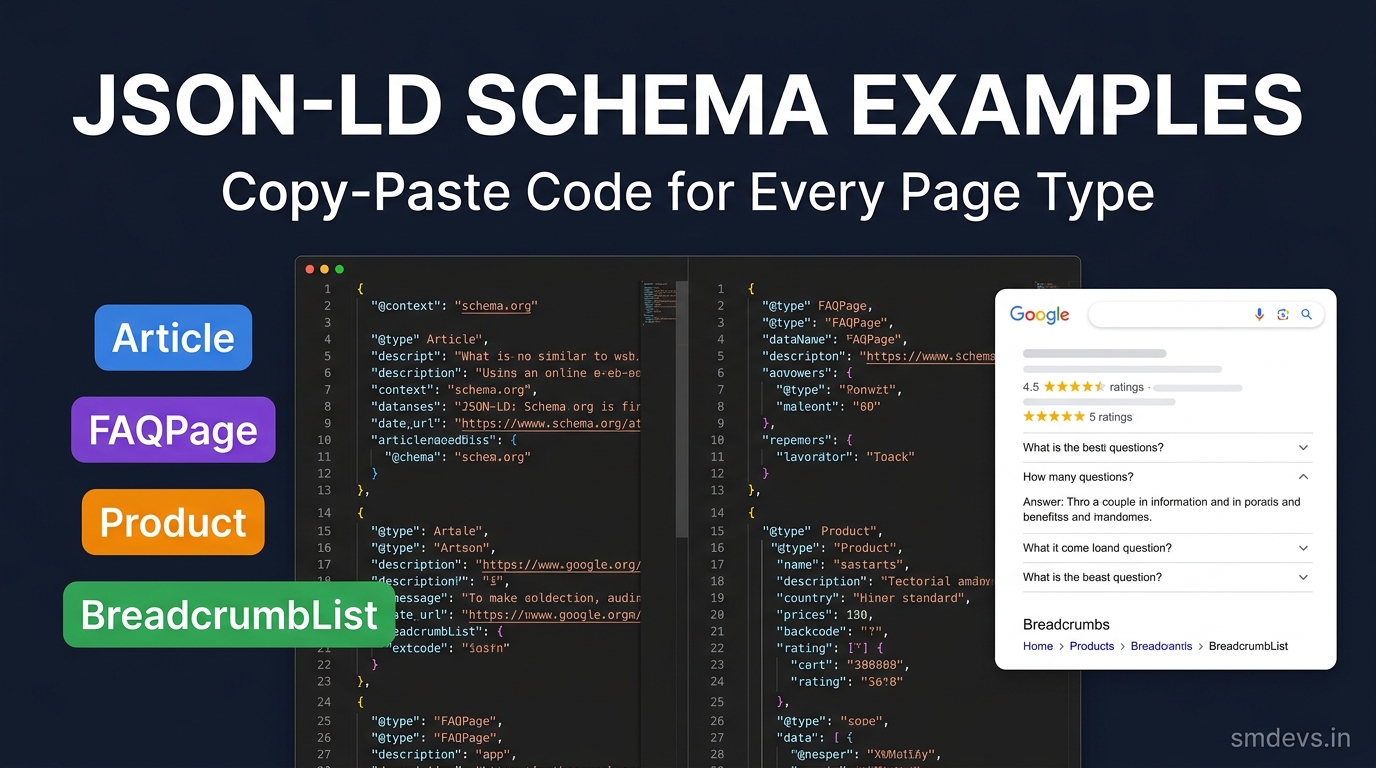
- JSON-LD is Google's recommended format for structured data markup. This guide provides complete, copy-paste ready JSON-LD schema code examples for every major schema type — Article, FAQPage, Product,
Why JSON-LD is the Best Format for Schema Markup
JSON-LD (JavaScript Object Notation for Linked Data) is Google's officially recommended format for structured data. Unlike Microdata (which is embedded inside HTML tags) or RDFa, JSON-LD is placed in a standalone <script type="application/ld+json"> tag — completely separate from your page's HTML.
This means you can add, edit, or remove schema markup without touching your page's visual content. It's the cleanest, most maintainable approach and the one used by Google's own Search Central documentation examples.
Validate any of the examples below with our free Schema Validator — paste the code and check for errors instantly.
1. Article Schema (JSON-LD) — For Blog Posts & News
Target rich results: Google News carousel, Top Stories, AMP articles
<script type="application/ld+json">
{
  "@context": "https://schema.org",
  "@type": "Article",
  "headline": "Your Article Title Here (max 110 characters)",
  "description": "Brief description of your article content",
  "image": {
    "@type": "ImageObject",
    "url": "https://yoursite.com/images/article-hero.jpg",
    "width": 1200,
    "height": 630
  },
  "author": {
    "@type": "Person",
    "name": "Author Name",
    "url": "https://yoursite.com/about"
  },
  "publisher": {
    "@type": "Organization",
    "name": "Your Site Name",
    "logo": {
      "@type": "ImageObject",
      "url": "https://yoursite.com/logo.png",
      "width": 600,
      "height": 60
    }
  },
  "datePublished": "2026-08-23T09:00:00+05:30",
  "dateModified": "2026-08-23T09:00:00+05:30",
  "mainEntityOfPage": {
    "@type": "WebPage",
    "@id": "https://yoursite.com/your-article-url"
  }
}
</script>
Required fields: headline, image, author, datePublished, publisher
Common error: Image dimensions not specified — always include width and height
2. FAQPage Schema (JSON-LD) — For Q&A Content
Target rich results: FAQ accordion dropdowns directly in Google search results — up to 3 questions shown
<script type="application/ld+json">
{
  "@context": "https://schema.org",
  "@type": "FAQPage",
  "mainEntity": [
    {
      "@type": "Question",
      "name": "What is schema markup in SEO?",
      "acceptedAnswer": {
        "@type": "Answer",
        "text": "Schema markup is structured data code added to a webpage that helps search engines understand the content's context and meaning, potentially enabling rich results in search."
      }
    },
    {
      "@type": "Question",
      "name": "How do I validate schema markup?",
      "acceptedAnswer": {
        "@type": "Answer",
        "text": "Use Google's Rich Results Test (search.google.com/test/rich-results) or our free schema validator at smdevs.in/tools/schema-validator to check for errors and eligibility."
      }
    },
    {
      "@type": "Question",
      "name": "Does schema markup improve Google rankings?",
      "acceptedAnswer": {
        "@type": "Answer",
        "text": "Schema markup is not a direct ranking factor but improves CTR through rich results, which sends positive user signals to Google. Pages with FAQ schema often see 20-30% higher click-through rates."
      }
    }
  ]
}
</script>
Key rule: Questions and answers must match content visible on the page. Marking up hidden content violates Google's guidelines.
3. Product Schema (JSON-LD) — For E-commerce Pages
Target rich results: Price, availability, star ratings shown directly below title in search results
<script type="application/ld+json">
{
  "@context": "https://schema.org",
  "@type": "Product",
  "name": "Product Name Here",
  "description": "Detailed product description",
  "image": [
    "https://yoursite.com/images/product-front.jpg",
    "https://yoursite.com/images/product-side.jpg"
  ],
  "brand": {
    "@type": "Brand",
    "name": "Brand Name"
  },
  "sku": "PRODUCT-SKU-123",
  "offers": {
    "@type": "Offer",
    "url": "https://yoursite.com/product-page",
    "priceCurrency": "INR",
    "price": "999",
    "priceValidUntil": "2026-12-31",
    "itemCondition": "https://schema.org/NewCondition",
    "availability": "https://schema.org/InStock",
    "seller": {
      "@type": "Organization",
      "name": "Your Store Name"
    }
  },
  "aggregateRating": {
    "@type": "AggregateRating",
    "ratingValue": "4.5",
    "reviewCount": "127",
    "bestRating": "5",
    "worstRating": "1"
  }
}
</script>Important: Only add aggregateRating if you have genuine reviews displayed on the page. Fake ratings violate Google's structured data policies.
4. BreadcrumbList Schema (JSON-LD) — For Navigation
Target rich results: Breadcrumb path shown instead of raw URL in search results (e.g., Home › SEO › Schema Markup)
<script type="application/ld+json">
{
  "@context": "https://schema.org",
  "@type": "BreadcrumbList",
  "itemListElement": [
    {
      "@type": "ListItem",
      "position": 1,
      "name": "Home",
      "item": "https://smdevs.in"
    },
    {
      "@type": "ListItem",
      "position": 2,
      "name": "Resources",
      "item": "https://smdevs.in/resources"
    },
    {
      "@type": "ListItem",
      "position": 3,
      "name": "Blogs",
      "item": "https://smdevs.in/resources/blogs"
    },
    {
      "@type": "ListItem",
      "position": 4,
      "name": "JSON-LD Schema Examples",
      "item": "https://smdevs.in/resources/blogs/json-ld-schema-examples"
    }
  ]
}
</script>
5. SoftwareApplication Schema — For Web Tools & Apps
Target rich results: App rating, price shown in search results
<script type="application/ld+json">
{
  "@context": "https://schema.org",
  "@type": "SoftwareApplication",
  "name": "Free Schema Validator Tool",
  "description": "Validate your JSON-LD structured data markup instantly — check for errors, warnings, and rich result eligibility.",
  "applicationCategory": "WebApplication",
  "operatingSystem": "All",
  "url": "https://smdevs.in/tools/schema-validator",
  "offers": {
    "@type": "Offer",
    "price": "0",
    "priceCurrency": "INR"
  },
  "aggregateRating": {
    "@type": "AggregateRating",
    "ratingValue": "4.8",
    "ratingCount": "234"
  },
  "author": {
    "@type": "Organization",
    "name": "SM Developers"
  }
}
</script>
6. Organization Schema — For Your Homepage
Target rich results: Knowledge Panel, sitelinks, brand SERP features
<script type="application/ld+json">
{
  "@context": "https://schema.org",
  "@type": "Organization",
  "name": "SM Developers",
  "url": "https://smdevs.in",
  "logo": "https://smdevs.in/logo.png",
  "description": "Free SEO and trading tools, calculators, and guides for Indian traders and website owners.",
  "sameAs": [
    "https://twitter.com/smdevs_in",
    "https://linkedin.com/company/smdevs"
  ],
  "contactPoint": {
    "@type": "ContactPoint",
    "contactType": "customer support",
    "url": "https://smdevs.in/contact"
  }
}
</script>
7. HowTo Schema — For Step-by-Step Tutorials
Target rich results: Steps shown as a rich result with optional images per step (desktop only)
<script type="application/ld+json">
{
  "@context": "https://schema.org",
  "@type": "HowTo",
  "name": "How to Add Schema Markup to a Website",
  "description": "Step-by-step guide to adding JSON-LD structured data to any website",
  "totalTime": "PT30M",
  "step": [
    {
      "@type": "HowToStep",
      "position": 1,
      "name": "Choose your schema type",
      "text": "Identify the correct schema.org type for your page — Article, FAQPage, Product, etc."
    },
    {
      "@type": "HowToStep",
      "position": 2,
      "name": "Write JSON-LD code",
      "text": "Create the JSON-LD structured data code using the schema.org vocabulary."
    },
    {
      "@type": "HowToStep",
      "position": 3,
      "name": "Add to your HTML head",
      "text": "Paste the script tag into the head section of your webpage."
    },
    {
      "@type": "HowToStep",
      "position": 4,
      "name": "Validate the schema",
      "text": "Test using Google's Rich Results Test or smdevs.in/tools/schema-validator."
    },
    {
      "@type": "HowToStep",
      "position": 5,
      "name": "Monitor in Search Console",
      "text": "Check GSC Enhancements reports for errors after Google crawls the page."
    }
  ]
}
</script>
Combining Multiple Schema Types on One Page
You can and should add multiple schema types to the same page where relevant. Use separate <script type="application/ld+json"> blocks for each:
<!-- Article schema -->
<script type="application/ld+json">{ "@type": "Article", ... }</script>

<!-- FAQ schema on same page -->
<script type="application/ld+json">{ "@type": "FAQPage", ... }</script>

<!-- Breadcrumb schema on same page -->
<script type="application/ld+json">{ "@type": "BreadcrumbList", ... }</script>
A blog post page can legitimately have Article + FAQPage + BreadcrumbList schema simultaneously — all three targeting different rich results.
Validate Your Schema — Free Schema Checker
After writing your JSON-LD code, always validate before deploying. Our free Schema Validator tool checks your structured data for:
- JSON syntax errors (missing commas, unclosed brackets)
- Missing required schema.org properties
- Invalid property values or wrong data types
- Rich result eligibility assessment
Also use Google's Rich Results Test for final verification before submitting URLs in GSC.
FAQs: JSON-LD Schema
What is the difference between JSON-LD, Microdata, and RDFa?
All three express schema.org structured data, but in different formats. JSON-LD is a separate script tag (recommended by Google), Microdata is embedded in HTML attributes (harder to maintain), and RDFa is an extension of HTML5 attributes. Google recommends JSON-LD for all new implementations.
Can I use schema markup on every page?
Yes, but only add schema that accurately describes the page's content. Adding irrelevant schema (e.g., Product schema on a blog post) can trigger structured data spam policies. At minimum, add BreadcrumbList to all pages and Article schema to all blog posts.
How do I check if my schema markup is working?
After adding schema and letting Google recrawl your page (submit in GSC for faster indexing), check: (1) Google Search Console → Enhancements for error/valid counts, (2) search your page URL in Google to see if rich results appear, (3) use our schema validator tool for immediate code validation.