Key Takeaways
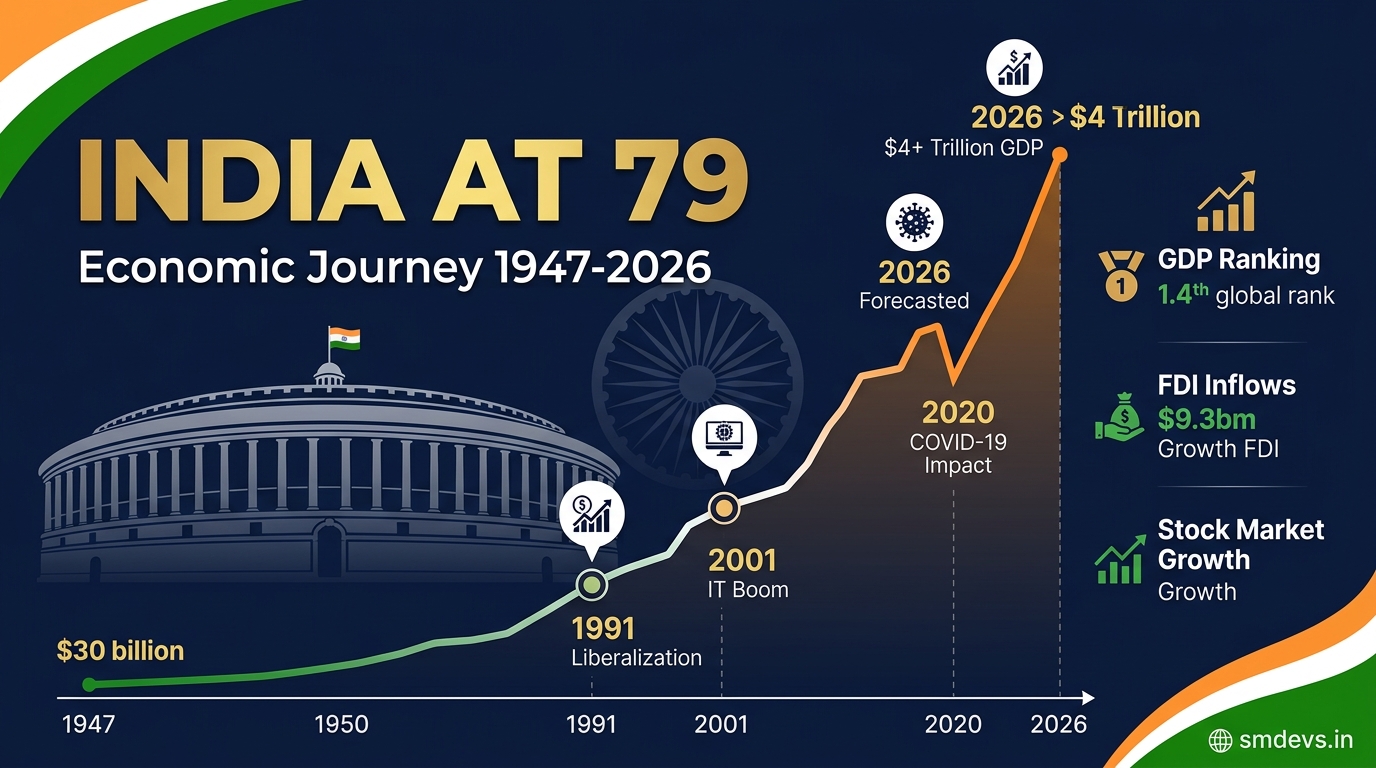
- On India's 79th Independence Day (August 15, 2026), we trace the remarkable economic journey of a nation that started with a GDP of just $30 billion in 1947 to become the world's fourth-largest econom
India at 79: Where We Began and Where We Stand
On August 15, 1947, India inherited a war-ravaged, colonially-extracted economy with:
- GDP: ~$30 billion (at 1947 prices)
- Literacy rate: ~12%
- Life expectancy: 32 years
- Per capita income: ~$50 per year
- Industrialisation: Minimal — primarily agriculture and textiles
On August 15, 2026, India stands as:
- GDP: ~$4.3 trillion (4th largest globally, behind USA, China, Germany)
- GDP per capita: ~$3,000+
- Literacy rate: ~77%
- Life expectancy: 70+ years
- Stock Market (Sensex): From 100 (1979 base) to 78,000+ (2026) — 780x in 47 years
- Forex Reserves: ~$680 billion (one of the world's largest)
The transformation is nothing short of extraordinary — and the best may be yet to come.
India's Economic Journey: Decade by Decade
1947–1960: The Foundation Years
Independent India chose a mixed economy model — combining private enterprise with heavy government planning. Key developments:
- First Five-Year Plan (1951–56): Focus on agriculture and basic industry
- Green Revolution seeds planted (actual revolution came in 1960s–70s)
- Heavy government investment in public sector: Steel (SAIL), Power (NTPC, BHEL foundational), Railways
- GDP growth: ~3.5% annually (the "Hindu rate of growth")
1960–1980: Nationalisation and Self-Reliance
- Green Revolution (1965–70): India became self-sufficient in food for the first time
- Bank nationalisation (1969): 14 major banks nationalised, bringing banking to rural India
- 1971: Indo-Pak war, Indira Gandhi's "Garibi Hatao" mandate
- 1974: Smiling Buddha — India's first nuclear test
- Oil shock (1973–74) hit India hard — heavily import-dependent even then
- GDP growth: ~3–4% — still the "Hindu rate of growth"
1980–1991: Cautious Opening
- Rajiv Gandhi era: Technology induction, computerisation of railways and banking
- Partial liberalisation — some industries opened to private sector
- Telecom seeds planted: DoT established
- GDP growth accelerated to ~5.5% in the late 1980s
- 1991 Crisis: India ran out of foreign exchange — only 2 weeks of import cover left. Gold airlifted to Bank of England as collateral. The darkest economic moment in post-independence history — and the catalyst for transformation.
1991–2000: The Great Liberalisation
Prime Minister Narasimha Rao and Finance Minister Manmohan Singh launched India's most consequential economic reforms:
- Import licensing abolished; customs duties slashed
- Private sector allowed in telecom, aviation, insurance, banking
- Foreign Direct Investment (FDI) opened
- Rupee made convertible on current account
- SEBI established (1992) to regulate capital markets; NSE launched (1994)
- Sensex: 1,000 in 1990 → 5,000 by 2000
- IT sector began its global ascent: Infosys IPO (1993), Wipro, TCS growth
2000–2008: The IT Miracle and Infrastructure Boom
- India became the world's back-office: IT services, BPO, KPO industry emerged
- GDP growth: 8–9% consistently (one of the world's fastest growing major economies)
- Real estate boom: Housing prices tripled in metro cities
- Telecom revolution: Mobile subscribers grew from 5 million (2000) to 350 million (2008)
- Auto sector boom: Maruti, Tata Motors, Hyundai drove middle-class aspirations
- Sensex: 5,000 (2000) → 21,000 (January 2008 peak) — 4x in 8 years
- 2008 Global Financial Crisis: Sensex crashed 60% to 7,697 — but India recovered faster than most
2008–2014: Recovery and Policy Paralysis
- Fast recovery from 2008 crisis — GDP grew at 8% in FY10, FY11
- Corruption scandals (2G spectrum, Coal gate, Commonwealth Games) damaged investor confidence
- Rupee crashed to ₹68/$ in 2013 (taper tantrum)
- GDP growth slowed to 5–6% by 2012–14
- But: Right to Education, Aadhaar biometric ID system launched — foundational for digital future
2014–2020: Digital India and Structural Reforms
- GST implementation (2017): One Nation, One Tax — replaced 17 different taxes, unifying the market
- IBC (Insolvency & Bankruptcy Code) 2016: Transformed NPA resolution in banking
- UPI launched (2016): India's digital payment revolution. By 2026, UPI processes 14+ billion transactions/month
- Demonetisation (2016): Short-term disruption, long-term formalisation
- Jan Dhan Yojana: 500 million bank accounts opened for the unbanked
- FDI inflows: Record $64 billion in FY20 before COVID
- COVID-19 (2020): GDP contracted 7.3% in FY21 — worst since independence
2020–2026: Bounce Back and the $4 Trillion Economy
- India's fastest-ever economic recovery: GDP grew 8.7% in FY22 (post-COVID bounce)
- PLI (Production Linked Incentive) scheme: Manufacturing revival in electronics, pharma, textiles, solar
- Semiconductor ambitions: India's first chip fab plants announced
- PM GatiShakti: ₹100 lakh crore infrastructure investment plan
- Nifty 50: 7,511 (March 2020) → 26,000+ (2024) → ~24,500 (Aug 2026)
- India overtook UK (2022) and Germany (expected by 2027) in GDP rankings
- Space: Chandrayaan-3 became first spacecraft to land on the Moon's south pole (2023)
- G20 Presidency (2023): India's global diplomatic moment
India's Stock Market: 1979 to 2026
| Year | Sensex Level | Return (from 1979 base) |
|---|---|---|
| 1979 (Base) | 100 | — |
| 1990 | 1,000 | 10x |
| 2000 | 5,000 | 50x |
| 2008 (Peak) | 21,000 | 210x |
| 2014 | 27,000 | 270x |
| 2020 (Low) | 25,638 | 256x |
| 2024 (Peak) | 85,978 | 860x |
| Aug 2026 | ~78,000 | ~780x |
A ₹10,000 investment in the Sensex in 1979 would be worth approximately ₹78 lakh today — a 780x return. This is the power of long-term equity investing in India.
The Next Chapter: India's Ambitions for 2047 (Centenary Year)
The Government of India has articulated "Viksit Bharat" (Developed India) 2047 — aiming to be a fully developed nation by India's 100th Independence Day:
- GDP target: $30–35 trillion (currently ~$4.3 trillion) — requires ~8% average growth for 21 years
- Manufacturing: Increase manufacturing's share of GDP from ~14% to 25%+
- Renewable Energy: 500 GW by 2030 (currently ~200 GW)
- Per capita income: From ~$3,000 to $18,000+ (high-income country threshold)
- Digital economy: India to be a $1 trillion digital economy by 2030
What This Means for Investors in 2026
India's structural growth story remains intact and compelling:
- Demographic dividend: India is the world's most populous nation with a median age of ~29 — peak working-age population for the next 20 years
- Urbanisation: Only ~37% urbanised today vs 60%+ in developed nations — massive headroom for infrastructure, real estate, consumer spending growth
- Formalisation: GST, UPI, and Jan Dhan have brought more economic activity into the formal, taxable, and investable universe
- Capital markets deepening: 10.5 crore SIP accounts, rising retail participation — domestic flows providing market stability
For long-term investors, India's next 20 years could be even more rewarding than the last 20. Happy Independence Day. 🇮🇳