Key Takeaways
- One of the biggest lies in personal finance is that you need a lot of money to start investing. The truth: ₹500 per month invested consistently from age 22 can grow to over ₹1 crore by retirement — th
What is a SIP (Systematic Investment Plan)?
A SIP (Systematic Investment Plan) is a method of investing a fixed amount of money in a mutual fund at regular intervals — typically monthly. Instead of investing a lump sum, you invest ₹500 (or any fixed amount) every month on an auto-debit basis. The mutual fund purchases units at the current NAV (Net Asset Value) each month.
Key benefits of SIP:
- Rupee Cost Averaging: When markets are down, your ₹500 buys more units. When markets are up, it buys fewer units. Over time, your average cost per unit is lower than if you had invested at a single price point.
- Discipline: Auto-debit ensures you invest every month regardless of market conditions — removing the temptation to "wait for a better time."
- Accessibility: ₹100–₹500 minimum investments make SIP the most democratic wealth-building tool available to Indians.
- Power of Compounding: Over long periods, returns compound on top of returns — creating wealth that grows exponentially, not linearly.
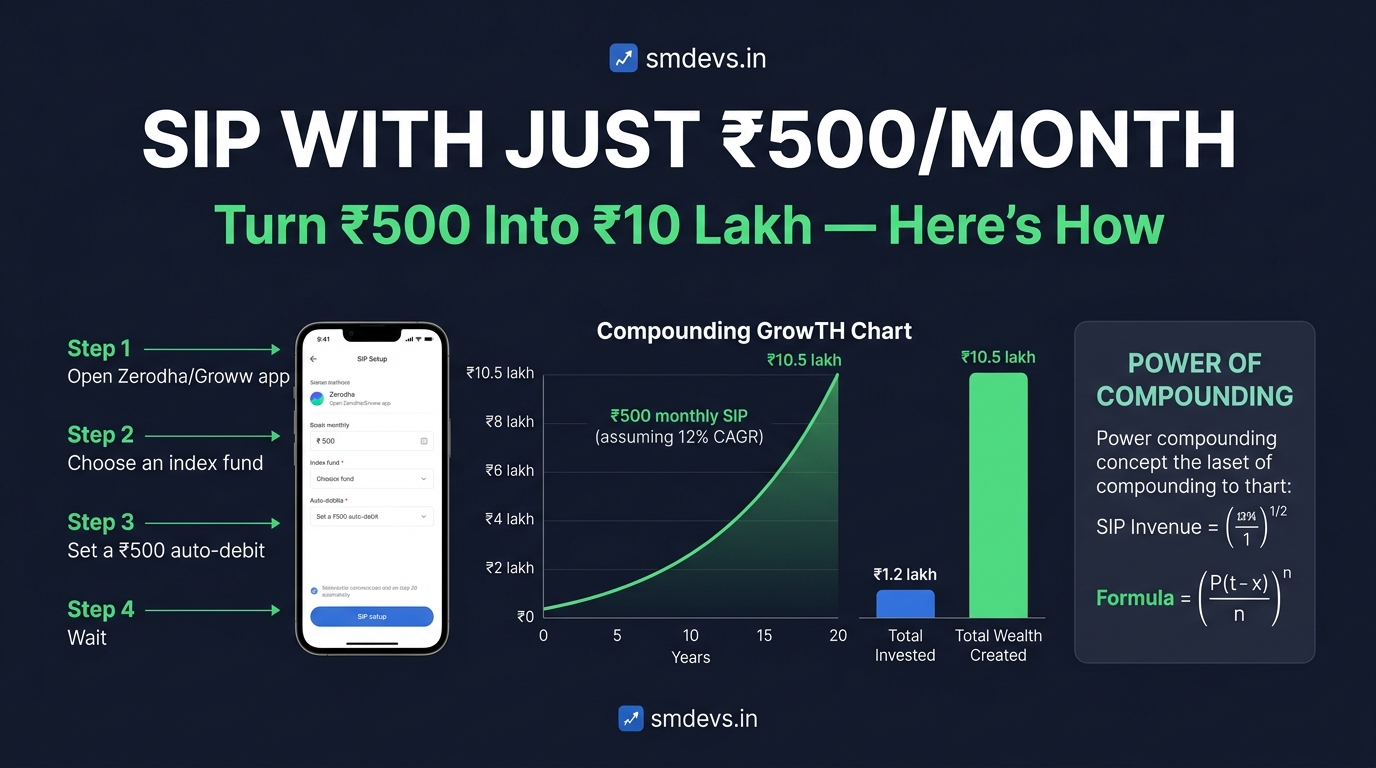
What ₹500/Month Grows to — The Real Numbers
Assuming an average return of 12% CAGR (approximately what Nifty 50 index funds have delivered historically over long periods):
| Duration | Total Invested | Total Wealth Created | Wealth Multiplier |
|---|---|---|---|
| 5 years | ₹30,000 | ₹40,500 | 1.35x |
| 10 years | ₹60,000 | ₹1,12,000 | 1.87x |
| 15 years | ₹90,000 | ₹2,51,000 | 2.79x |
| 20 years | ₹1,20,000 | ₹5,00,000 | 4.17x |
| 25 years | ₹1,50,000 | ₹9,50,000 | 6.33x |
| 30 years | ₹1,80,000 | ₹17,65,000 | 9.8x |
The key insight: The first 15 years create ₹2.51 lakh. The NEXT 15 years (on the SAME ₹500/month) create over ₹15 lakh more. This is compounding — the later years do the heavy lifting.
Note: These projections assume 12% CAGR continuously, which is a long-term historical average for Nifty 50. Actual returns will vary year to year — some years better, some worse. Past performance doesn't guarantee future results.
Step-by-Step: How to Start a ₹500 SIP in India (2026)
Step 1: Choose Your Investment Platform
You can start a SIP through:
- Direct mutual fund AMC websites: Invest directly at HDFC Mutual Fund, Nippon India, SBI MF, UTI MF — no brokerage/distributor commission (direct plan)
- Groww: The most beginner-friendly app in India; ₹0 commission; direct plans available; takes 5 minutes to start. Recommended for first-time investors.
- Zerodha Coin: Direct plans with no commission; integrated with Zerodha demat if you're already a Zerodha user
- Paytm Money: Also offers direct plans; large user base; easy UPI payment integration
- CAMS/KFintech: Aggregate platforms covering most AMCs; ideal if you want to manage multiple fund houses in one place
Recommendation for beginners: Start with Groww or Zerodha Coin. Both are SEBI-regulated, free to use, and offer direct plans (no commission = more returns for you).
Step 2: Complete KYC (One-Time — 5 Minutes)
KYC (Know Your Customer) is mandatory for mutual fund investments. You need:
- PAN card (mandatory)
- Aadhaar card
- Bank account (for auto-debit)
- Selfie + video verification (digital KYC through your chosen platform)
KYC is now fully digital through Aadhaar OTP-based verification — takes 5 minutes on Groww/Zerodha Coin apps.
Step 3: Choose the Right Fund for ₹500 SIP
For a ₹500/month beginner SIP, the best options are:
Option A: Nifty 50 Index Fund (Recommended for Most Beginners)
Passively tracks Nifty 50. Very low cost (expense ratio 0.05–0.20%). No fund manager risk. Has delivered approximately 13–15% CAGR over 20+ years.
- UTI Nifty 50 Index Fund — Direct Plan
- HDFC Index Fund — Nifty 50 Plan — Direct
- Nippon India Index Fund — Nifty 50 — Direct
Option B: Flexi Cap Fund (For Slightly More Aggressive Growth)
Actively managed, can invest across large/mid/small caps. Higher potential returns but higher risk and cost (1–1.5% expense ratio).
- Parag Parikh Flexi Cap Fund — Direct (most respected flexi cap with global diversification)
- DSP Flexi Cap Fund
Option C: Large Cap Index + Mid Cap Mix (For ₹500 × 2 Funds)
If you can do ₹1,000/month total: ₹500 in Nifty 50 index + ₹500 in Nifty Midcap 150 index fund. This gives diversification across market caps with minimal cost.
Step 4: Set Up Auto-Debit (SIP Mandate)
During the SIP setup on your chosen platform:
- Select the fund and choose "SIP" (not lump sum)
- Enter ₹500 (or your chosen amount)
- Choose SIP date (1st or 5th of month recommended — before most expenses hit)
- Set up auto-debit from your bank account via eNACH mandate (one-time setup)
- Confirm and activate
Once active, ₹500 is automatically debited from your bank every month on the chosen date. You don't need to do anything — the money is invested automatically.
Step 5: Forget It and Let It Compound (The Hardest Step)
The biggest SIP mistake is stopping during market downturns. When markets fall 20–30%, most retail investors panic and stop their SIP — exactly when they should continue (because they're buying more units cheaply).
Research consistently shows that SIP investors who continued through the COVID crash (Feb–March 2020) and the 2022 global selloff had significantly better returns than those who stopped and restarted later.
Rule: Set it, forget it for 10+ years. Check annually, not monthly.
Common ₹500 SIP Mistakes
- ❌ Stopping SIP when markets fall: You're buying cheap — this is when SIP is most beneficial. Continue always.
- ❌ Investing in regular plans (commission-based): Always choose "Direct" plans — they have the same portfolio but no commission, meaning 0.5–1% more returns annually
- ❌ Too many funds: 1 Nifty 50 index fund is enough for ₹500/month. 5 different funds with ₹100 each is over-diversification at this amount.
- ❌ Choosing thematic/sector funds: Defence fund, IT fund, pharma fund — these are high-risk, high-concentration for a beginner SIP. Start with diversified index or flexi cap funds.
- ❌ Increasing SIP only when you think the market is cheap: Step-up your SIP when your income grows (1–2% annual step-up), not based on market timing
FAQs: Starting SIP with ₹500
Can I start a SIP with ₹500 in India?
Yes — most mutual funds in India allow SIP investments starting from ₹100 to ₹500 per month. Some funds (like ELSS tax-saving funds) allow SIP from as low as ₹500. Platforms like Groww, Zerodha Coin, and Paytm Money make it extremely simple to start a ₹500 monthly SIP in minutes with just your PAN and Aadhaar.
Which mutual fund is best for ₹500 SIP in 2026?
For a beginner ₹500 SIP: UTI Nifty 50 Index Fund (Direct Plan) or HDFC Index Fund Nifty 50 (Direct Plan) are the most recommended — low cost (0.1–0.2% expense ratio), proven long-term track record tracking India's 50 largest companies, and no fund manager risk. For slightly higher growth potential with more risk: Parag Parikh Flexi Cap Fund (Direct) is widely respected and has outperformed consistently.
How much will ₹500 SIP grow in 20 years?
At 12% CAGR (historical Nifty 50 average): ₹500/month over 20 years = ₹1,20,000 total investment → approximately ₹5,00,000 total corpus. At 15% CAGR (if markets perform better): approximately ₹7,60,000. Note: These are projections, not guarantees. Actual returns depend on market performance, which varies significantly year to year.