Key Takeaways
- The risk-reward ratio (RRR) measures how much profit you're targeting relative to how much you're willing to lose on a trade.
- A minimum 1:2 risk-reward ratio is recommended for most trading strategies.
- The formula is: Risk = Entry − Stop Loss, Reward = Target − Entry, RRR = Risk ÷ Reward.
- Even with a 40% win rate, a 1:3 RRR strategy is profitable in the long run.
- Use SM Developers' free risk-reward calculator to instantly calculate RRR for any trade setup.
Ask any professional trader what separates winning traders from losing traders, and you'll hear the same answer: risk management. At the heart of every successful trading strategy is one deceptively simple metric — the risk-reward ratio.
In this guide, you'll learn exactly how to calculate the risk-reward ratio, why it's the most important number in your trading, and how to use our free risk-reward calculator to evaluate any trade in seconds.
What Is the Risk-Reward Ratio?
The risk-reward ratio (RRR) compares the potential profit of a trade to the potential loss. It tells you: "For every ₹1 I risk, how much can I make?"
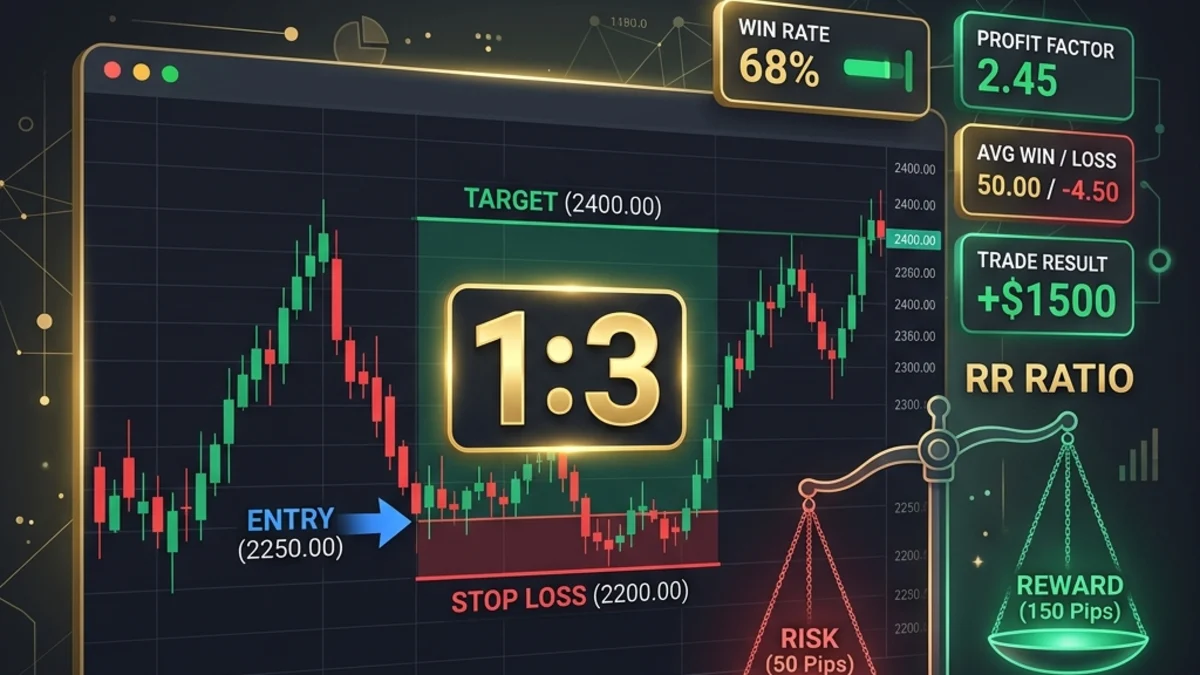
A 1:2 risk-reward ratio means you're risking ₹1 to potentially make ₹2. A 1:3 means you risk ₹1 to potentially make ₹3. The higher the reward relative to the risk, the better the trade setup.
The Risk-Reward Ratio Formula
Calculating RRR requires just three inputs:
- Entry Price — The price at which you enter the trade
- Stop Loss — The price at which you'll exit if the trade goes against you
- Target Price — The price at which you'll take profit
The formula is:
Risk = Entry Price − Stop Loss
Reward = Target Price − Entry Price
RRR = Risk ÷ Reward (expressed as 1:X)
Example Calculation (Long Trade)
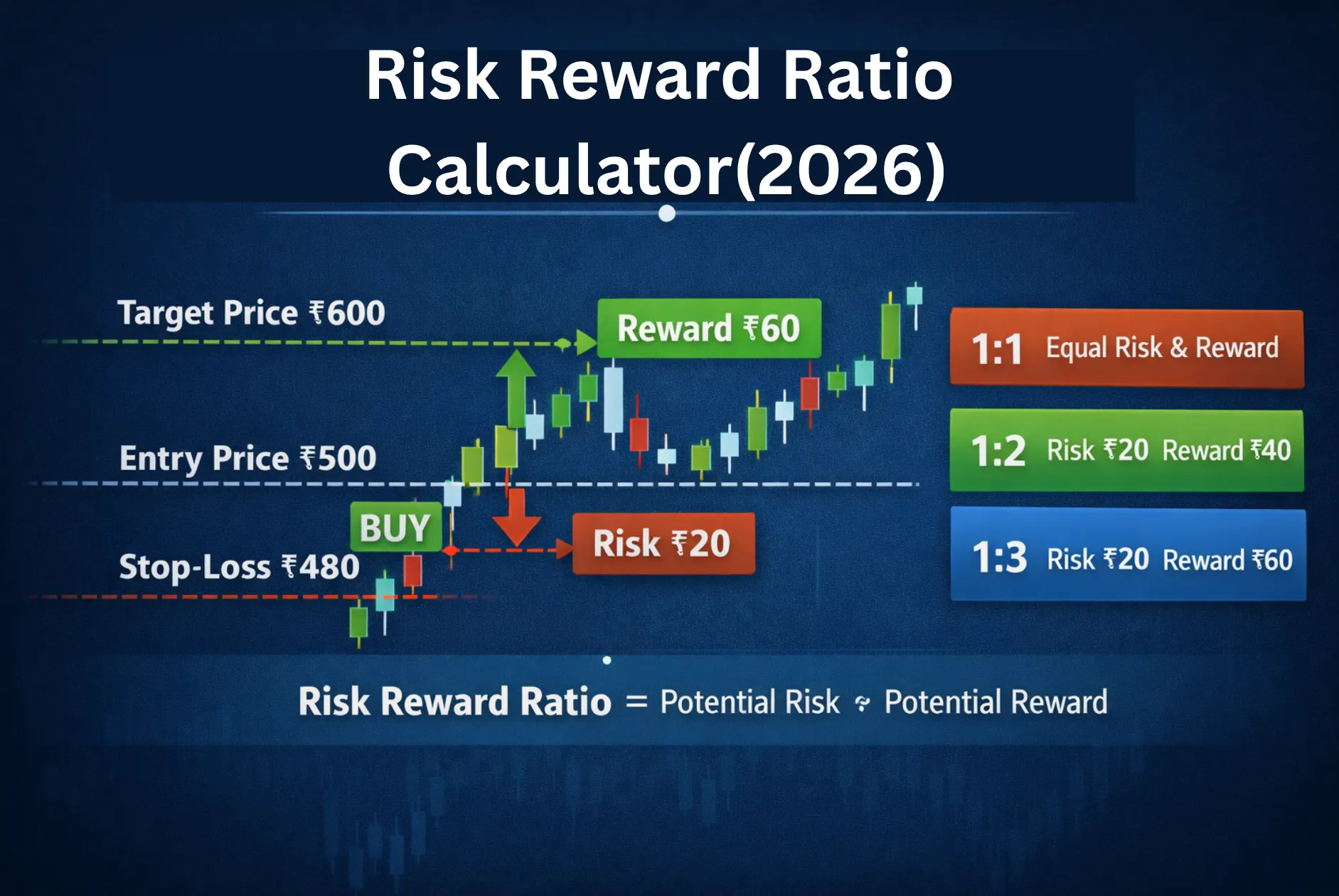
Let's say you're buying a stock:
- Entry Price: ₹500
- Stop Loss: ₹480 (risking ₹20 per share)
- Target Price: ₹560 (targeting ₹60 per share)
Risk = ₹500 − ₹480 = ₹20
Reward = ₹560 − ₹500 = ₹60
RRR = 20 ÷ 60 = 1:3
✅ This is an excellent trade setup. You're risking ₹20 to potentially make ₹60.
Why the Risk-Reward Ratio Is More Important Than Win Rate
Most new traders obsess over their win rate — the percentage of trades they win. But here's the math that changes everything:
Consider a trader with a 40% win rate using a 1:3 RRR:
- 10 trades: 4 wins, 6 losses
- Each win makes ₹3,000 (risking ₹1,000 per trade)
- Each loss loses ₹1,000
- Net result: (4 × ₹3,000) − (6 × ₹1,000) = ₹6,000 PROFIT
Now consider a trader with a 60% win rate using a 1:0.5 RRR:
- 10 trades: 6 wins, 4 losses
- Each win makes ₹500
- Each loss loses ₹1,000
- Net result: (6 × ₹500) − (4 × ₹1,000) = −₹1,000 LOSS
The trader who wins more often actually loses money. This is why professional traders focus relentlessly on maintaining a minimum 1:2 RRR, regardless of win rate.
What's a Good Risk-Reward Ratio?
| RRR | Minimum Win Rate to Break Even | Assessment |
|---|---|---|
| 1:1 | 50% | ⚠️ Marginal — very difficult to maintain profitability |
| 1:2 | 33% | ✅ Acceptable — minimum recommended ratio |
| 1:3 | 25% | 🔥 Excellent — professional standard |
| 1:5+ | 17% | 🏆 Outstanding — typical of trend-following strategies |
How to Use SM Developers' Free Risk-Reward Calculator
Manually calculating RRR for every trade is time-consuming. Our free risk-reward calculator does it instantly:
- Visit smdevs.in/tools/trading/risk-reward
- Enter your Entry Price
- Enter your Stop Loss price
- Enter your Target Price
- The calculator instantly shows your risk per unit, reward per unit, and overall RRR with a visual quality rating
Combine it with our Position Size Calculator to determine exactly how many shares to buy based on your account size and risk tolerance.
Risk-Reward Ratio for Different Trading Styles
Day Trading (Intraday)
For intraday traders, a 1:2 minimum RRR is essential because of the high number of trades executed daily. Even small, consistent edges compound significantly over time.
Swing Trading
Swing traders often target 1:3 to 1:5 ratios, allowing their profits to run over multiple days while keeping stops tight at key technical levels.
Long-Term Investing
Long-term investors may look at much higher ratios — sometimes 1:10 or more — when identifying undervalued stocks with strong fundamental support.
Common Mistakes When Using Risk-Reward Ratios
- Moving your stop loss after entering a trade (this destroys your pre-planned RRR)
- Setting unrealistic targets without technical justification
- Ignoring commissions and slippage which eat into your actual reward
- Using the same RRR regardless of market conditions (volatile markets require adjustment)
Frequently Asked Questions
What is a good risk-reward ratio for beginners?
For beginners, a minimum 1:2 risk-reward ratio is strongly recommended. This means for every ₹1 you risk, you should be targeting at least ₹2 in profit. This gives you a mathematical edge even if you win less than half of your trades.
Does risk-reward ratio guarantee profit?
No, the risk-reward ratio alone doesn't guarantee profit. It must be combined with a positive expectancy trading system. A good RRR only helps if your win rate exceeds the break-even threshold for that ratio. Use it as one part of a comprehensive trading plan.
Should I use the same RRR for every trade?
Not necessarily. The appropriate RRR depends on your trading strategy, market conditions, and volatility. However, you should always have a minimum threshold (e.g., never take a trade with less than 1:1.5 RRR) and stick to it consistently.
How does position sizing relate to risk-reward ratio?
Position sizing determines how much you invest in each trade, while RRR determines the structure of that trade. Together, they form the core of professional risk management. Use our Position Size Calculator to determine the right lot size for each trade based on your account risk percentage.
Conclusion: Make Every Trade Count With Proper RRR
The risk-reward ratio is not just a number — it's a discipline. The best traders in the world don't take trades that don't make mathematical sense, regardless of how "certain" they feel about a setup.
Start applying a minimum 1:2 RRR to every trade you take and watch your profitability transform, even without increasing your win rate.