Key Takeaways
- Investing in IPOs requires careful analysis. This guide explains how to evaluate an IPO in India — from reading the DRHP and analysing financials to checking GMP, subscription status, and valuations to make informed investment decisions.
What is an IPO?
An IPO (Initial Public Offering) is when a private company offers its shares to the public for the first time on a stock exchange. For investors, IPOs represent an opportunity to invest in a company at its "listing price" — but they also carry significant risk.
Step 1: Read the DRHP (Draft Red Herring Prospectus)
The DRHP is the most important IPO document. Filed with SEBI, it contains everything about the company. Key sections to read:
- Objects of the Issue: What will the company do with the money raised? Debt repayment is less attractive than growth investment
- Promoter Background: Who are the founders? Any regulatory issues?
- Risk Factors: The honest section — read it carefully
- Financial Statements: Last 3 years of P&L, balance sheet, cash flow
- Offer for Sale (OFS) vs Fresh Issue: OFS means existing investors are exiting — less cash comes to company
Step 2: Analyse the Financials
Revenue Growth
Is revenue growing consistently over 3 years? 20%+ CAGR is strong. Declining revenue is a red flag.
Profitability
Is the company profitable? Is net profit margin improving? Many IPOs from startup sectors are loss-making — check their path to profitability.
Debt Levels
High debt (Debt/Equity ratio above 1.5) increases risk, especially in rising interest rate environments.
Cash Flow
Positive operating cash flow despite accounting profit is a sign of real business health. Negative operating cash flow is concerning.
Step 3: Evaluate the Valuation
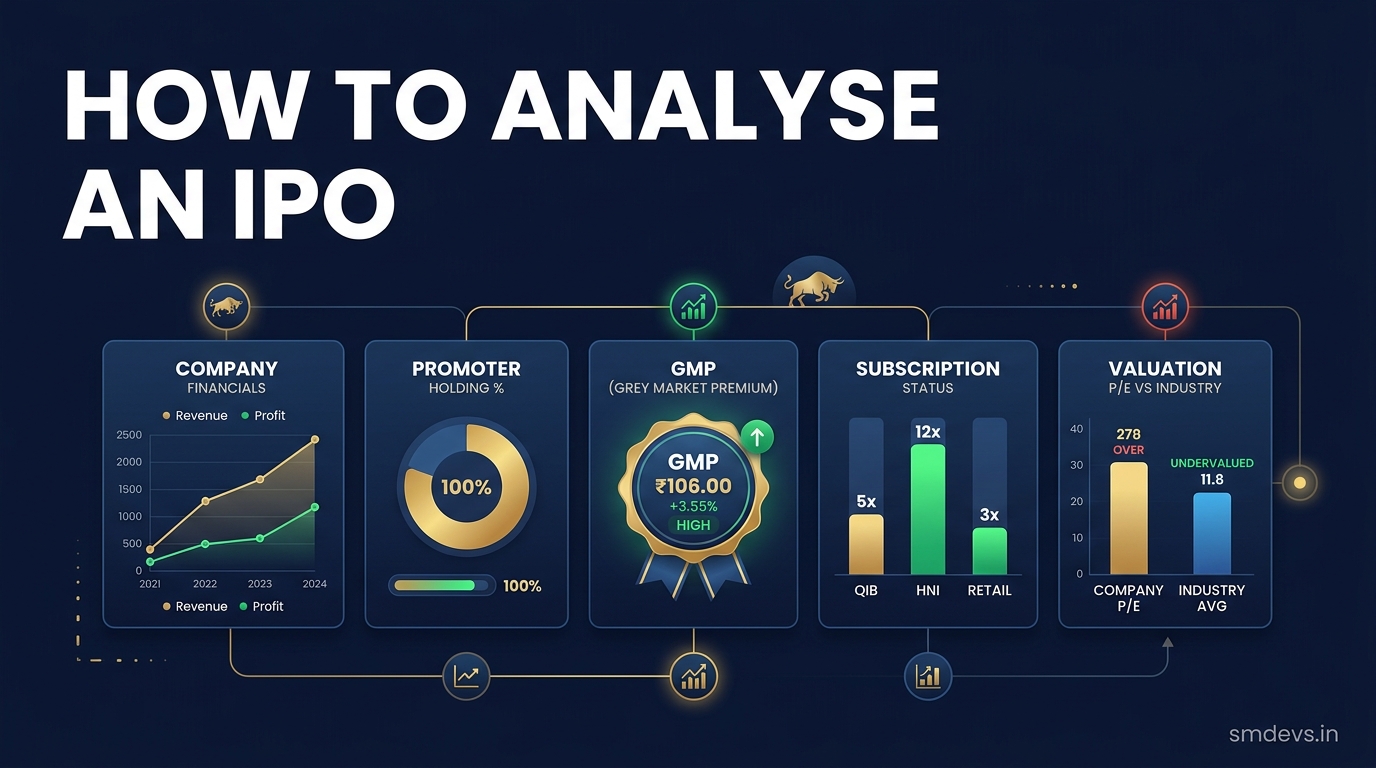
Compare the IPO's P/E ratio to industry peers:
- If the company IPOs at P/E 40× and industry average is 25×, it's expensive
- If IPO P/E is 20× vs industry 30×, it may be attractively priced
- For loss-making companies, use P/S (Price to Sales) or EV/Revenue comparisons
Step 4: Check the GMP (Grey Market Premium)
GMP is the unofficial price at which IPO shares are traded before listing. High GMP indicates strong demand and potential listing gains. However:
- GMP can change rapidly leading up to listing day
- High GMP ≠ guaranteed listing gains
- GMP is an unregulated market — treat as a sentiment indicator only
Step 5: Check Subscription Status
Track the IPO subscription on NSE/BSE websites during the bidding period:
- QIB (Qualified Institutional Buyers): High QIB subscription is the most bullish signal — institutions have done their due diligence
- HNI (High Net Worth Individuals): Often leveraged, can distort numbers
- Retail: Retail oversubscription shows public enthusiasm
Total oversubscription of 10×+ generally indicates strong demand. Under 1× (undersubscribed) is a serious warning sign.
Step 6: Promoter Holding and Lock-in
High promoter holding (60%+) post-IPO indicates founder conviction. Check the lock-in period — when promoters and pre-IPO investors can sell their shares. Large unlock events after lock-in expiry can pressure the stock price.
IPO Investing Strategies
Listing Gain Strategy
Apply for IPO only for listing day gains. Sell immediately on listing if gaining. This requires understanding GMP and subscription data.
Long-Term Investment Strategy
Buy companies with strong fundamentals and hold 3–5 years. Ignore short-term price volatility. Examples: Zomato, Nykaa (controversial), Mamaearth.